European Commission, Joint Research Centre (JRC), Ispra, Italy.
University of Macedonia, Thessaloniki, Greece.
PLoS One. 2022 Aug 4;17(8):e0269797. doi: 10.1371/journal.pone.0269797. eCollection 2022.
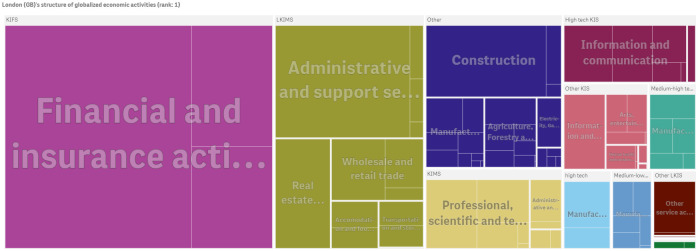
The aim of the paper is to propose the construction of an index that captures the economic complexity of cities over the globe, as well as to explore whether it is a good predictor for a range of city-level economic outcomes. This index aspires to mitigate data scarcity for cities and to provide policy makers with the tools for monitoring the evolving role of cities in the global economy. Analytically, we implement the economic complexity methodology on data for the ownership, location and economic activities of the world's 3,000 largest firms and their subsidiaries to propose a new indicator that quantifies the network of the largest cities worldwide and the economic activities of their globalized firms. We first show that complex cities are the highly diversified cities that host non-ubiquitous economic activities of firms with global presence. Then, in a sample of EU cities, we show that complex cities tend to be more prosperous, have higher population, and are associated with more jobs, human capital, innovation, technology and transport infrastructure. Last, using OLS methodology and accounting for several other confounders, we show that a higher ECI, at the city level, enhances the resilience of cities to negative economic shocks, i.e., their ability to bounce back after a shock. Specifically, we find that the expected increase of the ratio of employment in 2012 over 2006 is 0.01 (mean: 0.992; standard deviation: 0.081) when the ECI increases by 1 unit (mean: 0.371; standard deviation: 1.094), i.e., a satisfactory pace of recovery, in terms of employment. The ability to diversify in the presence of a shock, the reallocation of factors of production to other sectors and the ability to extract rents associated with those diversified activities, uncovers the mechanics of the ECI index.
本文旨在构建一个能够捕捉全球城市经济复杂性的指标,并探讨其是否能够很好地预测一系列城市层面的经济结果。该指数旨在缓解城市数据的稀缺性,并为政策制定者提供监测城市在全球经济中不断变化的角色的工具。在分析方面,我们将经济复杂性方法应用于全球 3000 家最大公司及其子公司的所有权、位置和经济活动数据,提出了一个新的指标,该指标量化了全球最大城市的网络及其全球化公司的经济活动。我们首先表明,复杂的城市是高度多样化的城市,拥有普遍存在的公司的非普遍经济活动。然后,在欧盟城市的样本中,我们表明,复杂的城市往往更加繁荣,拥有更多的人口,并且与更多的工作、人力资本、创新、技术和交通基础设施相关。最后,我们使用 OLS 方法并考虑了其他一些混杂因素,表明城市层面更高的 ECI 可以提高城市对负面经济冲击的弹性,即它们在冲击后反弹的能力。具体来说,我们发现,当 ECI 增加 1 个单位(平均值:0.371;标准差:1.094)时,城市层面的就业比率预计会从 2006 年增加 0.01(平均值:0.992;标准差:0.081),也就是说,就业方面的恢复速度令人满意。在冲击面前实现多样化的能力、将生产要素重新配置到其他部门的能力以及从这些多样化活动中提取租金的能力,揭示了 ECI 指数的工作原理。