Bakhtiar Yuriz, Khairunnisa Novita Ikbar, Prihastomo Krisna Tsaniadi, Brotoarianto Happy Kurnia, Arifin Muhamad Thohar, Muttaqin Zainal
Department of Neurosurgery, Diponegoro University, Semarang, Central Java, Indonesia.
Department of Neurosurgery, Faculty of Medicine, Diponegoro University, Semarang, Central Java, Indonesia.
Surg Neurol Int. 2022 Jul 15;13:298. doi: 10.25259/SNI_142_2022. eCollection 2022.
Posttraumatic epilepsy (PTE) is a debilitating sequelae following traumatic brain injury (TBI). Risk of developing PTE is higher in the first 6 months following head trauma and remains increased for 10 years. Many cases of PTE developed into drug-resistant epilepsy in which need surgical treatment.
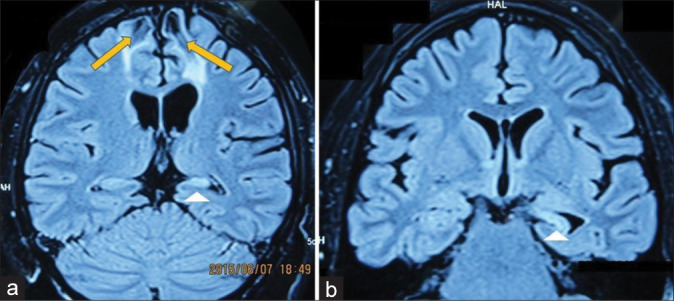
Fourteen patients were identified from 1998 until 2021. Mean age at onset was 21.00 ± 6.13 years, mean age of surgery was 29.50 ± 6.83 years. All patients had partial complex seizure with more than half of cases ( = 10, 71.4%) reported with focal impaired awareness seizure and focal to bilateral tonic-clonic type of seizure which were observed in the remained cases ( = 4, 28.6%). Abnormal magnetic resonance imaging findings were observed in 12 patients: mesial temporal sclerosis ( = 7), encephalomalacia ( = 4), brain atrophy ( = 4), and focal cortical dysplasia ( = 2). More than half of cases presented with mesial temporal lobe epilepsy despite site and type of brain injury. Most patients who undergone epileptogenic focus resection were free of seizure, but two patients remained to have seizure with worthwhile improvement.
This study emphasizes the clinical characteristic of PTE cases in our center in Indonesia. While encephalomalacia is a typical finding following TBI and often responsible for epilepsy, electroencephalogram recording remains critical in determining epileptic focus. Most of PTE patients presented with temporal lobe epilepsy had excellent outcomes after surgical resection of epileptogenic focus.
创伤后癫痫(PTE)是创伤性脑损伤(TBI)后一种使人衰弱的后遗症。头部创伤后最初6个月内发生PTE的风险较高,且10年内风险持续增加。许多PTE病例发展为药物难治性癫痫,需要手术治疗。
1998年至2021年共确定了14例患者。发病时的平均年龄为21.00±6.13岁,手术时的平均年龄为29.50±6.83岁。所有患者均有部分性复杂发作,超过半数病例(n = 10,71.4%)报告有局灶性意识障碍发作,其余病例(n = 4,28.6%)观察到从局灶性发作进展为双侧强直阵挛发作。12例患者磁共振成像检查结果异常:内侧颞叶硬化(n = 7)、脑软化(n = 4)、脑萎缩(n = 4)和局灶性皮质发育异常(n = 2)。尽管脑损伤部位和类型不同,但超过半数病例表现为内侧颞叶癫痫。大多数接受致痫灶切除术的患者无癫痫发作,但有2例患者仍有癫痫发作,不过有明显改善。
本研究强调了印度尼西亚我们中心PTE病例的临床特征。虽然脑软化是TBI后的典型表现且常导致癫痫,但脑电图记录对于确定癫痫病灶仍然至关重要。大多数表现为颞叶癫痫的PTE患者在致痫灶手术切除后预后良好。