Qian Wenwen, Chen Liang, Zhang Lizhu, Gao Mingzhu, Wang Chunxia, Qian Xi, Yang Chengjian, Lin Yahui, Han Zhijun
Department of Cardiology, Wuxi Second People's Hospital of Nanjing Medical University, Wuxi, China.
Department of Laboratory Medicine, Wuxi Second People's Hospital of Nanjing Medical University, Wuxi, China.
J Thorac Dis. 2022 Jul;14(7):2591-2601. doi: 10.21037/jtd-22-740.
Clopidogrel is a traditional P2Y12 receptor inhibitor that is widely used in clinical practice, but there are significant individual differences in its therapeutic effect. Carriers of the deletion allele have a higher risk of adverse cardiovascular events than non-carriers.
In this study, 170 patients diagnosed with coronary heart disease (CHD) and on regular oral clopidogrel or ticagrelor antiplatelet therapy in the Department of Cardiology of Wuxi Second People's Hospital from August to December 2019 were screened. Baseline patient data were collected, percutaneous coronary angiography (CAG) or coronary computed tomography angiography (CTA) results were recorded, gene type was detected, and prognosis/outcome was assessed by telephone/outpatient/inpatient follow-up for 12 months.
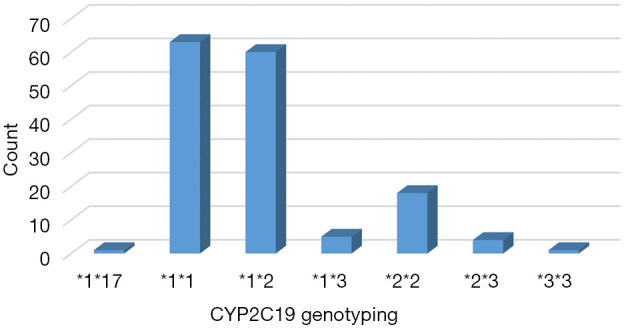
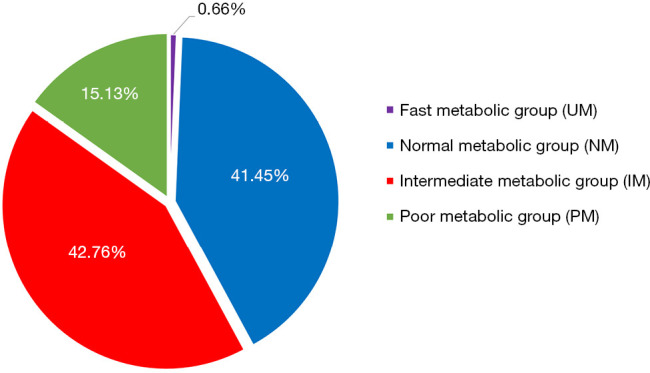
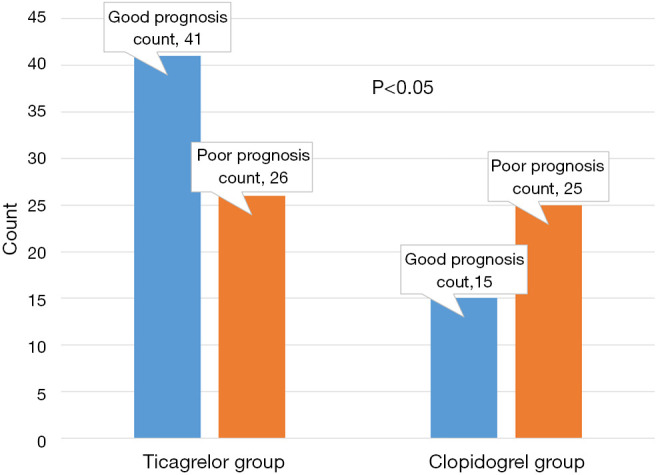
(I) Of the 170 patients, 0.66% were the fast metabolic type, 41.45% were the normal metabolic type, 42.76% were the intermediate metabolic type, and 15.13% were the poor metabolic type. mutation accounted for 89.29% of all mutations, mutation accounted for 9.82%, and mutation accounted for only 0.89%. (II) Among the patients with CHD who regularly took clopidogrel, the risk in the intermediate metabolic group was 5.208-fold higher than that of normal metabolic group, and that of the poor metabolic group was 3.75-fold higher than that of normal metabolic group; there was no significant difference between the intermediate and poor metabolic groups. (III) Prognosis was significantly associated with regular use of ticagrelor or clopidogrel by patients in the intermediate metabolic group. There was no significant correlation between poor metabolism (PM) and normal metabolism (NM). Prognosis was significantly associated with regular use of ticagrelor or clopidogrel in patients undergoing percutaneous coronary intervention (PCI), but not in patients who did not undergo PCI.
polymorphism was associated with the prognosis of patients with CHD administered antiplatelet therapy with oral clopidogrel. The incidence of poor prognosis was significantly increased with and/or mutations, and patients undergoing PCI or carrying a single deletion allele had a better prognosis with ticagrelor as replacement therapy.
氯吡格雷是一种传统的P2Y12受体抑制剂,在临床实践中广泛应用,但其治疗效果存在显著个体差异。缺失等位基因携带者发生心血管不良事件的风险高于非携带者。
本研究筛选了2019年8月至12月在无锡市第二人民医院心内科诊断为冠心病(CHD)并接受常规口服氯吡格雷或替格瑞洛抗血小板治疗的170例患者。收集患者基线数据,记录经皮冠状动脉造影(CAG)或冠状动脉计算机断层扫描血管造影(CTA)结果,检测基因类型,并通过电话/门诊/住院随访12个月评估预后/结局。
(I)170例患者中,快代谢型占0.66%,正常代谢型占41.45%,中间代谢型占42.76%,慢代谢型占15.13%。突变占所有突变的89.29%,突变占9.82%,突变仅占0.89%。(II)在规律服用氯吡格雷的冠心病患者中,中间代谢组风险比正常代谢组高5.208倍,慢代谢组比正常代谢组高3.75倍;中间代谢组与慢代谢组之间无显著差异。(III)中间代谢组患者规律使用替格瑞洛或氯吡格雷与预后显著相关。慢代谢(PM)与正常代谢(NM)之间无显著相关性。经皮冠状动脉介入治疗(PCI)患者规律使用替格瑞洛或氯吡格雷与预后显著相关,但未接受PCI的患者则不然。
基因多态性与口服氯吡格雷抗血小板治疗的冠心病患者预后相关。携带和/或突变会使预后不良的发生率显著增加,接受PCI或携带单个缺失等位基因的患者使用替格瑞洛作为替代治疗预后较好。