Wang Kai, Long Wen, Sima Xiaoxian, Zhao Yuanyuan, Xiao Bijing, Gulizeba Haimiti, Huang Yan
Department of Medical Oncology, Collaborative Innovation Center for Cancer Medicine, State Key Laboratory of Oncology in South China, Sun Yat-sen University Cancer Center, Guangzhou, China.
Department of Nuclear Medicine, Collaborative Innovation Center for Cancer Medicine, State Key Laboratory of Oncology in South China, Sun Yat-sen University Cancer Center, Guangzhou, China.
J Thorac Dis. 2022 Jul;14(7):2645-2651. doi: 10.21037/jtd-22-782.
Small cell lung cancer (SCLC) is one of the most aggressive types of lung cancer and reliable indicators are needed for improved patient management. The evaluation of skeletal muscle index of the third lumbar vertebra (L3MI) based on computed tomography (CT) is used to estimate patient prognosis in multiple cancers. However, its function in extensive-stage SCLC remains controversial. Considering that the maintenance of muscle mass may affect the survival of cancer patients. Herein, a retrospective study was conducted to investigate whether sarcopenia defined by skeletal muscle mass index at the third lumbar vertebra is a prognostic factor in extensive-stage SCLC cancer patients.
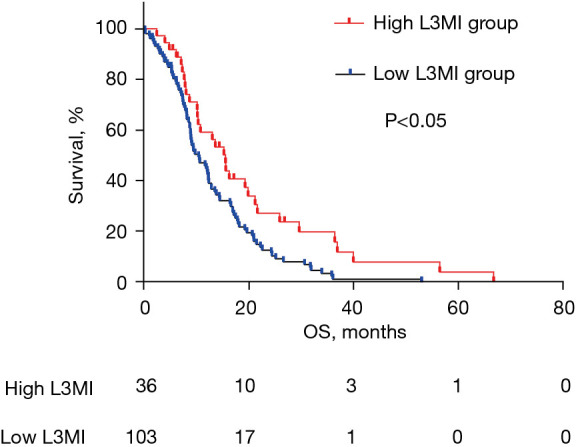
This retrospective analysis included extensive-stage SCLC patients diagnosed at the Sun Yat-sen University Cancer Center from January 2009 to March 2017 with platinum-based chemotherapy. Clinical data were collated for further examination, and CT or positron emission tomography (PET)/CT datasets were analyzed for body mass index (BMI) and L3MI. Follow-up data were collected by contacting patients or their families. Overall survival (OS) was defined as the interval between the date of treatment started and the date of death or censoring. The Kaplan-Meier product limit method and log-rank tests were used to assess differences in OS between the high L3MI and low L3MI groups. Cox regression analysis was used to identify independent factors of OS.
For the 139 extensive-stage SCLC patients, the median follow-up time was 26.1 months (range, 0.4 to 79.4 months). The median OS was 9.5 months. There were no differences in age, inflammatory factors, nor progression after first-line treatment between the high L3MI and low L3MI groups. Kaplan-Meier analysis showed that the OS of the high L3MI group was significantly longer than that of the low L3MI group (14.045 9.985 months; P=0.007), and multivariate analysis identified high L3MI to be an independent prognostic factor for predicting longer OS in extensive-stage SCLC patients [hazard ratio (HR), 0.623; 95% confidence interval (CI), 0.405-0.960; P=0.032].
Sarcopenia defined by L3MI is a prognostic factor for extensive-stage SCLC patients and early intervention of muscle mass maintaining may achieve better cancer management.
小细胞肺癌(SCLC)是最具侵袭性的肺癌类型之一,需要可靠指标来改善患者管理。基于计算机断层扫描(CT)评估第三腰椎骨骼肌指数(L3MI)可用于估计多种癌症患者的预后。然而,其在广泛期SCLC中的作用仍存在争议。考虑到肌肉量的维持可能影响癌症患者的生存。在此,进行了一项回顾性研究,以调查由第三腰椎骨骼肌质量指数定义的肌肉减少症是否是广泛期SCLC患者的预后因素。
这项回顾性分析纳入了2009年1月至2017年3月在中山大学肿瘤防治中心诊断为广泛期SCLC且接受铂类化疗的患者。整理临床数据以供进一步检查,并分析CT或正电子发射断层扫描(PET)/CT数据集以获取体重指数(BMI)和L3MI。通过联系患者或其家属收集随访数据。总生存期(OS)定义为开始治疗日期至死亡或失访日期的间隔。采用Kaplan-Meier乘积限法和对数秩检验评估高L3MI组和低L3MI组之间OS的差异。采用Cox回归分析确定OS的独立因素。
对于139例广泛期SCLC患者,中位随访时间为26.1个月(范围0.4至79.4个月)。中位OS为9.5个月。高L3MI组和低L3MI组在年龄、炎症因子以及一线治疗后的进展方面均无差异。Kaplan-Meier分析显示,高L3MI组的OS显著长于低L3MI组(14.045对9.985个月;P = 0.007),多因素分析确定高L3MI是预测广泛期SCLC患者更长OS的独立预后因素[风险比(HR),0.623;95%置信区间(CI),0.405 - 0.960;P = 0.032]。
由L3MI定义的肌肉减少症是广泛期SCLC患者的预后因素,早期干预维持肌肉量可能实现更好的癌症管理。