Nasca Vincenzo, Frezza Anna Maria, Morosi Carlo, Buonomenna Ciriaco, Parafioriti Antonina, Zappalà Giorgio, Bini Federica, Casali Paolo Giovanni, Loppini Mattia, Stacchiotti Silvia
Department of Medical Oncology, Fondazione Instituti Ricovero e Cura a Carattere Scientifico (IRCCS) Istituto Nazionale dei Tumori, Milano, Italy.
Department of Radiology, Fondazione Instituti Ricovero e Cura a Carattere Scientifico (IRCCS) Istituto Nazionale dei Tumori, Milano, Italy.
Front Oncol. 2022 Jul 19;12:953149. doi: 10.3389/fonc.2022.953149. eCollection 2022.
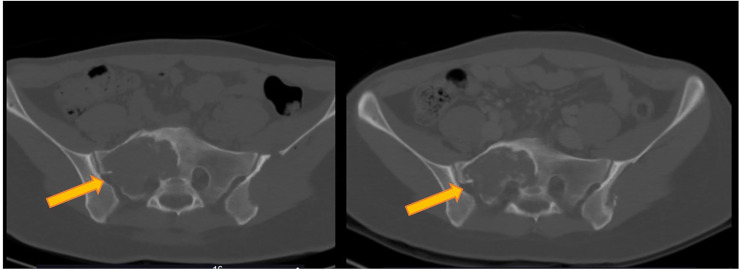
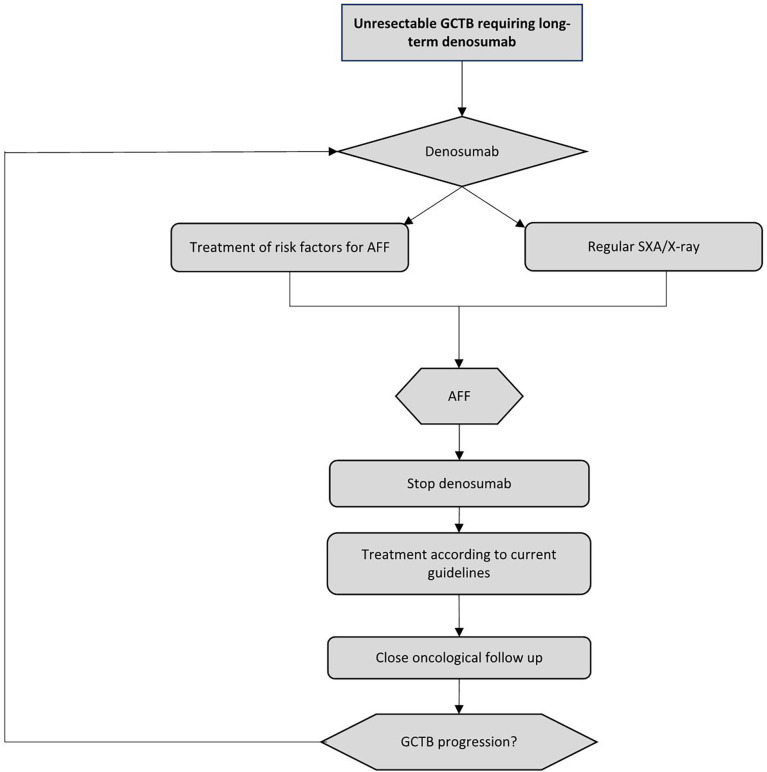
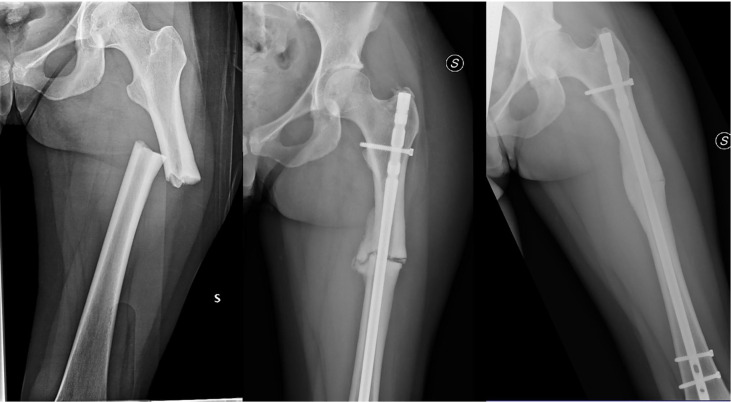
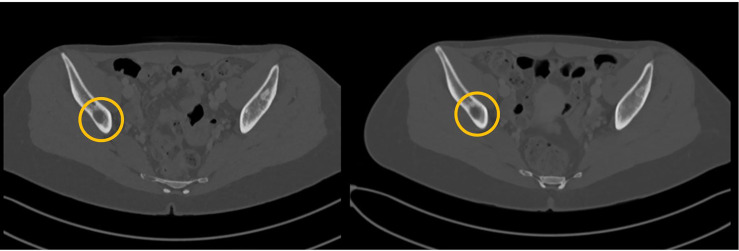
Giant cell tumor of the bone (GCTB) is a locally aggressive neoplasm where surgery is often curative. However, it can rarely give rise to distant metastases. Currently, the only available active therapeutic option for unresectable GCTB is denosumab, an anti-RANKL monoclonal antibody that dampens the aggressive osteolysis typically seen in this disease. For advanced/metastatic GCTB, denosumab should be continued lifelong, and although it is usually well tolerated, important questions may arise about the long-term safety of this drug. In fact, uncommon but severe toxicities can occur and eventually lead to denosumab discontinuation, such as atypical fracture of the femur (AFF). The optimal management of treatment-related AFF is a matter of debate, and to date, it is unknown whether reintroduction of denosumab at disease progression is a clinically feasible option, as no reports have been provided so far. Hereinafter, we present a case of a patient with metastatic GCTB who suffered from AFF after several years of denosumab; we describe the clinical features, orthopedic treatment, and oncological outcomes, finally providing the first evidence that denosumab rechallenge after AFF occurrence may be a safe and viable option at GCTB progression.
骨巨细胞瘤(GCTB)是一种具有局部侵袭性的肿瘤,手术通常可治愈。然而,它很少会发生远处转移。目前,对于无法切除的GCTB,唯一可用的有效治疗选择是地诺单抗,一种抗RANKL单克隆抗体,可抑制该疾病中常见的侵袭性骨溶解。对于晚期/转移性GCTB,地诺单抗应终身使用,尽管通常耐受性良好,但关于该药物的长期安全性可能会出现重要问题。事实上,可能会发生罕见但严重的毒性反应,并最终导致停用 地诺单抗,如股骨非典型骨折(AFF)。治疗相关AFF的最佳管理存在争议,迄今为止,尚不清楚在疾病进展时重新使用地诺单抗是否是一种临床可行的选择,因为目前尚无相关报道。在此,我们报告一例转移性GCTB患者,在使用地诺单抗数年 后发生AFF;我们描述了临床特征、骨科治疗和肿瘤学结局,最终提供了首个证据,表明在AFF发生后重新使用地诺单抗在GCTB进展时可能是一种安全可行的选择。