Abravan Azadeh, Price Gareth, Banfill Kathryn, Marchant Tom, Craddock Matthew, Wood Joe, Aznar Marianne C, McWilliam Alan, van Herk Marcel, Faivre-Finn Corinne
Division of Cancer Sciences, School of Medical Sciences, Faculty of Biology, Medicine and Health, The University of Manchester, Manchester, United Kingdom.
Department of Radiotherapy Related Research, The Christie National Health Service (NHS) Foundation Trust, Manchester, United Kingdom.
Front Oncol. 2022 Jul 19;12:934369. doi: 10.3389/fonc.2022.934369. eCollection 2022.
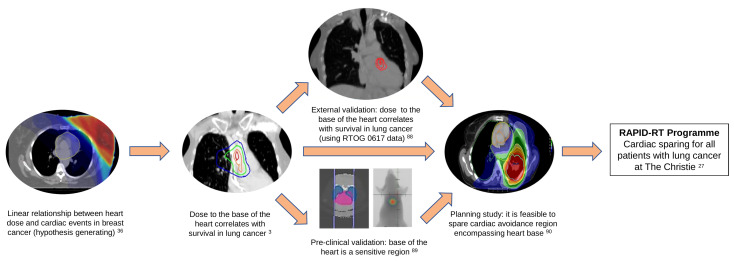
Radiation-induced heart disease (RIHD) is a recent concern in patients with lung cancer after being treated with radiotherapy. Most of information we have in the field of cardiac toxicity comes from studies utilizing real-world data (RWD) as randomized controlled trials (RCTs) are generally not practical in this field. This article is a narrative review of the literature using RWD to study RIHD in patients with lung cancer following radiotherapy, summarizing heart dosimetric factors associated with outcome, strength, and limitations of the RWD studies, and how RWD can be used to assess a change to cardiac dose constraints.
放射性心脏病(RIHD)是肺癌患者放疗后近期受到关注的问题。我们在心脏毒性领域所掌握的大部分信息来自利用真实世界数据(RWD)的研究,因为随机对照试验(RCT)在该领域通常不实用。本文是一篇叙述性文献综述,利用RWD研究肺癌患者放疗后的RIHD,总结与预后相关的心脏剂量学因素、RWD研究的优势和局限性,以及RWD如何用于评估心脏剂量限制的变化。