Multiphase Chemistry Department, Max Planck Institute for Chemistry, Mainz 55128, Germany.
Institute of Biology, Division of Plant Sciences, University of Graz, Graz 8010, Austria.
Environ Sci Technol. 2022 Aug 16;56(16):11865-11877. doi: 10.1021/acs.est.2c02207. Epub 2022 Aug 5.
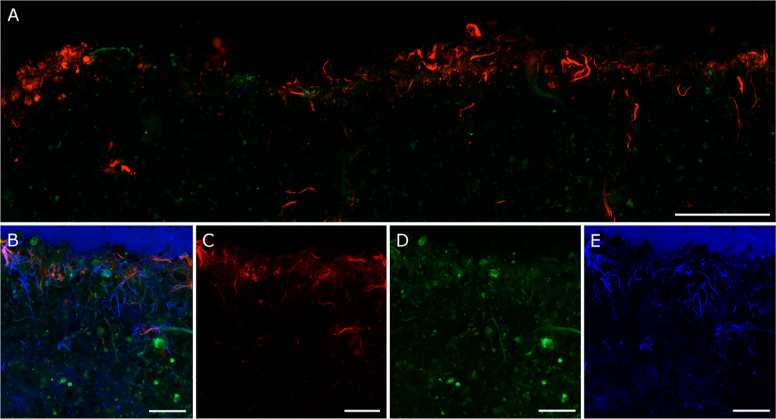
Biocrusts covering drylands account for major fractions of terrestrial biological nitrogen fixation and release large amounts of gaseous reactive nitrogen (N) as nitrous acid (HONO) and nitric oxide (NO). Recent investigations suggested that aerobic and anaerobic microbial nitrogen transformations occur simultaneously upon desiccation of biocrusts, but the spatio-temporal distribution of seemingly contradictory processes remained unclear. Here, we explore small-scale gradients in chemical concentrations related to structural characteristics and organism distribution. X-ray microtomography and fluorescence microscopy revealed mixed pore size structures, where photoautotrophs and cyanobacterial polysaccharides clustered irregularly in the uppermost millimeter. Microsensor measurements showed strong gradients of pH, oxygen, and nitrite, nitrate, and ammonium ion concentrations at micrometer scales in both vertical and lateral directions. Initial oxygen saturation was mostly low (∼30%) at full water holding capacity, suggesting widely anoxic conditions, and increased rapidly upon desiccation. Nitrite concentrations (∼6 to 800 μM) and pH values (∼6.5 to 9.5) were highest around 70% WHC. During further desiccation they decreased, while emissions of HONO and NO increased, reaching maximum values around 20% WHC. Our results illustrate simultaneous, spatially separated aerobic and anaerobic nitrogen transformations, which are critical for N emissions, but might be impacted by future global change and land management.
生物结皮覆盖干旱地区,占陆地生物固氮的主要部分,并释放大量气态活性氮(N),如亚硝酸(HONO)和一氧化氮(NO)。最近的调查表明,生物结皮干燥时同时发生好氧和厌氧微生物氮转化,但这些看似矛盾的过程的时空分布仍不清楚。在这里,我们探讨了与结构特征和生物分布相关的化学浓度的小尺度梯度。X 射线微断层扫描和荧光显微镜显示出混合孔径结构,其中光自养生物和蓝细菌多糖在上部毫米层不规则地聚集。微传感器测量显示,在垂直和水平方向上,在微米尺度上,pH 值、氧气以及亚硝酸盐、硝酸盐和铵离子浓度都存在强烈的梯度。初始氧饱和度在完全水持留能力下通常较低(约 30%),表明存在广泛的缺氧条件,并在干燥时迅速增加。亚硝酸盐浓度(约 6 至 800 μM)和 pH 值(约 6.5 至 9.5)在约 70% WHC 时最高。在进一步干燥过程中,它们会降低,而 HONO 和 NO 的排放会增加,在约 20% WHC 时达到最大值。我们的结果说明了同时发生的、空间分离的好氧和厌氧氮转化,这对 N 排放至关重要,但可能会受到未来全球变化和土地管理的影响。