Department of Respiratory and Critical Care Medicine, Shanghai Pulmonary Hospital, School of Medicine, Tongji University, Shanghai, People's Republic of China.
Institute of Respiratory Medicine, School of Medicine, Tongji University, Shanghai, People's Republic of China.
Emerg Microbes Infect. 2022 Dec;11(1):2132-2146. doi: 10.1080/22221751.2022.2110524.
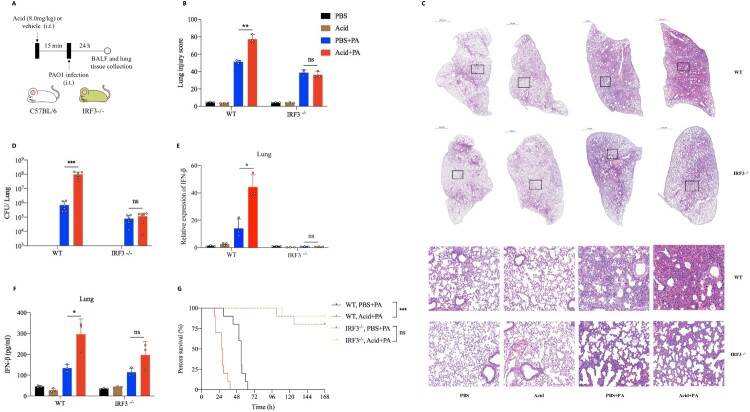
Airway microenvironment played an important role in the progression of chronic respiratory disease. Here we showed that standardized pondus hydrogenii (pH) of exhaled breath condensate (EBC) of bronchiectasis patients was significantly lower than that of controls and was significantly correlated with bronchiectasis severity index (BSI) scores and disease prognosis. EBC pH was lower in severe patients than that in mild and moderate patients. Besides, acidic microenvironment deteriorated pulmonary infection in mice models. Mechanistically, acidic microenvironment increased outer membrane vesicles (PA_OMVs) released and boosted it induced the activation of interferon regulatory factor3 (IRF3)-interferonβ (IFN-β) signalling pathway, ultimately compromised the anti-bacteria immunity. Targeted knockout of IRF3 or type 1 interferon receptor (IFNAR1) alleviated lung damage and lethality of mice after infection that aggravated by acidic microenvironment. Together, these findings identified airway acidification impaired host resistance to infection by enhancing it induced the activation of IRF3-IFN-β signalling pathway. Standardized EBC pH may be a useful biomarker of disease severity and a potential therapeutic target for the refractory infection. The study also provided one more reference parameter for drug selection and new drug discovery for bronchiectasis.
气道微环境在慢性呼吸系统疾病的进展中起着重要作用。在这里,我们发现支气管扩张症患者呼出气冷凝液(EBC)的标准化氢质子浓度(pH)明显低于对照组,且与支气管扩张症严重指数(BSI)评分和疾病预后显著相关。严重患者的 EBC pH 明显低于轻度和中度患者。此外,酸性微环境会加重小鼠模型中的肺部感染。在机制上,酸性微环境增加了外膜囊泡(PA_OMVs)的释放,并促进其诱导干扰素调节因子 3(IRF3)-干扰素β(IFN-β)信号通路的激活,最终损害了抗细菌免疫。IRF3 或 I 型干扰素受体(IFNAR1)的靶向敲除减轻了酸性微环境加重的感染后小鼠的肺部损伤和致死率。综上所述,这些发现表明气道酸化通过增强其诱导的 IRF3-IFN-β 信号通路的激活,损害了宿主对感染的抵抗力。标准化 EBC pH 可能是疾病严重程度的有用生物标志物,也是治疗难治性感染的潜在治疗靶点。该研究还为支气管扩张症的药物选择和新药发现提供了更多的参考参数。