Department of Chemistry, Seoul National University, Seoul, 08826, Republic of Korea.
Biomaterials Research Center, Biomedical Research Division, Korea Institute of Science and Technology (KIST), Seoul, 02792, Republic of Korea.
Nat Commun. 2022 Aug 5;13(1):4568. doi: 10.1038/s41467-022-32268-2.
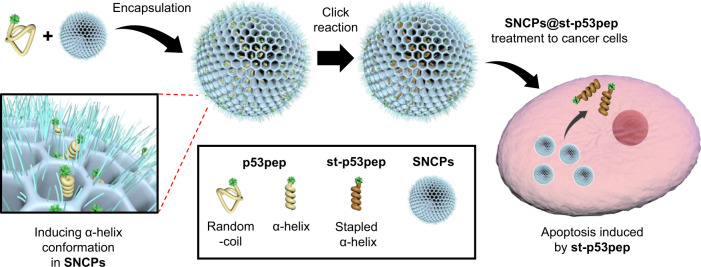
Artificial, synthetic chaperones have attracted much attention in biomedical research due to their ability to control the folding of proteins and peptides. Here, we report bio-inspired multifunctional porous nanoparticles to modulate proper folding and intracellular delivery of therapeutic α-helical peptide. The Synthetic Nano-Chaperone for Peptide (SNCP) based on porous nanoparticles provides an internal hydrophobic environment which contributes in stabilizing secondary structure of encapsulated α-helical peptides due to the hydrophobic internal environments. In addition, SNCP with optimized inner surface modification not only improves thermal stability for α-helical peptide but also supports the peptide stapling methods in situ, serving as a nanoreactor. Then, SNCP subsequently delivers the stabilized therapeutic α-helical peptides into cancer cells, resulting in high therapeutic efficacy. SNCP improves cellular uptake and bioavailability of the anti-cancer peptide, so the cancer growth is effectively inhibited in vivo. These data indicate that the bio-inspired SNCP system combining nanoreactor and delivery carrier could provide a strategy to expedite the development of peptide therapeutics by overcoming existing drawbacks of α-helical peptides as drug candidates.
人工合成分子伴侣在生物医学研究中受到了广泛关注,因为它们能够控制蛋白质和肽的折叠。在这里,我们报告了一种受生物启发的多功能多孔纳米粒子,用于调节治疗性α-螺旋肽的正确折叠和细胞内递药。基于多孔纳米粒子的肽合成纳米伴侣(SNCP)提供了一个内部疏水环境,由于内部疏水环境有助于稳定包裹的α-螺旋肽的二级结构。此外,经过优化的内部表面修饰的 SNCP 不仅提高了α-螺旋肽的热稳定性,还支持原位肽交联方法,充当纳米反应器。然后,SNCP 将稳定的治疗性α-螺旋肽递送至癌细胞内,从而产生高治疗效果。SNCP 提高了抗癌肽的细胞摄取和生物利用度,从而有效地抑制了体内的肿瘤生长。这些数据表明,结合纳米反应器和递药载体的仿生 SNCP 系统可以为克服α-螺旋肽作为药物候选物的现有缺陷,加速肽治疗药物的开发提供一种策略。