Center of Excellence for Medical Genomics, Department of Pediatrics, Faculty of Medicine, Chulalongkorn University, Bangkok, Thailand; Excellence Center for Genomics and Precision Medicine, King Chulalongkorn Memorial Hospital, The Thai Red Cross Society, Bangkok, Thailand.
Medical Life Sciences Institute, Department of Medical Sciences, Ministry of Public Health, Nonthaburi, Thailand.
Heart Rhythm. 2022 Nov;19(11):1874-1879. doi: 10.1016/j.hrthm.2022.07.019. Epub 2022 Aug 5.
Severe acute respiratory syndrome coronavirus 2 vaccination reduces morbidity and mortality associated with coronavirus disease 2019 (COVID-19); unfortunately, it is associated with serious adverse events, including sudden unexplained death (SUD).
We aimed to study the genetic basis of SUD after COVID-19 vaccination in Thailand.
From April to December 2021, cases with natural but unexplained death within 7 days of COVID-19 vaccination were enrolled for whole exome sequencing.
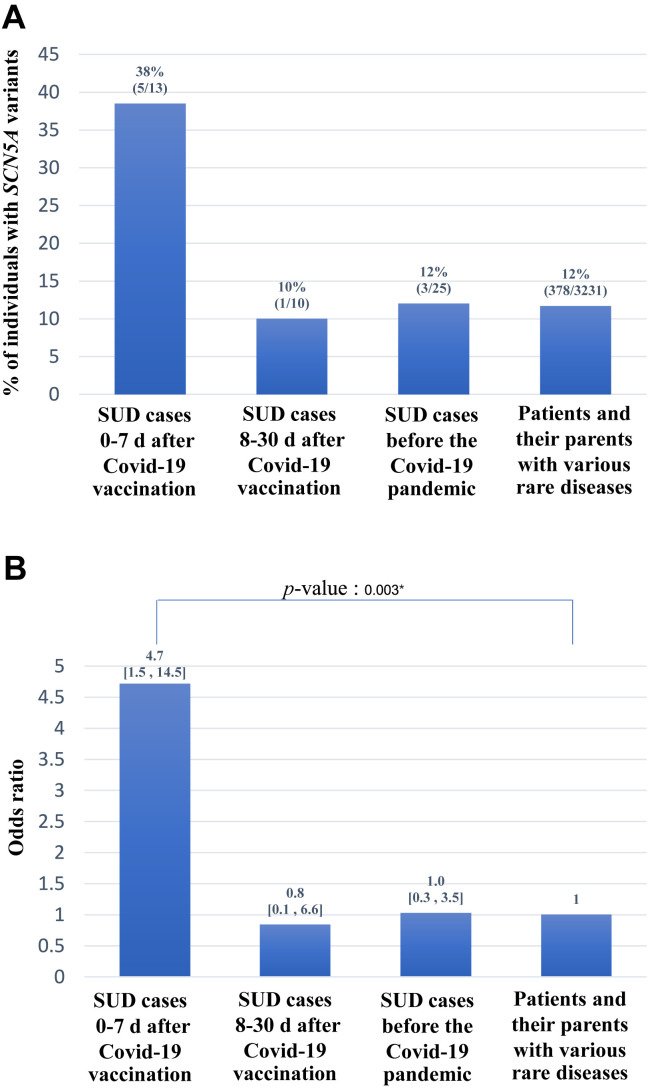
Thirteen were recruited, aged between 23 and 72 years; 10 (77%) were men, 12 were Thai; and 1 was Australian. Eight (61%) died after receiving the first dose of vaccine, and 7 (54%) died after receiving ChAdOx1 nCoV-19; however, there were no significant correlations between SUD and either the number or the type of vaccine. Fever was self-reported in 3 cases. Ten (77%) and 11 (85%) died within 24 hours and 3 days of vaccination, respectively. Whole exome sequencing analysis revealed that 5 cases harbored SCN5A variants that had previously been identified in patients with Brugada syndrome, giving an SCN5A variant frequency of 38% (5 of 13). This is a significantly higher rate than that observed in Thai SUD cases occurring 8-30 days after COVID-19 vaccination during the same period (10% [1 of 10]), in a Thai SUD cohort studied before the COVID-19 pandemic (12% [3 of 25]), and in our in-house exome database (12% [386 of 3231]).
These findings suggest that SCN5A variants may be associated with SUD within 7 days of COVID-19 vaccination, regardless of vaccine type, number of vaccine dose, and presence of underlying diseases or postvaccine fever.
严重急性呼吸综合征冠状病毒 2 疫苗接种可降低与 2019 年冠状病毒病(COVID-19)相关的发病率和死亡率;不幸的是,它与严重的不良事件相关,包括突发性不明原因死亡(SUD)。
我们旨在研究泰国 COVID-19 疫苗接种后 SUD 的遗传基础。
从 2021 年 4 月至 12 月,我们招募了在 COVID-19 疫苗接种后 7 天内自然但原因不明死亡的病例进行全外显子组测序。
共招募了 13 例病例,年龄在 23 至 72 岁之间;10 例(77%)为男性,12 例为泰国人;1 例为澳大利亚人。8 例(61%)在接种第一剂疫苗后死亡,7 例(54%)在接种 ChAdOx1 nCoV-19 后死亡;然而,SUD 与疫苗的数量或类型之间没有显著相关性。3 例病例自述发热。10 例(77%)和 11 例(85%)分别在接种疫苗后 24 小时和 3 天内死亡。全外显子组测序分析显示,5 例病例携带先前在 Brugada 综合征患者中发现的 SCN5A 变异体,SCN5A 变异体频率为 38%(13 例中的 5 例)。这一比率明显高于同期 COVID-19 疫苗接种后 8-30 天泰国 SUD 病例(10%[10 例中的 1 例])、COVID-19 大流行前泰国 SUD 队列(12%[25 例中的 3 例])和我们内部外显子组数据库(12%[3231 例中的 386 例])。
这些发现表明,SCN5A 变异体可能与 COVID-19 疫苗接种后 7 天内的 SUD 相关,而与疫苗类型、疫苗剂量、基础疾病或疫苗接种后发热无关。