Department of Gastroenterology, National Medical Center "20 de Noviembre", ISSSTE, Mexico City, Mexico.
University's Program of Research in Health (Programa Universitario de Investigación en Salud (PUIS), National Autonomous University of Mexico, Mexico City, Mexico.
Med Sci Monit. 2022 Aug 8;28:e937528. doi: 10.12659/MSM.937528.
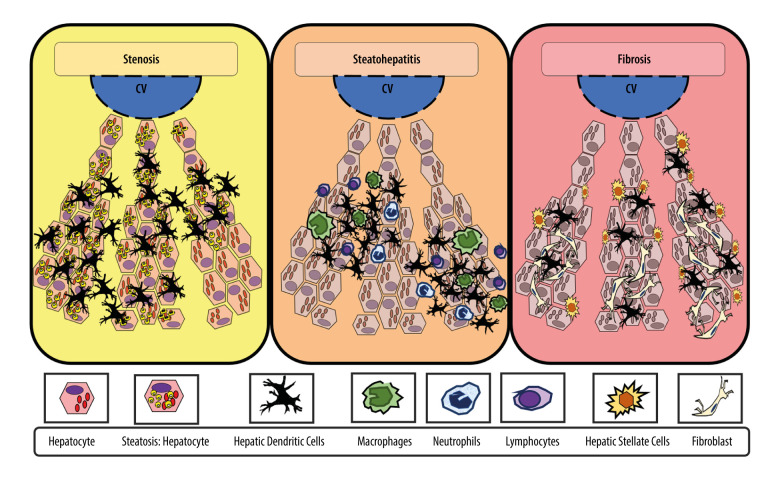
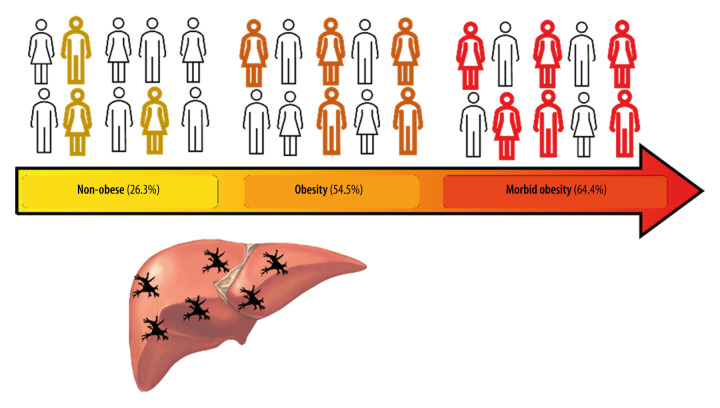
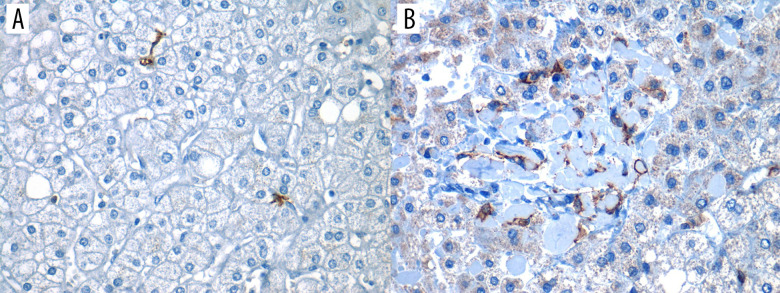
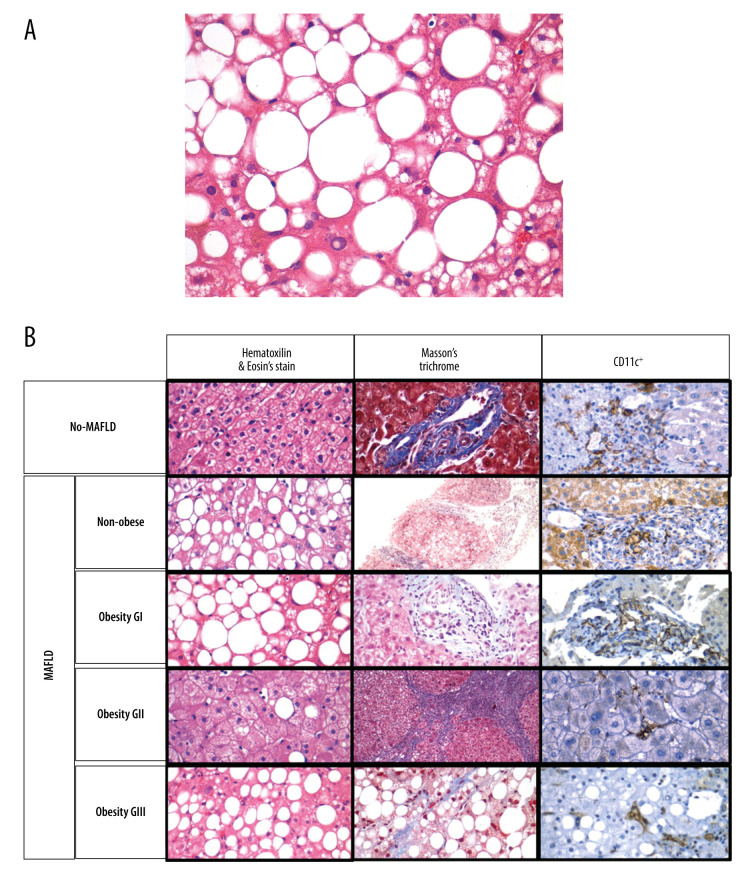
BACKGROUND Metabolic dysfunction-associated fatty liver disease (MAFLD) is now the term used for hepatic steatosis in patients who are overweight or obese, have type 2 diabetes mellitus (T2DM), or evidence of metabolic dysregulation. The prevalence of MAFLD among morbidly obese subjects is 65-93%. Hepatic dendritic cells (hDCs) are antigen-presenting cells that induce T cell-mediated immunity. MAFLD pathogenesis involves numerous immune cell-mediated inflammatory processes, while the particular role of hDCs is yet to be well defined. This study aimed to identify hDCs in liver biopsies from 128 patients with MAFLD associated with obesity. MATERIAL AND METHODS In this cross-sectional study, 128 liver biopsies from 128 patients with MAFLD (diagnosed as presence of hepatic steatosis, plus T2DM, metabolic dysregulation or overweight/obesity) were collected and assessed for CD11c⁺ immunoreactivity degree (CD11c as dendritic cell biomarker), through antigen retrieval, reaction with CD11c antibodies (primary), and marking with diaminobenzidine chromogen. RESULTS Among the 128 patients with MAFLD, 64 (50%) had MAFLD and fibrosis and 72 (56.2%) positively expressed hDCs (CD11c⁺). Among morbidly obese patients, 49 (64.5%) positively expressed hDCs (CD11c⁺) in liver tissue; from patients with obesity grade I- grade II (GI-II), 18 (54.5%) positively expressed hDCs (CD11c⁺) in liver tissue; and from non-obese patients with MAFLD, 5 (26.3%) positively expressed hDCs (CD11c⁺) in liver tissue. CONCLUSIONS hDC expression increases significantly in morbidly obese patients with MAFLD compared with non-obese patients, independent of the degree of fibrosis, suggesting the role of adaptive changes within hDCs in the perpetuation of inflammatory insults in chronic liver diseases.
代谢相关脂肪性肝病(MAFLD)是指超重或肥胖、患有 2 型糖尿病(T2DM)或存在代谢紊乱的患者中出现的肝脂肪变性。病态肥胖患者中 MAFLD 的患病率为 65-93%。肝脏树突状细胞(hDC)是提呈抗原的细胞,可诱导 T 细胞介导的免疫。MAFLD 的发病机制涉及多种免疫细胞介导的炎症过程,而 hDC 的特定作用尚未得到很好的定义。本研究旨在鉴定 128 例肥胖相关 MAFLD 患者肝活检中的 hDC。
在这项横断面研究中,共收集了 128 例 MAFLD 患者(诊断为存在肝脂肪变性,加 T2DM、代谢紊乱或超重/肥胖)的 128 例肝活检,并通过抗原修复、用 CD11c 抗体(一抗)反应和二氨基联苯胺显色剂标记来评估 CD11c⁺免疫反应程度(CD11c 作为树突状细胞的标志物)。
在 128 例 MAFLD 患者中,64 例(50%)患者存在 MAFLD 伴纤维化,72 例(56.2%)hDC 阳性表达(CD11c⁺)。在病态肥胖患者中,49 例(64.5%)肝组织中 hDC 阳性表达(CD11c⁺);在肥胖 I- II 级(GI-II)患者中,18 例(54.5%)肝组织中 hDC 阳性表达(CD11c⁺);而非肥胖 MAFLD 患者中,有 5 例(26.3%)肝组织中 hDC 阳性表达(CD11c⁺)。
与非肥胖 MAFLD 患者相比,病态肥胖 MAFLD 患者 hDC 的表达显著增加,与纤维化程度无关,这提示 hDC 适应性变化在慢性肝病中持续炎症损伤中的作用。