Isnaini Naniek, Mardian Yan, Lokida Dewi, Budiono Fajar, Butar-Butar Deni P, Arlinda Dona, Salim Gustiani, Kosasih Herman, Wulan Wahyu Nawang, Perodin Jacqueline, Neal Aaron, Lane H Clifford, Karyana Muhammad
Tangerang District Hospital, Tangerang, Indonesia.
Indonesia Research Partnership on Infectious Disease, Jakarta, Indonesia.
Front Med (Lausanne). 2022 Jul 22;9:906469. doi: 10.3389/fmed.2022.906469. eCollection 2022.
Reinfection with SARS-CoV-2 has been well documented, yet little is known about the degree of protection a previous infection provides against reinfection, especially against Variants of Concern (VOC).
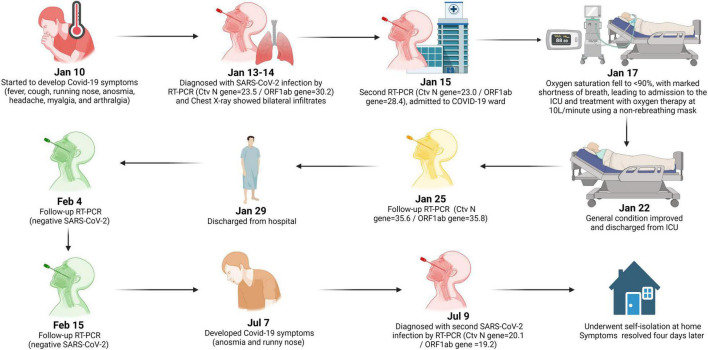
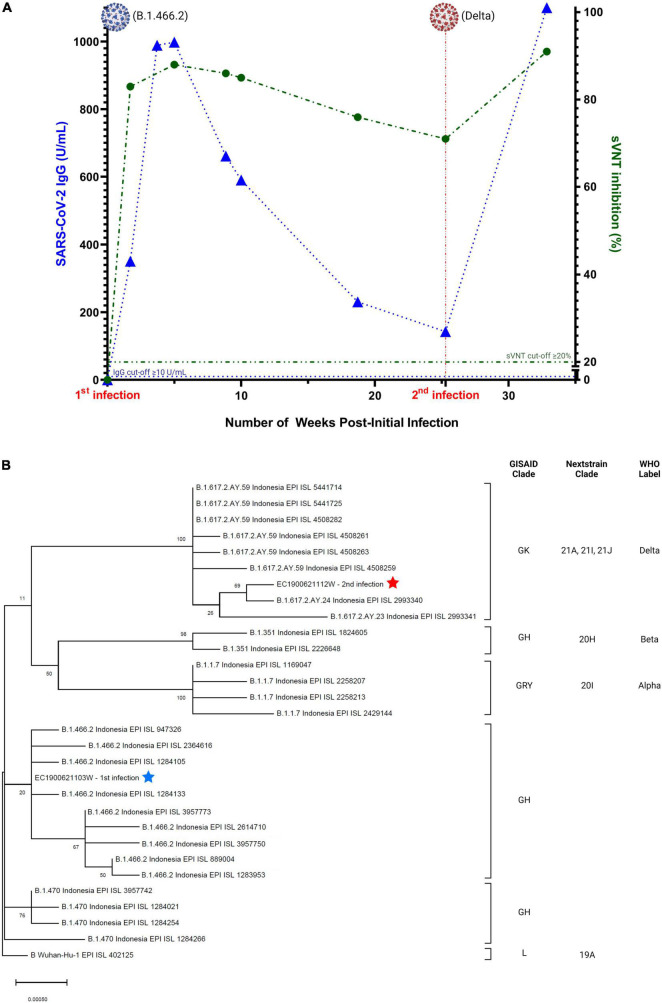
Here we describe a case of an unvaccinated 49-year-old man who experienced two sequential SARS-CoV-2 infections with two different variants, as evidenced by genomic sequencing. The first episode was caused by the Pango lineage B.1.466.2 and resulted in severe COVID-19 with 5 days in an intensive care unit (ICU). The second episode occurred approximately 6 months later, during the Delta surge in Indonesia. Genomic analysis showed that the second infection was caused by the Delta variant (Pango lineage B.1.617.2) and resulted in mild disease that did not require hospitalization. No SARS-CoV-2 nucleic acid was detected between the two episodes, but both binding and neutralizing antibodies to SARS-CoV-2 were detected prior to the reinfection, with the second infection leading to an increase in the levels of antibody.
We confirmed that the patient experienced a reinfection instead of persistent viral shedding from the first infection based on epidemiological, clinical, serological, and genomic analyses. Our case supports the hypothesis that SARS-CoV-2 reinfection may occur once antibody titers decrease or following the emergence of a new variant. The milder presentation in the patient's second infection deserves further investigation to provide a clear picture of the role of post-infection immunity in altering the course of subsequent disease.
SARS-CoV-2再次感染已有充分记录,但对于既往感染所提供的针对再次感染的保护程度,尤其是针对关注变异株(VOC)的保护程度,人们了解甚少。
在此,我们描述一例未接种疫苗的49岁男性病例,该患者先后两次感染SARS-CoV-2,且感染的是两种不同变异株,这由基因组测序证实。首次感染由Pango谱系B.1.466.2引起,导致严重的新冠肺炎,患者在重症监护病房(ICU)治疗了5天。第二次感染发生在大约6个月后,当时印度尼西亚正处于德尔塔毒株激增期间。基因组分析显示,第二次感染由德尔塔变异株(Pango谱系B.1.617.2)引起,导致的疾病症状较轻,无需住院治疗。两次感染期间均未检测到SARS-CoV-2核酸,但在再次感染前检测到了针对SARS-CoV-2的结合抗体和中和抗体,第二次感染导致抗体水平升高。
基于流行病学、临床、血清学和基因组分析,我们证实该患者经历的是再次感染,而非首次感染后的持续病毒脱落。我们的病例支持以下假设:一旦抗体滴度下降或出现新的变异株,SARS-CoV-2再次感染可能会发生。患者第二次感染时症状较轻,这值得进一步研究,以明确感染后免疫在改变后续疾病进程中的作用。