Department of Dermatology, Medical Center - University of Freiburg, Faculty of Medicine, Freiburg, Germany.
Department of Dermatology, Faculty of Medicine and Graduate School of Medicine, Hokkaido University, Sapporo, Japan.
Front Immunol. 2022 Jul 22;13:953546. doi: 10.3389/fimmu.2022.953546. eCollection 2022.
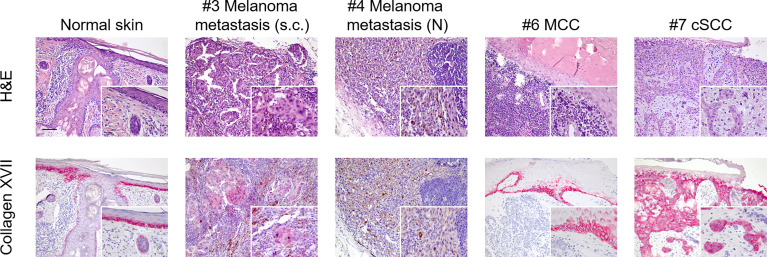
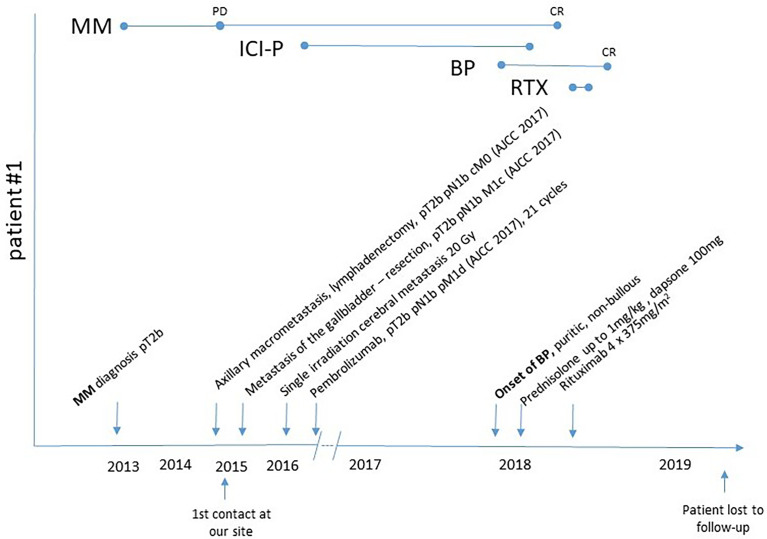
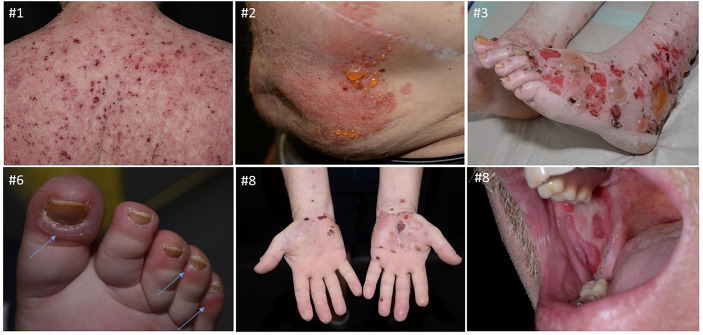
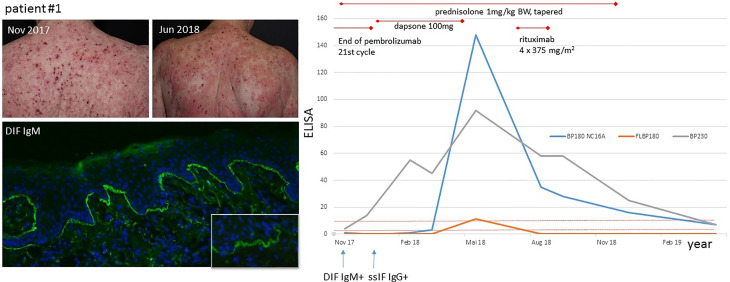
Immune checkpoint inhibitors (ICI) induce T-cell-mediated antitumour responses. While ICI were initially successfully applied in metastasized melanoma, they are now approved for several tumour entities. Numerous autoimmune disorders have been reported to occur as adverse events of the treatment, among them bullous pemphigoid (BP), with less than 1% of the patients experiencing ICI-induced BP. This number is higher than the estimated prevalence of autoimmune bullous diseases in the general population of Germany, which lies around 0.05%. We here describe our cohort of eight patients, who developed a bullous pemphigoid under or shortly after ICI treatment. Half of them had a severe subtype (as shown by BPDAI >57) and showed a median onset of ICI-BP after 10 months of ICI initiation. Six patients had a palmar and/or plantar involvement, while oral involvement occurred in one case. All patients had linear epidermal IgG depositions in split skin in the indirect immunofluorescence. In four out of five biopsies available for direct immunofluorescence, linear IgG and C3 depositions were detected at the basement membrane, while one patient showed linear IgM staining. Moderate to high levels of FLBP180 autoantibodies were found in seven of eight cases. The disease can still be active after ICI discontinuation, while rituximab might be required for remission. Finally, four tumour samples were stained histochemically for collagen XVII (BP180), but no enhanced expression was found.
免疫检查点抑制剂 (ICI) 诱导 T 细胞介导的抗肿瘤反应。虽然 ICI 最初在转移性黑色素瘤中成功应用,但现在已批准用于多种肿瘤实体。据报道,许多自身免疫性疾病作为治疗的不良反应发生,其中包括大疱性类天疱疮 (BP),不到 1%的患者经历 ICI 诱导的 BP。这个数字高于德国普通人群中估计的自身免疫性大疱性疾病的患病率,约为 0.05%。我们在这里描述了我们的八名患者队列,他们在接受 ICI 治疗或治疗后不久出现了大疱性类天疱疮。其中一半为严重亚型(BPDAI >57 表明),在开始 ICI 后 10 个月出现 ICI-BP 的中位发病时间。六名患者有手掌和/或足底受累,而口腔受累发生在一例中。所有患者的皮肤活检间接免疫荧光检查均显示线性表皮 IgG 沉积。在五个可用于直接免疫荧光的活检中,有四个检测到基底膜处的线性 IgG 和 C3 沉积,而一名患者显示线性 IgM 染色。在七个病例中的八个病例中发现了中等至高水平的 FLBP180 自身抗体。ICI 停药后疾病仍可能活跃,而利妥昔单抗可能需要缓解。最后,四个肿瘤样本进行了组织化学染色,用于胶原 XVII (BP180),但未发现增强表达。