Upadhyay Drashti, Scheidt Michael, Garbis Nickolas, Salazar Dane
Loyola University Chicago Stritch School of Medicine, Orland Park.
Department of Orthopaedic Surgery and Rehabilitation, Loyola University Medical Center, Maywood.
Arthrosc Tech. 2022 Jul 22;11(7):e1353-e1357. doi: 10.1016/j.eats.2022.03.022. eCollection 2022 Jul.
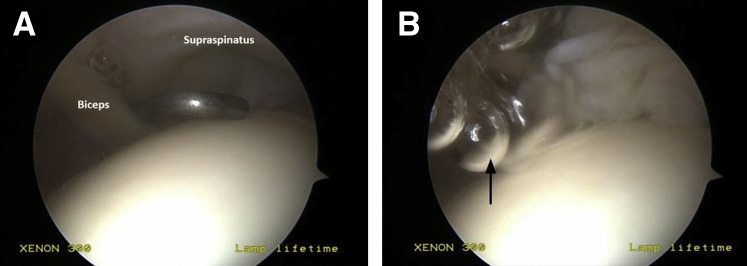
Distinguishing between partial-thickness and small focal full-thickness tears of rotator cuff may be important for determining the appropriate surgical treatment options and repair constructs in the care of patients with rotator cuff pathology. This article presents a simple intraoperative technical trick to aid in identification of small full-thickness tears of the superior rotator cuff. The relatively higher-pressured subacromial space and the low-pressured glenohumeral joint are separated by the supraspinatus tendon. When this barrier is compromised due to a full-thickness tear, free fluid flows from high to low pressure down the native pressure gradient. This is seen as the movement of air bubbles into the glenohumeral joint from the subacromial space and can be used to identify the presence of a full-thickness rotator cuff tear on diagnostic arthroscopy.
区分肩袖的部分厚度撕裂和小范围局灶性全层撕裂对于确定肩袖病变患者的合适手术治疗方案和修复结构可能很重要。本文介绍一种简单的术中技术窍门,以帮助识别肩袖上方的小全层撕裂。相对高压的肩峰下间隙和低压的盂肱关节由冈上肌腱分隔。当由于全层撕裂导致该屏障受损时,自由液体沿天然压力梯度从高压流向低压。这表现为气泡从肩峰下间隙进入盂肱关节,可用于在诊断性关节镜检查时识别全层肩袖撕裂的存在。