Balla Mohammed Yousif, Gorafi Yasir Serag Alnor, Kamal Nasrein Mohamed, Abdalla Modather Galal Abdeldaim, Tahir Izzat Sidahmed Ali, Tsujimoto Hisashi
United Graduate School of Agricultural Sciences, Tottori University, Tottori, Japan.
Arid Land Research Center, Tottori University, Tottori, Japan.
Front Plant Sci. 2022 Jul 22;13:895742. doi: 10.3389/fpls.2022.895742. eCollection 2022.
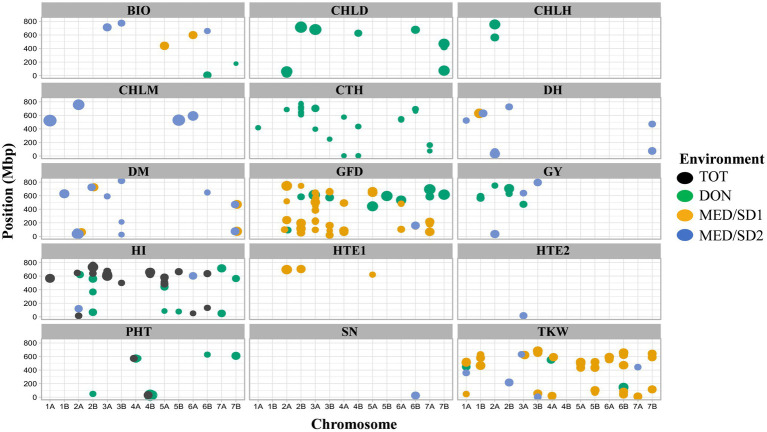
Wheat is highly sensitive to temperature beyond the optimum. To improve wheat adaptation to heat stress, the best option is to exploit the diversity of wild wheat progenitors. This study aimed to identify germplasm and quantitative trait loci associated with heat stress tolerance from wild emmer wheat diversity. We evaluated a diverse set of multiple derivative lines harboring chromosome segments from nine wild emmer wheat parents under four environments: two optimum environments at Tottori, Japan and Dongola, Sudan, one moderate heat stress environment, and one severe heat stress environment at Wad Medani, Sudan. Genome-wide association analysis was conducted with 13,312 SNP markers. Strong marker-trait associations (MTAs) were identified for chlorophyll content at maturity on chromosomes 1A and 5B: these MTAs explained 28.8 and 26.8% of the variation, respectively. A region on chromosome 3A (473.7-638.4 Mbp) contained MTAs controlling grain yield, under optimum and severe heat stress. Under severe heat stress, regions on chromosomes 3A (590.4-713.3 Mbp) controlled grain yield, biomass, days to maturity and thousand kernel weight, and on 3B (744.0-795.2 Mbp) grain yield and biomass. Heat tolerance efficiency (HTE) was controlled by three MTAs, one each on chromosomes 2A, 2B, and 5A under moderate heat stress and one MTA on chromosome 3A under severe heat stress. Some of the MTAs found here were previously reported, but the new ones originated from the wild emmer wheat genomes. The favorable alleles identified from wild emmer wheat were absent or rare in the elite durum wheat germplasm being bred for heat stress tolerance. This study provides potential genetic materials, alleles, MTAs, and quantitative trait loci for enhancing wheat adaptation to heat stress. The derivative lines studied here could be investigated to enhance other stress tolerance such as drought and salinity.
小麦对超出最适温度范围的温度高度敏感。为提高小麦对热胁迫的适应性,最佳选择是利用野生小麦祖先的多样性。本研究旨在从野生二粒小麦多样性中鉴定与耐热性相关的种质和数量性状位点。我们在四种环境下评估了一组多样的多衍生系,这些系含有来自九个野生二粒小麦亲本的染色体片段:日本鸟取和苏丹栋古拉的两个最适环境、一个中度热胁迫环境以及苏丹瓦德迈达尼的一个重度热胁迫环境。使用13,312个单核苷酸多态性(SNP)标记进行全基因组关联分析。在1A和5B染色体上鉴定出与成熟时叶绿素含量相关的强标记 - 性状关联(MTA):这些MTA分别解释了28.8%和26.8%的变异。3A染色体上的一个区域(473.7 - 638.4兆碱基对)包含在最适和重度热胁迫下控制籽粒产量的MTA。在重度热胁迫下,3A染色体上的区域(590.4 - 713.3兆碱基对)控制籽粒产量、生物量、成熟天数和千粒重,3B染色体上的区域(744.0 - 795.2兆碱基对)控制籽粒产量和生物量。耐热效率(HTE)由三个MTA控制,在中度热胁迫下,2A、2B和5A染色体上各有一个,在重度热胁迫下,3A染色体上有一个MTA。这里发现的一些MTA之前已有报道,但新的MTA源自野生二粒小麦基因组。从野生二粒小麦中鉴定出的有利等位基因在为耐热性培育的优质硬粒小麦种质中不存在或罕见。本研究为增强小麦对热胁迫的适应性提供了潜在的遗传材料、等位基因、MTA和数量性状位点。这里研究的衍生系可用于研究增强其他胁迫耐受性,如干旱和盐胁迫。