Lang Raynell, Gill M John, Viczko Jeannine, Naugler Christopher, Church Deirdre
Departments of Medicine and Community Health Sciences, Cumming School of Medicine, University of Calgary, Calgary, AlbertaCanada.
Southern Alberta HIV Clinic, Alberta Health Services, Calgary, AlbertaCanada.
Open Forum Infect Dis. 2022 Aug 3;9(8):ofac318. doi: 10.1093/ofid/ofac318. eCollection 2022 Aug.
Bloodstream infections (BSIs) among people with human immunodeficiency virus (PWH) remain a poorly studied source of morbidity and mortality. We characterize the epidemiology, microbiology, and clinical outcomes including reinfection, hospitalization, and mortality rates of both community-acquired and hospital-acquired BSI in PWH.
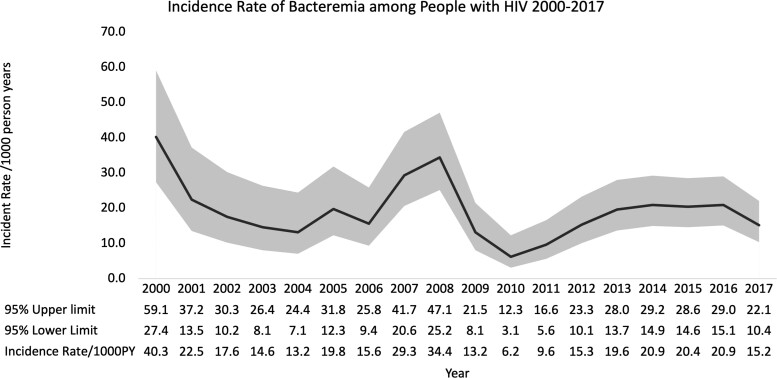
We identified all BSI, between January 1, 2000 and December 31, 2017 in PWH in care at Southern Alberta Clinic, by linking data from laboratory and clinical databases. Crude incidence rates per 1000 person-years for BSI and death were calculated. Cox proportional hazards models estimated crude and adjusted hazard ratios (HRs) and 95% confidence intervals (CIs) to conduct a risk factor analysis of BSI in PWH. Logistic regression models with generalized estimating equations estimated crude and adjusted odds ratios (aORs) to identify characteristics associated with 1-year mortality after BSI.
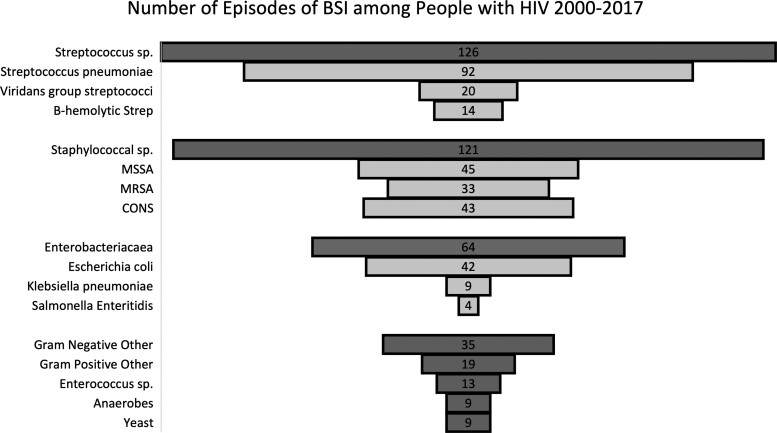
Among 2895 PWH, 396 BSI episodes occurred in 228 (8%) PWH. There were 278 (72%) Gram-positive and 109 (28%) Gram-negative BSI. People with human immunodeficiency virus with lower CD4 nadirs, higher Charlson comorbidity indices, and hepatitis C virus were at highest risk for BSI. Long-term all-cause mortality was greater in those experiencing BSI (HR, 5.25; 95% CI, 4.21-6.55). CD4 count <200 cells/mm measured closest to the time of BSI was associated with 1-year mortality after BSI (aOR, 3.88; 95% CI, 1.78-8.46). Repeat episodes (42%) and polymicrobial BSI (19%) were common.
Bloodstream infections continue to occur at an elevated rate among PWH with high reoccurrence rates and associated morbidity and mortality. To risk stratify and develop targeted interventions, we identified PWH at greatest risk for BSI. People with human immunodeficiency virus with low immunity at the time of BSI are at highest risk of poor outcomes.
人类免疫缺陷病毒感染者(PWH)的血流感染(BSIs)仍是一个研究较少的发病和死亡原因。我们对PWH社区获得性和医院获得性BSI的流行病学、微生物学及临床结局(包括再感染、住院率和死亡率)进行了特征描述。
通过关联实验室和临床数据库的数据,我们确定了2000年1月1日至2017年12月31日期间在艾伯塔省南部诊所接受治疗的所有PWH中的BSI病例。计算了每1000人年的BSI粗发病率和死亡率。Cox比例风险模型估计了粗风险比和调整后风险比(HRs)以及95%置信区间(CIs),以对PWH中的BSI进行风险因素分析。带有广义估计方程的逻辑回归模型估计了粗比值比和调整后比值比(aORs),以确定与BSI后1年死亡率相关的特征。
在2895名PWH中,228名(8%)PWH发生了396次BSI发作。有278例(72%)革兰氏阳性菌BSI和109例(28%)革兰氏阴性菌BSI。CD4最低点较低、Charlson合并症指数较高以及感染丙型肝炎病毒的人类免疫缺陷病毒感染者发生BSI的风险最高。发生BSI者的长期全因死亡率更高(HR,5.25;95%CI,4.21 - 6.55)。在最接近BSI发生时间测得的CD4细胞计数<200个/mm与BSI后1年死亡率相关(aOR,3.88;95%CI,1.78 - 8.46)。重复发作(42%)和多微生物BSI(19%)很常见。
PWH中血流感染的发生率持续升高,复发率高,且伴有发病和死亡。为了进行风险分层并制定有针对性的干预措施,我们确定了发生BSI风险最高的PWH。在发生BSI时免疫力低下的人类免疫缺陷病毒感染者预后不良的风险最高。