Zhu Mingxing, Wang Xin, Deng Hanjie, He Yuchao, Zhang Haoshi, Liu Zhenzhen, Chen Shixiong, Wang Mingjiang, Li Guanglin
School of Electronic and Information Engineering, Harbin Institute of Technology, Shenzhen, China.
CAS Key Laboratory of Human-Machine Intelligence-Synergy Systems, Shenzhen Institute of Advanced Technology, Chinese Academy of Sciences, Shenzhen, China.
Front Neurosci. 2022 Jul 22;16:941594. doi: 10.3389/fnins.2022.941594. eCollection 2022.
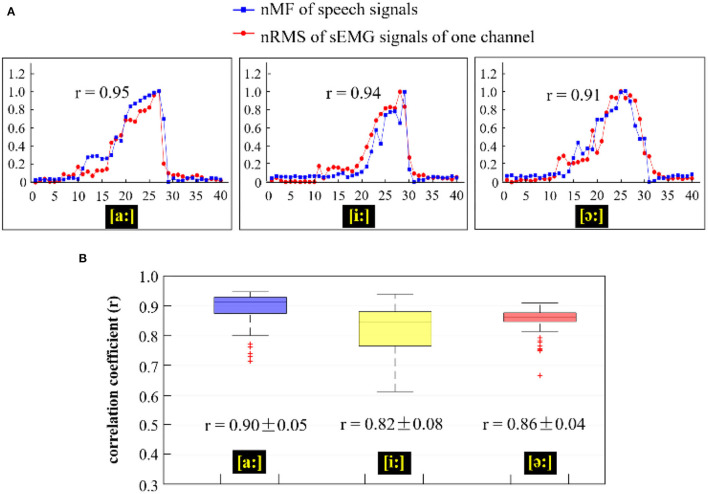
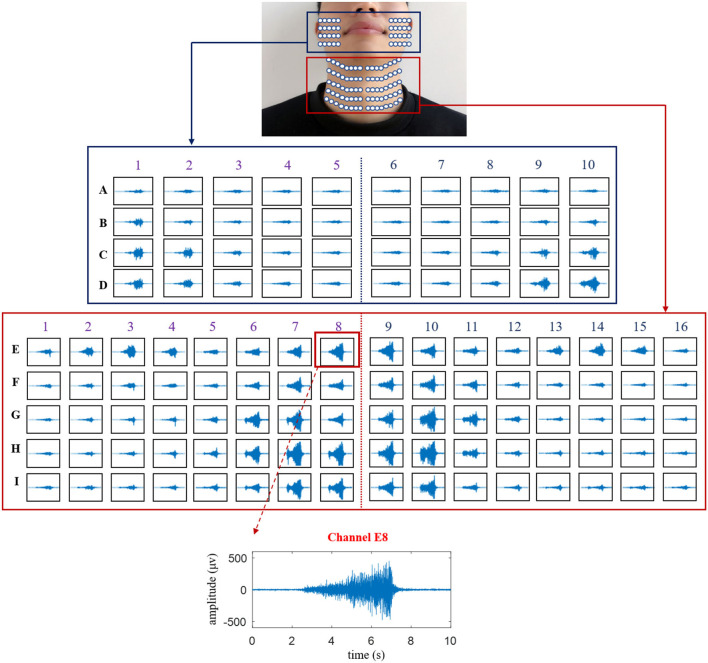
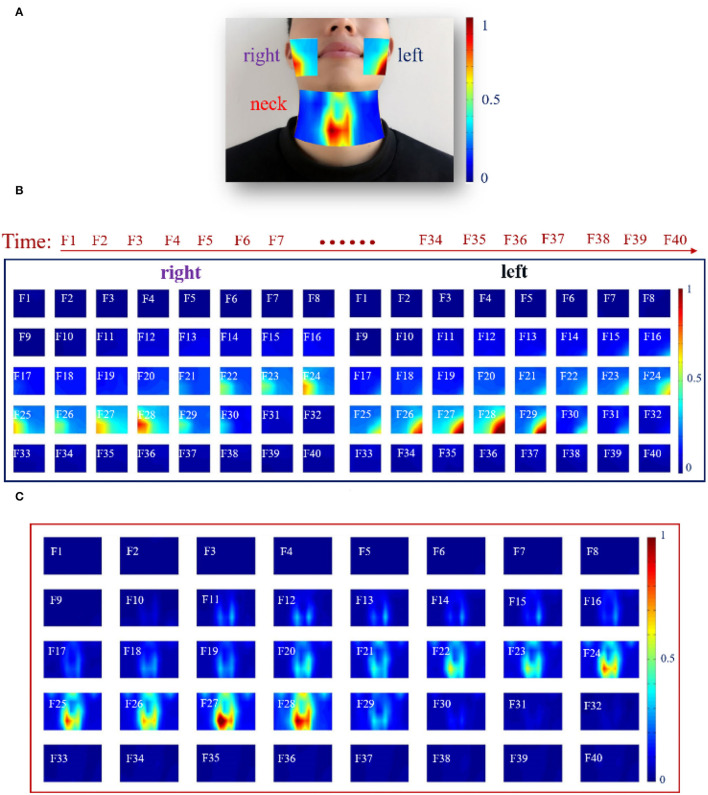
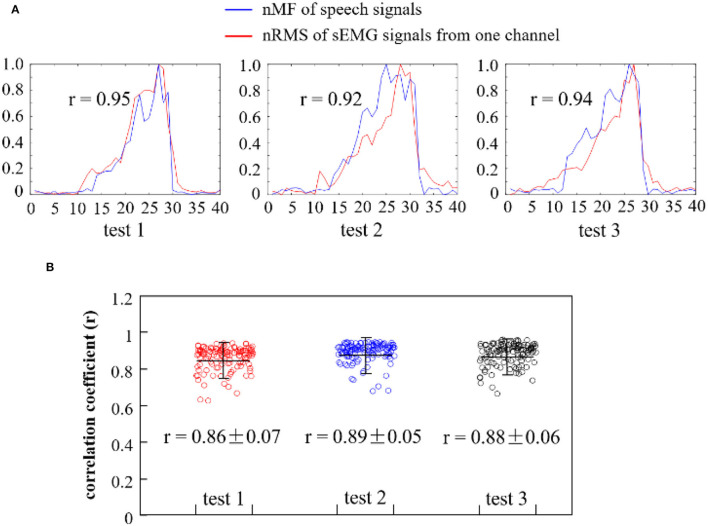
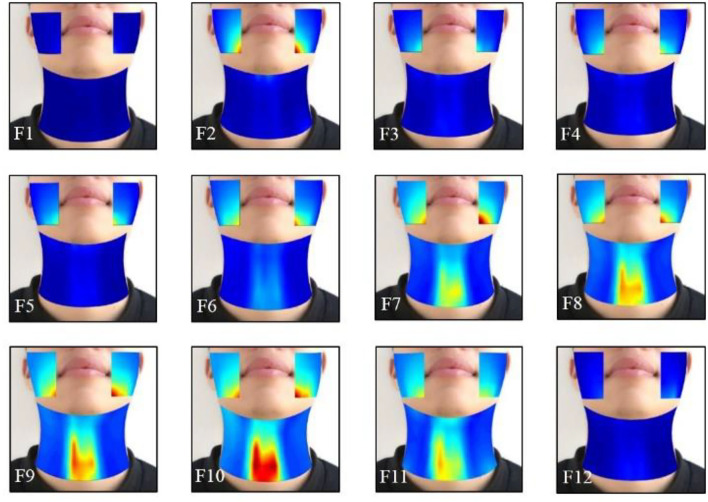
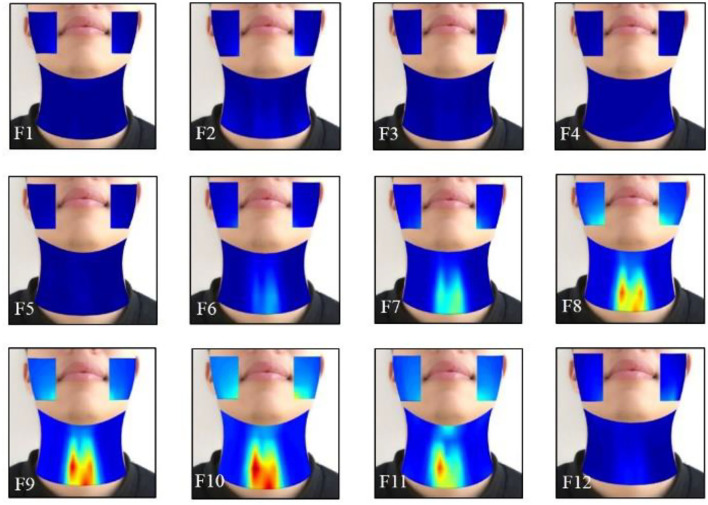
Pitch, as a sensation of the sound frequency, is a crucial attribute toward constructing a natural voice for communication. Producing intelligible sounds with normal pitches depend on substantive interdependencies among facial and neck muscles. Clarifying the interrelations between the pitches and the corresponding muscular activities would be helpful for evaluating the pitch-related phonating functions, which would play a significant role both in training pronunciation and in assessing dysphonia. In this study, the speech signals and the high-density surface electromyography (HD sEMG) signals were synchronously acquired when phonating [a:], [i:], and [ә:] vowels with increasing pitches, respectively. The HD sEMG energy maps were constructed based on the root mean square values to visualize spatiotemporal characteristics of facial and neck muscle activities. Normalized median frequency (nMF) and root-mean square (nRMS) were correspondingly extracted from the speech and sEMG recordings to quantitatively investigate the correlations between sound frequencies and myoelectric characteristics. The results showed that the frame-wise energy maps built from sEMG recordings presented that the muscle contraction strength increased monotonously across pitch-rising, with left-right symmetrical distribution for the face/neck. Furthermore, the nRMS increased at a similar rate to the nMF when there were rising pitches, and the two parameters had a significant correlation across different vowel tasks [(a:) (0.88 ± 0.04), (i:) (0.89 ± 0.04), and (ә:) (0.87 ± 0.05)]. These findings suggested the possibility of utilizing muscle contraction patterns as a reference for evaluating pitch-related phonation functions. The proposed method could open a new window for developing a clinical approach for assessing the muscular functions of dysphonia.
音高作为对声音频率的一种感觉,是构建自然交流语音的关键属性。发出具有正常音高的可理解声音取决于面部和颈部肌肉之间的实质相互依存关系。阐明音高与相应肌肉活动之间的相互关系将有助于评估与音高相关的发声功能,这在语音训练和嗓音障碍评估中都将发挥重要作用。在本研究中,当分别以逐渐升高的音高发出[a:]、[i:]和[ә:]元音时,同步采集了语音信号和高密度表面肌电图(HD sEMG)信号。基于均方根值构建了HD sEMG能量图,以可视化面部和颈部肌肉活动的时空特征。相应地从语音和sEMG记录中提取归一化中频(nMF)和均方根(nRMS),以定量研究声音频率与肌电特征之间的相关性。结果表明,由sEMG记录构建的逐帧能量图显示,随着音高升高,肌肉收缩强度单调增加,面部/颈部呈左右对称分布。此外,当音高升高时,nRMS与nMF以相似的速率增加,并且这两个参数在不同元音任务中具有显著相关性[(a:)(0.88±0.04),(i:)(0.89±0.04),和(ә:)(0.87±0.05)]。这些发现提示了利用肌肉收缩模式作为评估与音高相关发声功能参考的可能性。所提出的方法可为开发一种评估嗓音障碍肌肉功能的临床方法打开一扇新窗口。