An Shiyu, Yao Dan, Zhang Wenyi, Sun Hao, Yu Tianyi, Jia Ruizhe, Yang Yang
State Key Laboratory of Reproductive Medicine, Nanjing Medical University, Nanjing, China.
Department of Obstetrics, Women's Hospital of Nanjing Medical University, Nanjing Maternity and Child Health Care Institute, Nanjing, China.
Front Genet. 2022 Jul 22;13:905395. doi: 10.3389/fgene.2022.905395. eCollection 2022.
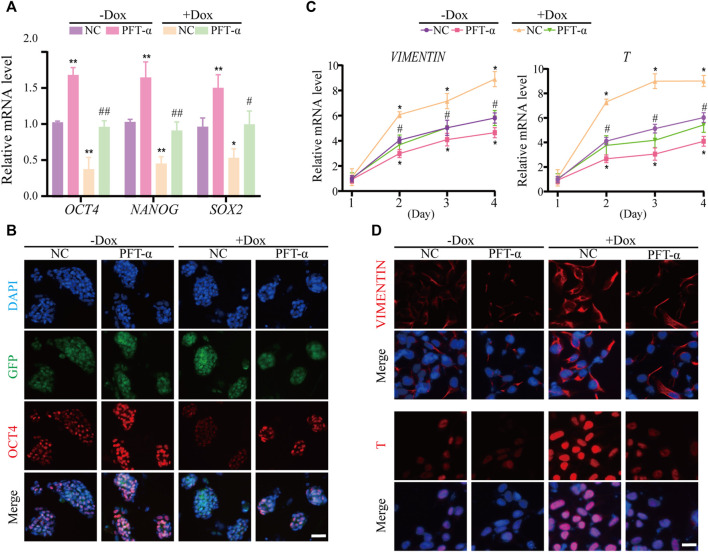
Extended pluripotent stem cells (EPS cells) have unlimited self-renewal ability and the potential to differentiate into mesodermal, ectodermal, and endodermal cells. Notably, in addition to developing the embryonic (Em) lineages, it can also make an effective contribution to extraembryonic (ExEm) lineages both and . However, multiple mysteries still remain about the underlying molecular mechanism of EPS cells' maintenance and developmental potential. WDR36 (WD Repeat Domain 36), a protein of 105 kDa with 14 WD40 repeats, which may fold into two β-propellers, participates in 18sRNA synthesis and P53 stress response. Though WDR36 safeguards mouse early embryonic development, that is, homozygous knockout of WDR36 can result in embryonic lethality, what role does WDR36 plays in self-renewal and differentiation developmental potential of human EPS cells is still a subject of concern. Here, our findings suggested that the expression of WDR36 was downregulated during human hEPS cells lost self-renewal. Through constructing inducible knockdown or overexpressing WDR36-human EPS cell lines, we found that WDR36 knockdown disrupted self-renewal but promoted the mesodermal differentiation of human EPS cells; however, overexpressing of WDR36 had little effect. Additionally, P53 inhibition could reverse the effects of WDR36 knockdown, on both self-renewal maintenance and differentiation potential of human EPS cells. These data implied that WDR36 safeguards self-renewal and pluripotency of human EPS cells, which would extend our understanding of the molecular mechanisms of human EPS cells' self-renewal and differentiation.
扩展多能干细胞(EPS细胞)具有无限自我更新能力以及分化为中胚层、外胚层和内胚层细胞的潜力。值得注意的是,除了发育胚胎(Em)谱系外,它还能有效地促进胚胎外(ExEm)谱系的发育。然而,关于EPS细胞维持和发育潜力的潜在分子机制仍存在诸多谜团。WDR36(WD重复结构域36)是一种105 kDa的蛋白质,有14个WD40重复序列,可能折叠成两个β-螺旋桨结构,参与18sRNA合成和P53应激反应。虽然WDR36对小鼠早期胚胎发育起到保护作用,即WDR36纯合敲除会导致胚胎致死,但WDR36在人类EPS细胞的自我更新和分化发育潜力中发挥何种作用仍是一个备受关注的问题。在这里,我们的研究结果表明,在人类hEPS细胞失去自我更新能力的过程中,WDR36的表达下调。通过构建可诱导敲低或过表达WDR36的人类EPS细胞系,我们发现敲低WDR36会破坏自我更新,但会促进人类EPS细胞的中胚层分化;然而,过表达WDR36的影响不大。此外,抑制P53可以逆转WDR36敲低对人类EPS细胞自我更新维持和分化潜能的影响。这些数据表明,WDR36保护人类EPS细胞的自我更新和多能性,这将扩展我们对人类EPS细胞自我更新和分化分子机制的理解。