Department of Neonatology, Amsterdam UMC location University of Amsterdam, Amsterdam, The Netherlands.
Amsterdam Reproduction & Development research institute, Amsterdam, The Netherlands.
Pediatr Pulmonol. 2022 Nov;57(11):2754-2762. doi: 10.1002/ppul.26096. Epub 2022 Aug 17.
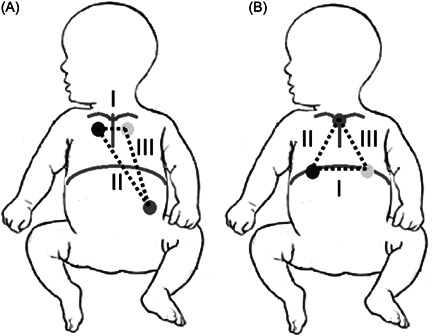
Current cardiorespiratory monitoring in neonates with electrocardiogram (ECG) and chest impedance (CI) has limitations. Adding transcutaneous electromyography of the diaphragm (dEMG) may improve respiratory monitoring, but requires additional hardware. We aimed to determine the feasibility of measuring dEMG and ECG/CI simultaneously using the standard ECG/CI hardware, with its three electrodes repositioned to dEMG electrode locations.
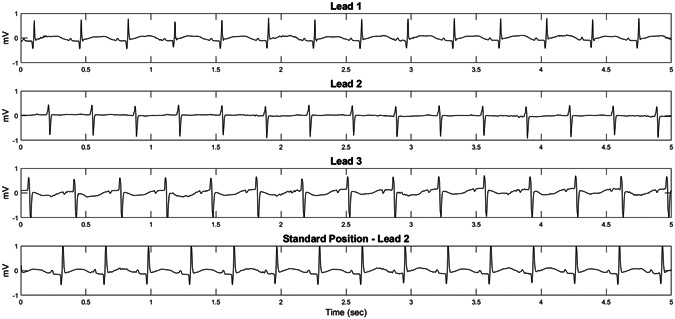
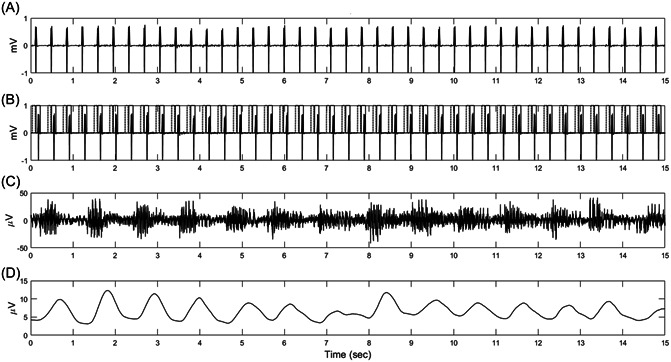
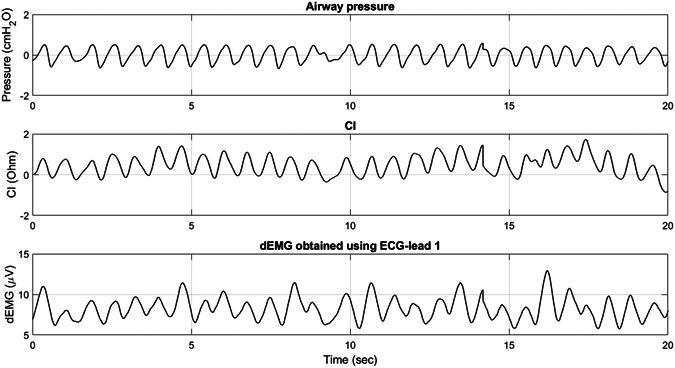
Thirty infants (median postmenstrual age 30.4 weeks) were included. First, we assessed the feasibility of extracting dEMG from the ECG-signal. If successful, the agreement between dEMG-based respiratory rate (RR), using three different ECG-leads, and a respiratory reference signal was assessed using the Bland-Altman analysis and the intraclass correlation coefficient (ICC). Furthermore, we studied the agreement between CI-based RR and the reference signal with the electrodes placed at the standard and dEMG position. Finally, we explored the quality of the ECG-signal at the different electrode positions.
In 15 infants, feasibility of measuring dEMG with the monitoring electrodes was confirmed. In the next 15 infants, comparing dEMG-based RR to the reference signal resulted in a mean difference and limits of agreement for ECG-lead I, II and III of 4.2 [-8.2 to 16.6], 4.3 [-10.7 to 19.3] and 5.0 [-14.2 to 24.2] breaths/min, respectively. ICC analysis showed a moderate agreement for all ECG-leads. CI-based RR agreement was similar at the standard and dEMG electrode position. An exploratory analysis suggested similar quality of the ECG-signal at both electrode positions.
Measuring dEMG using the ECG/CI hardware with its electrodes on the diaphragm is feasible, leaving ECG/CI monitoring unaffected.
目前,新生儿的心电图(ECG)和胸部阻抗(CI)监测存在局限性。增加膈肌经皮肌电图(dEMG)可能会改善呼吸监测,但需要额外的硬件。我们旨在确定使用标准 ECG/CI 硬件同时测量 dEMG 和 ECG/CI 的可行性,该硬件的三个电极重新定位到 dEMG 电极位置。
纳入 30 名婴儿(中位胎龄 30.4 周)。首先,我们评估了从 ECG 信号中提取 dEMG 的可行性。如果成功,我们使用 Bland-Altman 分析和组内相关系数(ICC)评估了使用三个不同 ECG 导联的基于 dEMG 的呼吸频率(RR)与呼吸参考信号之间的一致性。此外,我们研究了将电极放置在标准和 dEMG 位置时,基于 CI 的 RR 与参考信号之间的一致性。最后,我们探讨了不同电极位置 ECG 信号的质量。
在 15 名婴儿中,证实了使用监测电极测量 dEMG 的可行性。在接下来的 15 名婴儿中,与参考信号相比,基于 dEMG 的 RR 在 ECG 导联 I、II 和 III 上的平均差异和一致性界限分别为 4.2 [–8.2 至 16.6]、4.3 [–10.7 至 19.3] 和 5.0 [–14.2 至 24.2] 次/分钟。ICC 分析表明,所有 ECG 导联均具有中等一致性。在标准和 dEMG 电极位置,基于 CI 的 RR 一致性相似。探索性分析表明,两个电极位置的 ECG 信号质量相似。
使用带有电极的 ECG/CI 硬件在膈肌上测量 dEMG 是可行的,不会影响 ECG/CI 监测。