Center for Molecular and Vascular Biology, Department of Cardiovascular Sciences, KU Leuven, Leuven, Belgium.
Laboratory for Translational Genetics, VIB - KU Leuven, Leuven, Belgium; Department of Respiratory Diseases, University Hospitals Leuven, Leuven, Belgium.
EBioMedicine. 2022 Sep;83:104195. doi: 10.1016/j.ebiom.2022.104195. Epub 2022 Aug 5.
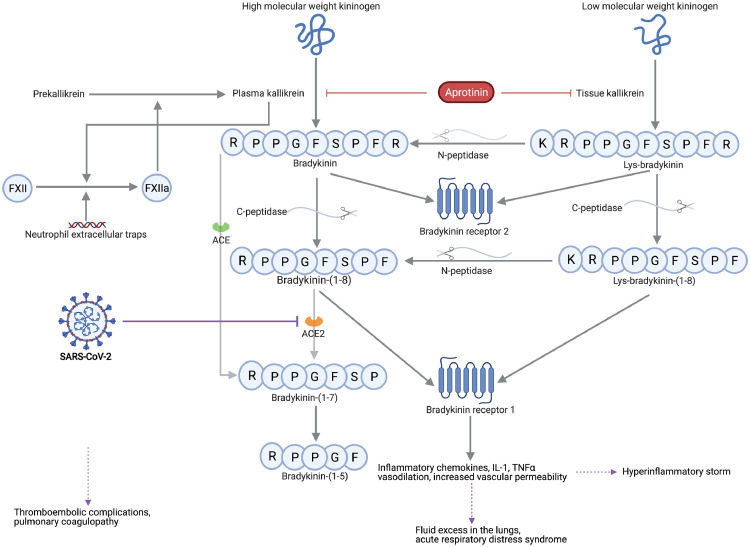
Severe acute respiratory syndrome coronavirus 2 (SARS-CoV-2) binds to the angiotensin-converting enzyme 2 (ACE2) receptor, a critical component of the kallikrein-kinin system. Its dysregulation may lead to increased vascular permeability and release of inflammatory chemokines. Interactions between the kallikrein-kinin and the coagulation system might further contribute to thromboembolic complications in COVID-19.
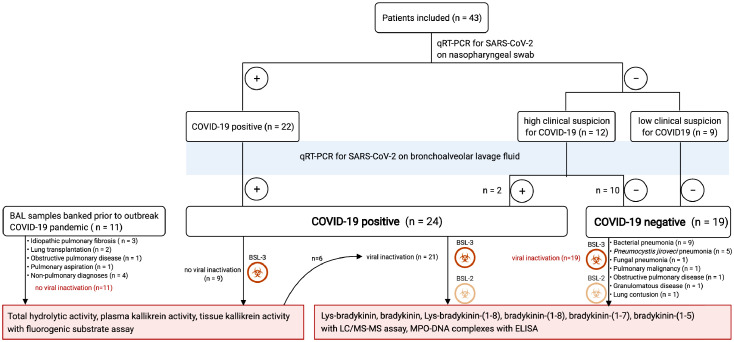
In this observational study, we measured plasma and tissue kallikrein hydrolytic activity, levels of kinin peptides, and myeloperoxidase (MPO)-DNA complexes as a biomarker for neutrophil extracellular traps (NETs), in bronchoalveolar lavage (BAL) fluid from patients with and without COVID-19.
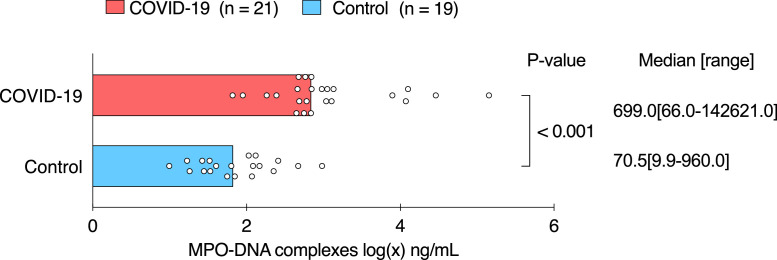
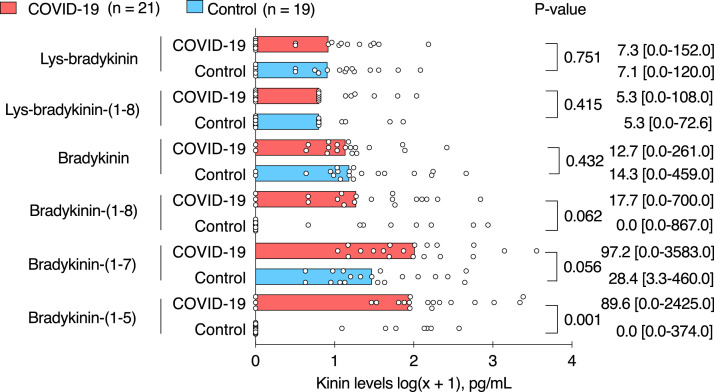
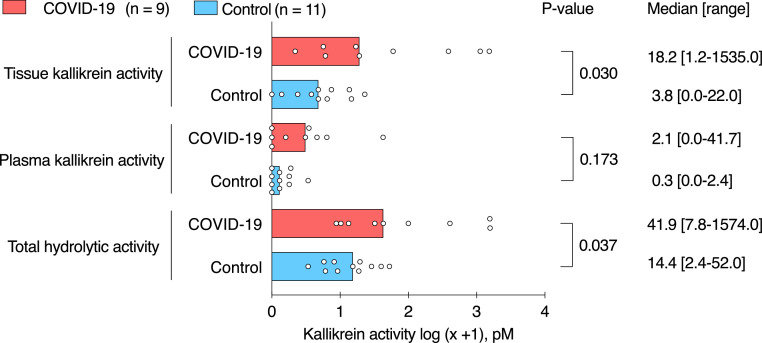
In BAL fluid from patients with severe COVID-19 (n = 21, of which 19 were mechanically ventilated), we observed higher tissue kallikrein activity (18·2 pM [1·2-1535·0], median [range], n = 9 vs 3·8 [0·0-22·0], n = 11; p = 0·030), higher levels of the kinin peptide bradykinin-(1-5) (89·6 [0·0-2425·0], n = 21 vs 0·0 [0·0-374·0], n = 19, p = 0·001), and higher levels of MPO-DNA complexes (699·0 ng/mL [66·0-142621·0], n = 21 vs 70·5 [9·9-960·0], n = 19, p < 0·001) compared to patients without COVID-19.
Our observations support the hypothesis that dysregulation of the kallikrein-kinin system might occur in mechanically ventilated patients with severe pulmonary disease, which might help to explain the clinical presentation of patients with severe COVID-19 developing pulmonary oedema and thromboembolic complications. Therefore, targeting the kallikrein-kinin system should be further explored as a potential treatment option for patients with severe COVID-19.
Research Foundation-Flanders (G0G4720N, 1843418N), KU Leuven COVID research fund.
严重急性呼吸综合征冠状病毒 2(SARS-CoV-2)与血管紧张素转换酶 2(ACE2)受体结合,ACE2 受体是激肽释放酶-激肽系统的关键组成部分。其失调可能导致血管通透性增加和炎症趋化因子的释放。激肽释放酶-激肽系统与凝血系统的相互作用可能进一步导致 COVID-19 中的血栓栓塞并发症。
在这项观察性研究中,我们测量了患有和不患有 COVID-19 的患者支气管肺泡灌洗液(BAL)中血浆和组织激肽水解活性、激肽肽水平以及髓过氧化物酶(MPO)-DNA 复合物作为中性粒细胞胞外陷阱(NETs)的生物标志物。
在患有严重 COVID-19 的患者(n=21,其中 19 例接受机械通气)的 BAL 液中,我们观察到更高的组织激肽活性(18·2 pM [1·2-1535·0],中位数[范围],n=9 与 3·8 [0·0-22·0],n=11;p=0·030)、更高水平的激肽肽缓激肽-(1-5)(89·6 [0·0-2425·0],n=21 与 0·0 [0·0-374·0],n=19,p=0·001)和更高水平的 MPO-DNA 复合物(699·0 ng/mL [66·0-142621·0],n=21 与 70·5 [9·9-960·0],n=19,p<0·001)与未患 COVID-19 的患者相比。
我们的观察结果支持这样一种假设,即激肽释放酶-激肽系统的失调可能发生在患有严重肺部疾病的机械通气患者中,这可能有助于解释患有严重 COVID-19 的患者出现肺水肿和血栓栓塞并发症的临床表现。因此,作为 COVID-19 重症患者的潜在治疗选择,靶向激肽释放酶-激肽系统应进一步探索。
研究基金会-佛兰德斯(G0G4720N,1843418N),鲁汶大学 COVID 研究基金。