Department of Pharmacology, Institute of Medical Sciences, Banaras Hindu University, Varanasi, Uttar Pradesh, India.
Department of Geriatric Medicine, Institute of Medical Sciences, Banaras Hindu University, Varanasi, Uttar Pradesh, India.
Am J Trop Med Hyg. 2022 Aug 8;107(4):850-855. doi: 10.4269/ajtmh.22-0172. Print 2022 Oct 12.
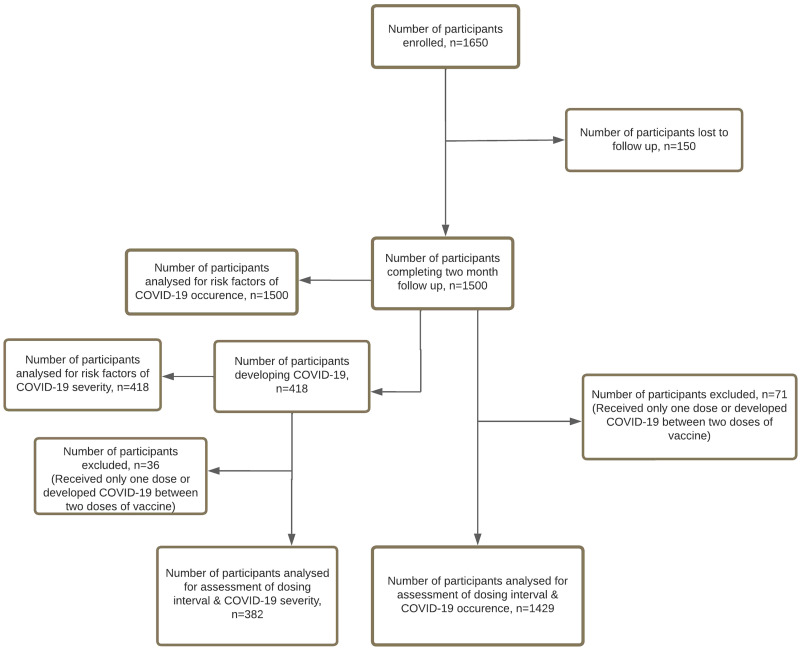
The current analysis is a part of an ongoing observational study that began in February 2021 in the Sir Sunder Lal Hospital (Varanasi, Uttar Pradesh) in northern India and is expected to continue until June 2022. This analysis aimed to delineate the clinical presentation and risk factors of occurrence and severity of COVID-19 in vaccinated individuals. The study enrolled health-care workers and the elderly receiving the COVID-19 vaccine at one of three centers linked to the study hospital. The participants received the ChAdOx1 nCoV-19 (Oxford-AstraZeneca) vaccine based on the chimpanzee adenovirus platform (manufactured in India by the Serum Institute of India). The adenovirus codes for the spike (S) protein of SARS-CoV-2. Participants were contacted by phone at pre-decided intervals and questioned about the occurrence of COVID-19, clinical presentation, severity, and persistence of symptoms. A logistic regression analysis was performed to predict the risk factors of occurrence and severity of COVID-19. Of the 1,500 participants included in the analysis, 418 developed COVID-19 (27.9%). Fever was the most common symptom (72%), followed by cough (34%) and rhinitis (26%). Cardiovascular involvement was seen in more than 2% of individuals, and 11% had post-COVID-19 complaints. Regression analysis showed 1.6 times greater odds of contracting the disease in females and in those younger than 40 years, 1.4 times greater odds in individuals who were overweight, and 2.9 times greater odds in those receiving only one dose, compared with respective comparators. Individuals receiving two doses at a gap of ≤ 30 days had 6.7 times greater odds of infection than those receiving at a > 60-day interval. There was no association between COVID-19 occurrence in the vaccinees and pre-vaccination history of SARS-CoV-2 infection. Males were at a 3.6 times greater risk, and persons with preexisting lung disease-mainly asthma-had a 5.9 times greater risk of experiencing moderate to severe COVID-19 than comparators. While an extended interval between the two vaccine doses seems to be a better strategy, gender differences and an association of asthma phenotypes with COVID-19 need to be explored.
本分析是一项正在进行的观察性研究的一部分,该研究于 2021 年 2 月在印度北部的西里·桑德·拉尔医院(北方邦瓦拉纳西)开始,预计将持续到 2022 年 6 月。本分析旨在描绘接种疫苗个体中 COVID-19 的发病和严重程度的临床表现和危险因素。该研究纳入了在与研究医院相关的三个中心之一接种 COVID-19 疫苗的医护人员和老年人。参与者接种了基于 chimpanzee adenovirus 平台的 ChAdOx1 nCoV-19(牛津-阿斯利康)疫苗(由印度血清研究所在印度制造)。该腺病毒编码 SARS-CoV-2 的刺突(S)蛋白。研究人员通过预先设定的间隔通过电话联系参与者,询问 COVID-19 的发生、临床表现、严重程度和症状持续时间。进行了逻辑回归分析以预测 COVID-19 的发病和严重程度的危险因素。在纳入分析的 1500 名参与者中,418 人患有 COVID-19(27.9%)。发热是最常见的症状(72%),其次是咳嗽(34%)和鼻炎(26%)。超过 2%的个体出现心血管受累,11%的个体有 COVID-19 后投诉。回归分析显示,女性和 40 岁以下个体患病的几率高 1.6 倍,超重个体患病的几率高 1.4 倍,仅接受一剂疫苗的个体患病的几率高 2.9 倍,与各自的对照组相比。在间隔 ≤ 30 天内接受两剂疫苗的个体感染的几率高 6.7 倍,而在间隔 > 60 天内接受疫苗的个体。疫苗接种者的 COVID-19 发病与 SARS-CoV-2 感染的疫苗接种前史无关。男性的风险高 3.6 倍,而患有既往肺部疾病(主要是哮喘)的个体发生中重度 COVID-19 的风险高 5.9 倍,与对照组相比。虽然两剂疫苗之间的间隔延长似乎是更好的策略,但需要探索性别差异和哮喘表型与 COVID-19 的关联。