Hancı Pervin, Öcal Serpil, Kaya Esat Kıvanç, Topeli Arzu
Department of Pulmonary Medicine, and Intensive Care, Trakya University, Faculty of Medicine, Edirne,Turkey.
Department of Internal Medicine, and Intensive Care, Hacettepe University Faculty of Medicine, Ankara, Turkey.
Turk Thorac J. 2022 Sep;23(5):336-342. doi: 10.5152/TurkThoracJ.2022.21268.
This study investigated the efficacy of high-flow nasal oxygen therapy in patients with severe acute exacerbation of chronic obstructive pulmonary disease admitted to the intensive care unit.
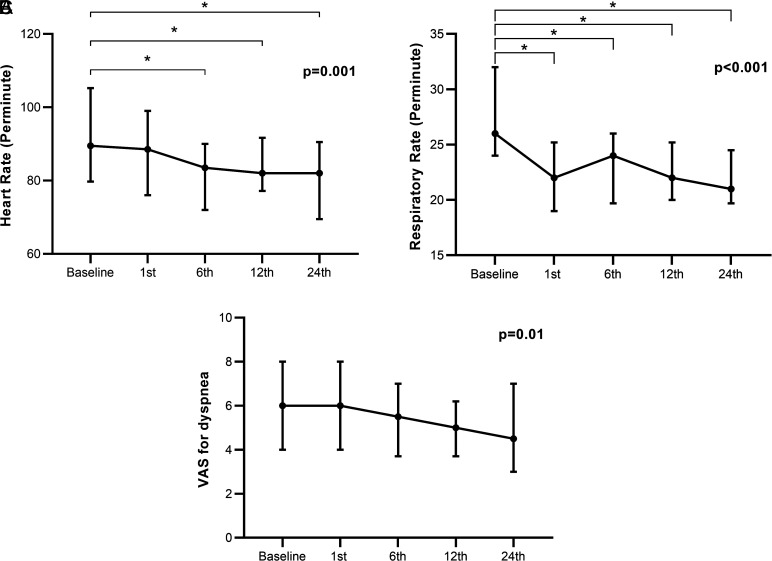
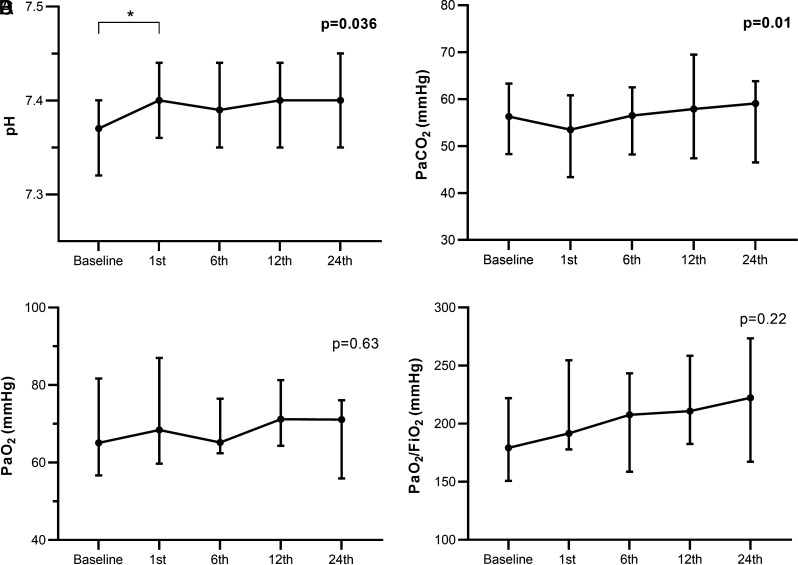
Totally, 23 patients were enrolled in the study. High-flow nasal oxygen therapy was administered with a predefined protocol. Vital signs, Visual Analog Scale for dyspnea, and arterial blood gas parameters were recorded at the beginning under low-flow oxygen support therapy and the 1st, 6th, 12th, and 24th hours of high-flow nasal oxygen therapy. High-flow nasal oxygen therapy duration, intensive care unit length of stay, and intensive care unit, in-hospital, and 60-day mortality were recorded as outcomes and compared according to the presence of pneumonia upon admission.
In 12 patients (52.2%), pneumonia was present. High-flow nasal oxygen therapy was applied for a median of 57 hours [49.2-104.5]. Overall decreases were detected in heart rate (P = .001), respiratory rate (P < .001), and Visual Analog Scale for dyspnea (P = .001) during the first 24 hours of the therapy. Although there was an increase in PaCO2 (P = .001), pH increased (P < .001) over time too. No change in partial arterial oxygen pressure (P = .63) and partial arterial oxygen pressure/fraction of inspired oxygen ratio (P = .22) was noted. Nineteen patients (77%) were successfully weaned from high-flow nasal oxygen therapy. While the high-flow nasal oxygen therapy failure rate was 23%, the in-hospital and 60-day mortality rates were 8.6%. Outcomes were not different between patients with and without pneumonia.
High-flow nasal oxygen therapy was efficient in relieving respiratory distress and well-tolerated with no adverse out- come in severe acute exacerbation of chronic obstructive pulmonary disease patients admitted to the intensive care unit.
本研究探讨了高流量鼻导管给氧疗法对入住重症监护病房的慢性阻塞性肺疾病严重急性加重患者的疗效。
本研究共纳入23例患者。按照预先设定的方案给予高流量鼻导管给氧疗法。在低流量氧疗支持开始时以及高流量鼻导管给氧治疗的第1、6、12和24小时记录生命体征、视觉模拟评分法评估的呼吸困难程度以及动脉血气参数。记录高流量鼻导管给氧治疗持续时间、重症监护病房住院时间、重症监护病房、住院期间及60天死亡率作为结局指标,并根据入院时是否存在肺炎进行比较。
12例患者(52.2%)存在肺炎。高流量鼻导管给氧治疗的中位时间为57小时[49.2 - 104.5]。在治疗的前24小时内,心率(P = 0.001)、呼吸频率(P < 0.001)和视觉模拟评分法评估的呼吸困难程度(P = 0.001)总体均下降。尽管动脉血二氧化碳分压升高(P = 0.001),但pH值也随时间升高(P < 0.001)。动脉血氧分压(P = 0.63)和动脉血氧分压/吸入氧分数比(P = 0.22)无变化。19例患者(77%)成功撤掉高流量鼻导管给氧治疗。高流量鼻导管给氧治疗失败率为23%,住院期间及60天死亡率为8.6%。有肺炎和无肺炎患者的结局无差异。
高流量鼻导管给氧疗法可有效缓解慢性阻塞性肺疾病严重急性加重且入住重症监护病房患者的呼吸窘迫,耐受性良好,无不良结局。