Graduate School of Engineering, Osaka City University, 3-3-138 Sugimoto, Sumiyoshi, Osaka, 558-8585, Japan.
Department of Clinical Engineering, Faculty of Human Care at Makuhari, Tohto University, Chiba, Japan.
Biomed Eng Online. 2022 Aug 9;21(1):56. doi: 10.1186/s12938-022-01021-7.
Flat feet increase the risk of knee osteoarthritis and contribute to frailty, which may lead to worse life prognoses. The influence of the foot skeletal structure on flat feet is not yet entirely understood. Footprints are often used to evaluate feet. However, footprint-based measurements do not reflect the underlying structures of feet and are easily confounded by soft tissue. Three-dimensional evaluation of the foot shape can reveal the characteristics of flat feet. Therefore, foot shape evaluations have garnered increasing research interest. This study aimed to determine the correlation between the three-dimensional (3D) features of the foot and the measurement results of footprint and to predict the evaluation results of flat feet from the footprint based on the 3D features. Finally, the three-dimensional characteristics of flat feet, which cannot be revealed by footprint, were determined.
A total of 403 individuals (40-89 years) participated in this study. The proposed system was developed to identify seven skeletal features that were expected to be associated with flat feet. The loads on the soles of the feet were measured in a static standing position and with a digital footprint device. Specifically, two footprint indices were calculated: the Chippaux-Smirak index (CSI) and the Staheli index (SI). In the analysis, comparisons between male and female measurement variables were performed using the Student's t test. The relationships between the 3D foot features and footprint index parameters were determined by employing the Pearson correlation coefficient. Multiple linear regression was utilized to identify 3D foot features that were strongly associated with the CSI and SI. Foot features identified as significant in the multivariate regression analysis were compared based on a one-way analysis of variance (ANOVA) with Tukey's post hoc test.
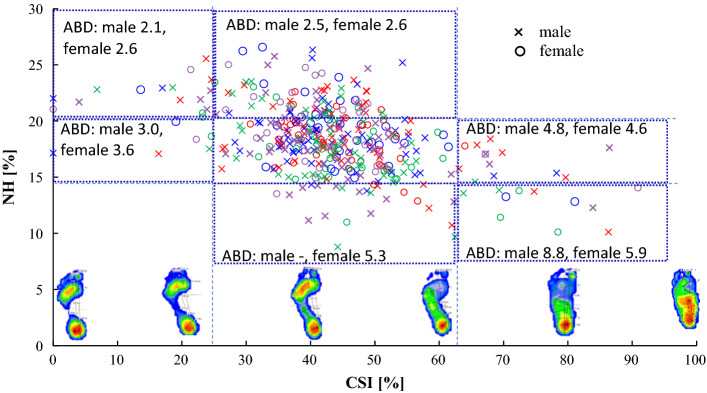
The CSI and SI were highly correlated with the instep height (IH) and navicular height (NH) of the 3D foot scanning system and were also derived from multiple regression analysis. In addition to the NH and IH, the indicators of the forefoot, transverse arch width, and transverse arch height were considered. In the flat foot group with CSI values above 62.7%, NH was 13.5% (p < 0.001) for males and 14.9% (p = 0.01) for females, and the axis of the bone distance was 5.3% (p = 0.05) for males and 4.9% (p = 0.10) for females. In particular, for CSI values above 62.7% and NH values below 13%, the axis of the bone distance was large and the foot skeleton was deformed.
Decreased navicular bone height could be evaluated with the 3D foot scanning system even when flat feet were not detected from the footprint. The results indicate that the use of quantitative indices for 3D foot measurements is important when evaluating the flattening of the foot. Trial registration number UMIN000037694. Name of the registry: University Hospital Medical Information Network Registry. Date of registration: August 15, 2019.
扁平足会增加膝关节骨关节炎的风险,并导致虚弱,从而导致预后更差。足部骨骼结构对扁平足的影响尚不完全清楚。足印通常用于评估足部。然而,基于足印的测量并不能反映足部的潜在结构,并且很容易受到软组织的干扰。足部形状的三维评估可以揭示扁平足的特征。因此,对足部形状的评估越来越受到关注。本研究旨在确定足部的三维(3D)特征与足印测量结果之间的相关性,并基于 3D 特征预测基于足印的扁平足评估结果。最后,确定了足印无法揭示的扁平足的三维特征。
共有 403 名(40-89 岁)个体参与了这项研究。该系统旨在识别七个预计与扁平足相关的骨骼特征。在静态站立位和数字足印设备上测量足底的负荷。具体来说,计算了两个足印指数:Chippaux-Smirak 指数(CSI)和 Staheli 指数(SI)。在分析中,使用学生 t 检验比较了男性和女性测量变量之间的差异。通过 Pearson 相关系数确定了 3D 足特征与足印指数参数之间的关系。采用多元线性回归确定与 CSI 和 SI 强烈相关的 3D 足特征。在多元回归分析中确定为显著的足特征,基于方差分析(ANOVA)与 Tukey 事后检验进行比较。
CSI 和 SI 与 3D 足部扫描系统的足背高度(IH)和舟骨高度(NH)高度相关,也可通过多元回归分析得出。除了 NH 和 IH 之外,还考虑了前足、横弓宽度和横弓高度的指标。在 CSI 值大于 62.7%的扁平足组中,男性 NH 值为 13.5%(p<0.001),女性 NH 值为 14.9%(p=0.01),骨骼轴距离为 5.3%(p=0.05),女性为 4.9%(p=0.10)。特别是对于 CSI 值大于 62.7%且 NH 值低于 13%的情况,骨骼轴距离较大且足部骨骼变形。
即使从足印中未检测到扁平足,也可以使用 3D 足部扫描系统评估舟骨高度降低。结果表明,在评估足部扁平时,使用 3D 足部测量的定量指标很重要。试验注册号 UMIN000037694。注册机构名称:大学医院医疗信息网注册处。注册日期:2019 年 8 月 15 日。


