Department of Medical Oncology, National Cancer Center Hospital, Tokyo, Japan.
Department of Experimental Therapeutics, National Cancer Center Hospital, Tokyo, Japan.
BMC Cancer. 2022 Aug 9;22(1):869. doi: 10.1186/s12885-022-09949-8.
Aberrant fibroblast growth factor receptor (FGFR) signaling can substantially influence oncogenicity. Despite that FGFR gene abnormality is often detected by cancer genome profiling tests, there is no tumor-agnostic approval yet for these aberrations. E7090 (tasurgratinib) is an orally available selective tyrosine kinase inhibitor of FGFR1-3. Specific FGFR alterations were previously reported to be highly sensitive to E7090 based on a high-throughput functional evaluation method, called mixed-all-nominated-mutants-in-one (MANO) method, narrowing down the most promising targets. This trial was focused on the alterations identified by the MANO method and was performed under the nationwide large registry network for rare cancers in Japan (MASTER KEY Project).
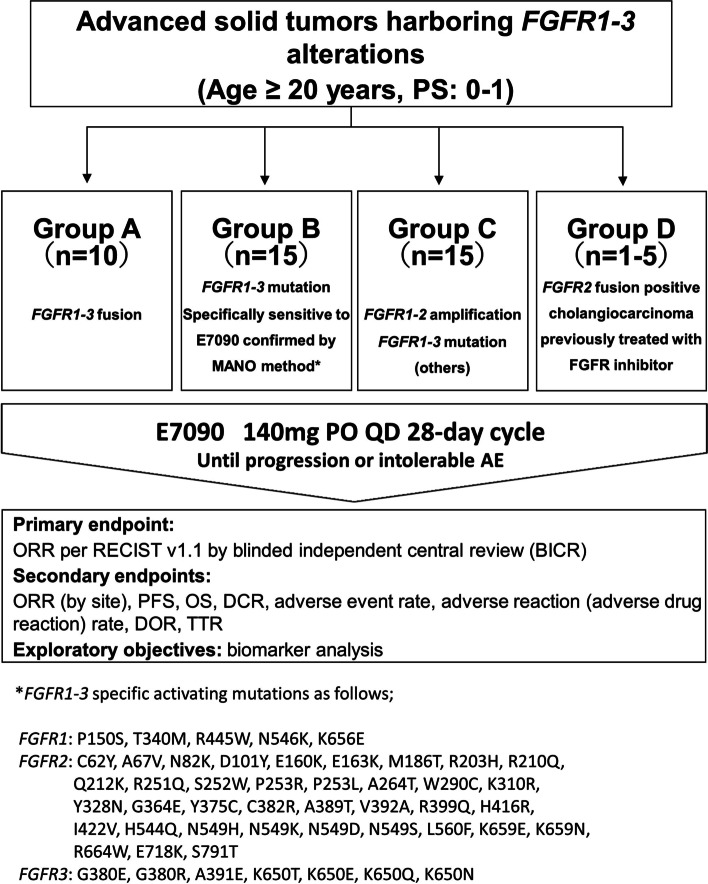
METHODS/DESIGN: This single-arm Phase 2 trial was designed to evaluate the safety and efficacy of E7090 in patients with advanced or recurrent solid tumors harboring FGFR alterations. Three cohorts were set based on the type of FGFR alterations and the results of MANO method. A maximum of 45 patients will be enrolled from 5 institutions over 2.5 years. E7090 will be administered once daily as an oral single agent in 28-day cycles. The primary endpoint is the objective overall response rate; whereas, the secondary endpoints include progression-free survival, overall survival, disease control rate, safety, duration of response, and time to response. Ethics approval was granted by the National Cancer Center Hospital Certified Review Board. Patient enrollment began in June 2021.
A unique investigator-initiated multicenter Phase 2 trial was designed based on the results of preclinical investigation aiming to acquire the approval of E7090 for solid tumors harboring FGFR gene alterations. The findings may serve as a novel model for the development of tumor-agnostic molecular targeted therapies against rare genetic abnormalities.
Japan Registry of Clinical Trial: jRCT2031210043 (registered April 20, 2021) ClinicalTrials.gov: NCT04962867 (registered July 15, 2021).
异常的成纤维细胞生长因子受体(FGFR)信号可以显著影响致癌性。尽管 FGFR 基因异常通常通过癌症基因组分析测试检测到,但目前还没有针对这些异常的肿瘤非特异性批准。E7090(tasurgratinib)是一种口服的 FGFR1-3 选择性酪氨酸激酶抑制剂。基于高通量功能评估方法,即混合提名突变(MANO)方法,先前报道特定的 FGFR 改变对 E7090 高度敏感,该方法缩小了最有希望的靶标范围。该试验专注于 MANO 方法鉴定的改变,并在日本罕见癌症全国性大型登记网络(MASTER KEY 项目)下进行。
方法/设计:这项单臂 2 期试验旨在评估 E7090 治疗携带 FGFR 改变的晚期或复发性实体瘤患者的安全性和疗效。根据 FGFR 改变的类型和 MANO 方法的结果,设立了三个队列。在 2.5 年内,将从 5 个机构招募最多 45 名患者。E7090 将作为口服单药每日一次给药,每 28 天一个周期。主要终点是客观总缓解率;次要终点包括无进展生存期、总生存期、疾病控制率、安全性、缓解持续时间、缓解时间。国家癌症中心医院认证审查委员会批准了伦理。患者入组于 2021 年 6 月开始。
根据旨在获得 E7090 对携带 FGFR 基因改变的实体瘤的批准的临床前研究结果,设计了一项独特的研究者发起的多中心 2 期试验。研究结果可能为针对罕见遗传异常的肿瘤非特异性分子靶向治疗的开发提供一种新的模式。
日本临床试验注册:jRCT2031210043(2021 年 4 月 20 日注册);ClinicalTrials.gov:NCT04962867(2021 年 7 月 15 日注册)。