Division of Digestive and Liver DiseasesUniversity of Texas Southwestern Medical CenterDallasTexasUSA.
University of Utah School of Medicine and Huntsman Cancer InstituteSalt Lake CityUtahUSA.
Hepatol Commun. 2022 Oct;6(10):2925-2936. doi: 10.1002/hep4.2045. Epub 2022 Aug 9.
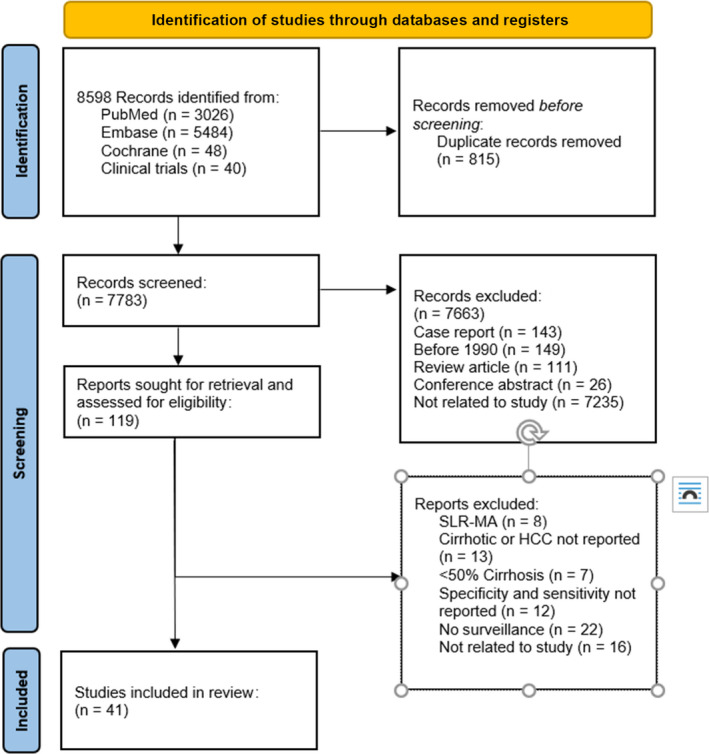
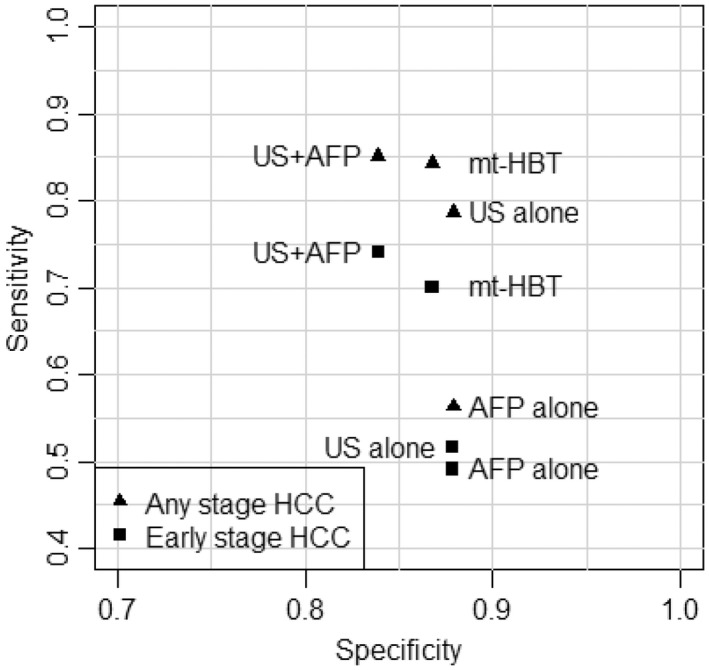
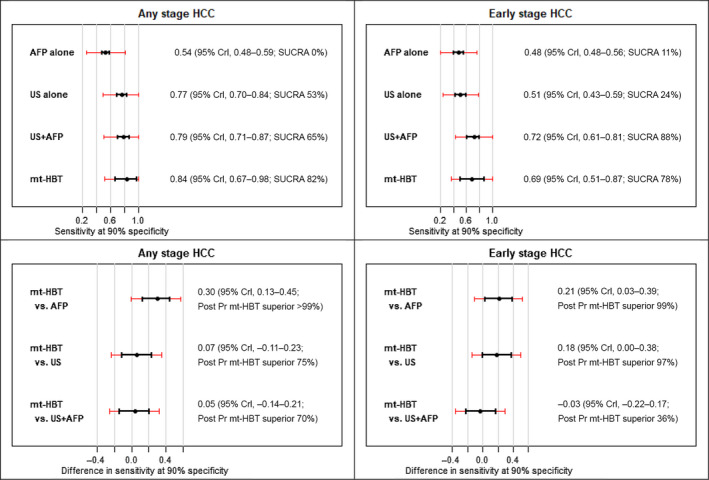
Ultrasound-based surveillance has suboptimal sensitivity for early detection of hepatocellular carcinoma (HCC) in patients with cirrhosis. There are several emerging alternatives, including a novel multitarget HCC blood test (Mt-HBT). We compared performance of mt-HBT against ultrasound with or without alpha-fetoprotein (AFP) for early HCC detection in patients with cirrhosis. Per the Preferred Reporting Items for Systematic Reviews and Meta-Analysis (PRISMA) guidelines, two reviewers searched PubMed, Cochrane, Embase, and clinicaltrials.gov databases from January 1990 through December 2020 to identify studies reporting sensitivity and/or specificity of ultrasound and AFP for overall and early stage HCC detection in patients with cirrhosis. Mt-HBT diagnostic performance was derived from a clinical validation study. A network meta-analysis model was built for comparative assessment, and pooled estimates of sensitivity at a fixed specificity were estimated based on Bayesian binormal receiver operating characteristic models for each modality. Forty-one studies (comprising 62,517 patients with cirrhosis) met inclusion criteria. Ultrasound-alone sensitivity was 51.6% (95% credible interval [CrI], 43.3%-60.5%) for early stage HCC detection, which increased with the addition of AFP to 74.1% (95% CrI, 62.6%-82.4%); however, this was offset by decreased specificity (87.9% vs. 83.9%, respectively). With specificity fixed at 90%, mt-HBT sensitivity for early stage HCC detection was higher than ultrasound alone (18.2%; 95% CrI, 0.2%-37.7%) and similar to ultrasound with AFP (-3.3%; 95% CrI, -22.3%-17.4%). Pairwise posterior probabilities suggested a preference for mt-HBT over ultrasound alone in 97.4% of cases but only 36.3% of cases versus ultrasound with AFP. Conclusion: A blood-based mt-HBT has higher sensitivity than ultrasound alone for early stage HCC detection but similar sensitivity compared to ultrasound and AFP. Mt-HBT could be a comparable alternative to existing methods for HCC surveillance in patients who are at risk.
基于超声的监测对于肝硬化患者早期肝癌(HCC)的检测灵敏度较低。目前有几种新兴的替代方法,包括一种新型的多靶点 HCC 血液检测(Mt-HBT)。我们比较了 Mt-HBT 与超声联合或不联合甲胎蛋白(AFP)在肝硬化患者早期 HCC 检测中的性能。根据系统评价和荟萃分析的首选报告项目(PRISMA)指南,两位审查员搜索了 PubMed、Cochrane、Embase 和 clinicaltrials.gov 数据库,以确定从 1990 年 1 月至 2020 年 12 月期间报告超声和 AFP 用于肝硬化患者整体和早期 HCC 检测的灵敏度和/或特异性的研究。Mt-HBT 的诊断性能来自一项临床验证研究。建立了一个网络荟萃分析模型进行比较评估,并根据贝叶斯二项正态接收者操作特征模型为每种模式估计了固定特异性下的灵敏度汇总估计值。41 项研究(包括 62517 例肝硬化患者)符合纳入标准。单独使用超声检测早期 HCC 的灵敏度为 51.6%(95%可信区间[CrI],43.3%-60.5%),加入 AFP 后增加至 74.1%(95% CrI,62.6%-82.4%);然而,特异性降低(分别为 87.9%和 83.9%)抵消了这一优势。当特异性固定在 90%时,Mt-HBT 检测早期 HCC 的灵敏度高于单独使用超声(18.2%;95% CrI,0.2%-37.7%),与使用 AFP 联合超声相似(-3.3%;95% CrI,-22.3%-17.4%)。后验概率提示,在 97.4%的情况下,与单独使用超声相比,更倾向于使用 Mt-HBT,而与使用 AFP 联合超声相比,仅为 36.3%。结论:一种基于血液的 Mt-HBT 对于早期 HCC 检测的灵敏度高于单独使用超声,但与超声联合 AFP 的灵敏度相似。Mt-HBT 可能是一种与现有 HCC 监测方法相当的替代方法,适用于高危患者。