Mao Yifeng, Yang Gaowei, Li Yingbang, Liang Guowu, Xu Wangwang, Hu Mingqiu
Department of Urology, The Second Affiliated Hospital of Bengbu Medical College, Bengbu 233041, China.
Anhui Province Key Laboratory of Translational Cancer Research, Bengbu Medical University, Bengbu 233030, China.
Cancers (Basel). 2022 Jul 31;14(15):3744. doi: 10.3390/cancers14153744.
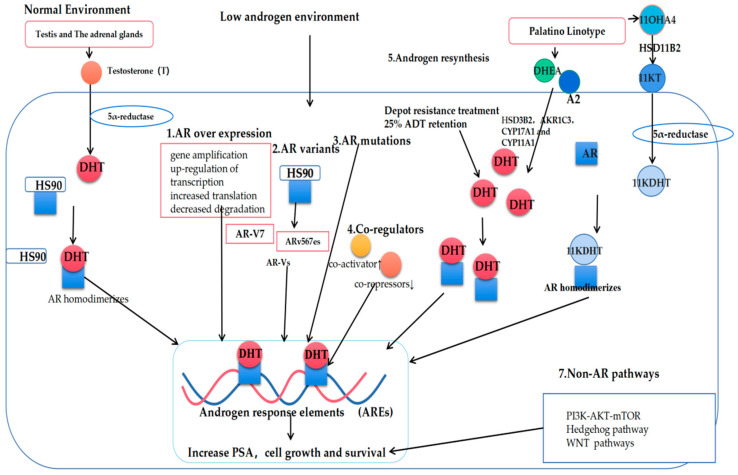
Despite aggressive treatment and androgen-deprivation therapy, most prostate cancer patients ultimately develop castration-resistant prostate cancer (CRPC), which is associated with high mortality rates. However, the mechanisms governing the development of CRPC are poorly understood, and androgen receptor (AR) signaling has been shown to be important in CRPC through AR gene mutations, gene overexpression, co-regulatory factors, AR shear variants, and androgen resynthesis. A growing number of non-AR pathways have also been shown to influence the CRPC progression, including the Wnt and Hh pathways. Moreover, non-coding RNAs have been identified as important regulators of the CRPC pathogenesis. The present review provides an overview of the relevant literature pertaining to the mechanisms governing the molecular acquisition of castration resistance in prostate cancer, providing a foundation for future, targeted therapeutic efforts.
尽管进行了积极治疗和雄激素剥夺治疗,但大多数前列腺癌患者最终都会发展为去势抵抗性前列腺癌(CRPC),这与高死亡率相关。然而,CRPC发生发展的机制尚不清楚,并且雄激素受体(AR)信号通路已被证明在CRPC中通过AR基因突变、基因过表达、共调节因子、AR剪切变体和雄激素再合成发挥重要作用。越来越多的非AR信号通路也被证明会影响CRPC的进展,包括Wnt和Hh信号通路。此外,非编码RNA已被确定为CRPC发病机制的重要调节因子。本综述概述了有关前列腺癌去势抵抗分子机制的相关文献,为未来的靶向治疗研究奠定了基础。