Renzulli Matteo, Pecorelli Anna, Brandi Nicolò, Brocchi Stefano, Tovoli Francesco, Granito Alessandro, Carrafiello Gianpaolo, Ierardi Anna Maria, Golfieri Rita
Department of Radiology, IRCCS Azienda Ospedaliero-Universitaria di Bologna, Via Albertoni 15, 40138 Bologna, Italy.
Division of Internal Medicine, IRCCS Azienda Ospedaliero-Universitaria di Bologna, 40138 Bologna, Italy.
J Clin Med. 2022 Jul 28;11(15):4399. doi: 10.3390/jcm11154399.
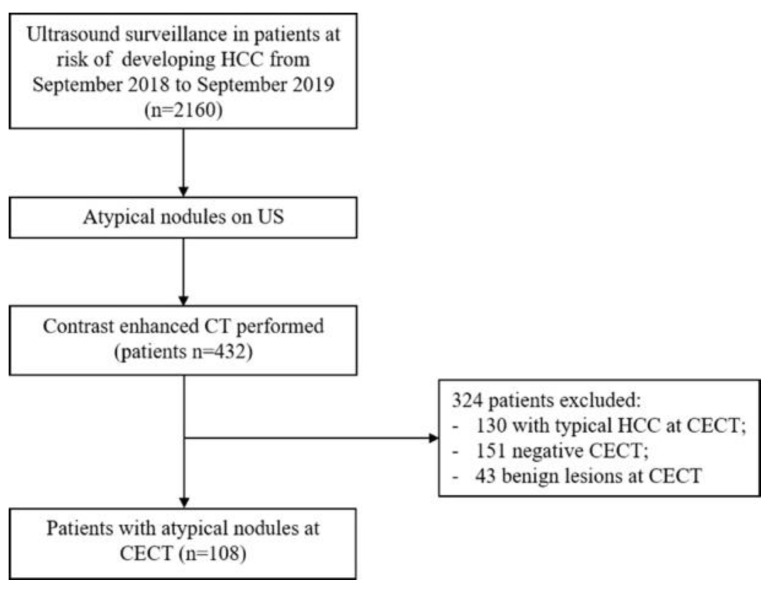
: The aim of the present study is to determine the feasibility of biopsy for atypical liver nodules in patients under surveillance for hepatocellular carcinoma (HCC), assessing which factors influence the decision to perform it. : A total of 128 atypical liver nodules in 108 patients under surveillance for HCC, who underwent CT between September 2018 and September 2019, were included. All the images were saved digitally (on CD-ROM) and the two most representative images in the arterial and delayed phases were selected for each lesion and inserted into a digital atlas (on PDF). Two experienced radiologists (Readers 1 and 2) reviewed both the CD-ROM and the PDF to define the feasibility of biopsy in both scenarios, specifying the reasons for the unfeasibility of biopsy. The intra-observer variability and inter-observer variability were assessed. : When reviewing the PDF, 76 (59.4%) and 68 (53.1%) nodules were deemed unfeasible for biopsy by the less experienced radiologist (Reader 1) and the more experienced radiologist (Reader 2), respectively ( = 0.604). When reviewing the entire CT study, both percentages decreased slightly (Reader 1 = 70/128 (54.7%); Reader 2 = 61/128 (47.6%); = 0.591). The intra-reader agreement on the PDF was substantial (k = 0.648 (95% CI = 0.513-0.783)). The inter-reader agreement on the PDF was slight (k = 0.185 (95% CI = 0.021-0.348)) and moderate on the entire CT study (k = 0.424 (95% CI = 0.269-0.579)). When assessing the PDF, the nodule size (10-20 mm) and location in segments six and eight were negatively and positively associated with the feasibility of liver biopsy, respectively. When assessing the CD-ROM, only the nodule dimension was associated with the unfeasibility of liver biopsy. : The unfeasibility of liver biopsy is mainly due to the small size of the lesions and their location.
本研究的目的是确定在肝细胞癌(HCC)监测患者中对非典型肝结节进行活检的可行性,并评估哪些因素会影响活检决策。
纳入了2018年9月至2019年9月期间接受CT检查的108例HCC监测患者中的128个非典型肝结节。所有图像均以数字方式保存(存储在光盘上),并为每个病变选择动脉期和延迟期最具代表性的两张图像,插入数字图谱(以PDF格式)。两位经验丰富的放射科医生(读者1和读者2)审查了光盘和PDF,以确定在两种情况下活检的可行性,并指明活检不可行的原因。评估了观察者内变异性和观察者间变异性。
在审查PDF时,经验较少的放射科医生(读者1)和经验较丰富的放射科医生(读者2)分别认为76个(59.4%)和68个(53.1%)结节不可行活检(P = 0.604)。在审查整个CT研究时,两个百分比均略有下降(读者1 = 70/128(54.7%);读者2 = 61/128(47.6%);P = 0.591)。读者对PDF的内部一致性较高(κ = 0.648(95%CI = 0.513 - 0.783))。读者对PDF的观察者间一致性较弱(κ = 0.185(95%CI = 0.021 - 0.348)),对整个CT研究的一致性为中等(κ = 0.424(95%CI = 0.269 - 0.579))。在评估PDF时,结节大小(10 - 20毫米)以及位于第六和第八段与肝活检的可行性分别呈负相关和正相关。在评估光盘时,只有结节大小与肝活检的不可行性相关。
肝活检不可行主要是由于病变体积小及其位置。