Zhou Xian, Chen Xia, Han Wei, Han Yi, Guo Mengxin, Peng Ziling, Fan Zeyu, Shi Yan, Wan Sha
Changjiang River Scientific Research Institute, Research Center of Water Engineering Safety and Disaster Prevention of Ministry of Water Resources, Wuhan 430010, China.
College of Resources and Environment, Anqing Normal University, Anqing 246011, China.
Nanomaterials (Basel). 2022 Jul 28;12(15):2595. doi: 10.3390/nano12152595.
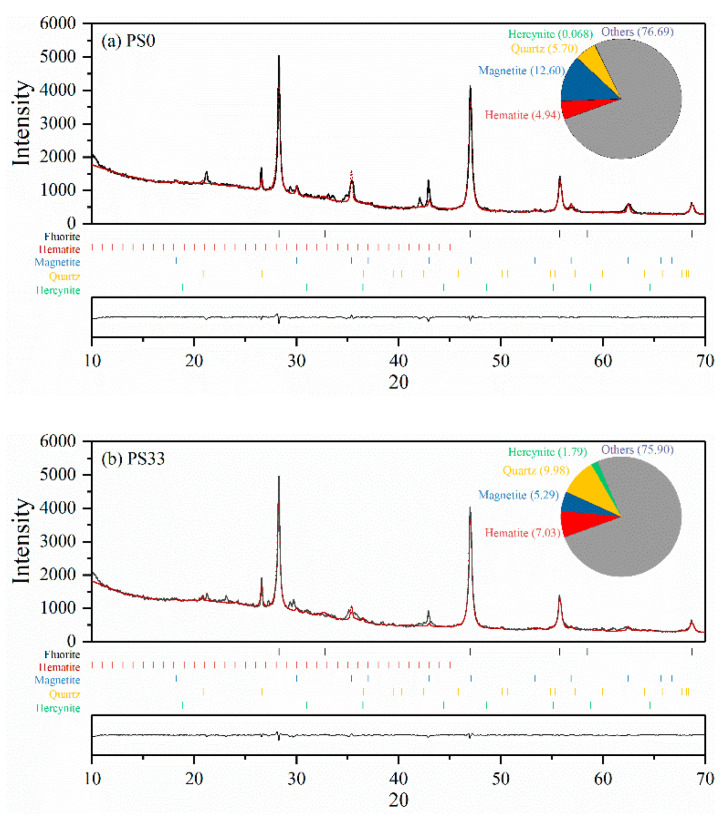
The sludge-derived biochar is considered an effective emerging contaminants adsorbent for wastewater treatment. In this paper, red mud and steel slag (RMSS) was used for improving sludge dewaterability and enhancing the sludge-derived biochar adsorption capacity. X-ray diffraction (XRD), Fourier transform infrared spectroscopy (FTIR), and a scanning electron microscope (SEM) were employed to comprehensively characterize the mineral composition, functional group, and morphology of the adsorbent. RMSS was able to improve the sludge dewatering performance by providing a skeleton structure to promote drainage and Fe(III) to decrease the Zeta potential. The dosage of 20 mg/g RMSS was able to reduce the specific resistance to filtration (SRF) and the Zeta potential of sludge from 1.57 × 10 m/kg and -19.56 mV to 0.79 × 10 m/kg and -9.10 mV, respectively. The co-pyrolysis of RMSS and sludge (2:8) induced the formation of biochar containing FeAlO (PS80). The PS80 exhibited a large surface area (46.40 m/g) and high tetracycline (TC) removal capacity (98.87 mg/g) when combined with HO (PS80-HO). The adsorption process of TC onto PS80 and PS80-HO was well described by the pseudo-first-order and pseudo-second-order kinetic model, indicating physisorption and chemisorption behavior. The results indicated that co-pyrolysis of RMSS sludge PS80-HO could enhance the biochar adsorption capacity of TC, attributable to the degradation by ·OH generated by the heterogeneous Fenton reaction of FeAlO and HO, the release of adsorbed sites, and the improvement of the biochar pore structure. This study proposed a novel method for the use of RMSS to dewater sludge as well as to induce the formation of FeAlO in biochar with effective TC removal by providing a Fe and Al source, achieving a waste-to-resource strategy for the integrated management of industrial solid waste and sewage sludge.
污泥衍生生物炭被认为是一种用于废水处理的有效的新兴污染物吸附剂。本文采用赤泥和钢渣(RMSS)来提高污泥脱水性能并增强污泥衍生生物炭的吸附能力。利用X射线衍射(XRD)、傅里叶变换红外光谱(FTIR)和扫描电子显微镜(SEM)对吸附剂的矿物组成、官能团和形态进行了全面表征。RMSS能够通过提供促进排水的骨架结构和降低Zeta电位的Fe(III)来改善污泥脱水性能。20 mg/g RMSS的投加量能够将污泥的比过滤阻力(SRF)和Zeta电位分别从1.57×10 m/kg和 -19.56 mV降低至0.79×10 m/kg和 -9.10 mV。RMSS与污泥(2:8)的共热解诱导形成了含FeAlO的生物炭(PS80)。当与HO(PS80-HO)结合时,PS80表现出较大的比表面积(46.40 m/g)和较高的四环素(TC)去除能力(98.87 mg/g)。TC在PS80和PS80-HO上的吸附过程可以用准一级和准二级动力学模型很好地描述,表明存在物理吸附和化学吸附行为。结果表明,RMSS污泥PS80-HO的共热解能够提高生物炭对TC的吸附能力,这归因于FeAlO与HO的非均相芬顿反应产生的·OH的降解作用、吸附位点的释放以及生物炭孔隙结构的改善。本研究提出了一种利用RMSS对污泥进行脱水以及通过提供铁和铝源诱导生物炭中形成FeAlO从而有效去除TC的新方法,实现了工业固体废物和污水污泥综合管理的变废为宝策略。