Department of Computer Science, Princess Sumaya University for Technology, Amman 11941, Jordan.
Sensors (Basel). 2022 Aug 2;22(15):5765. doi: 10.3390/s22155765.
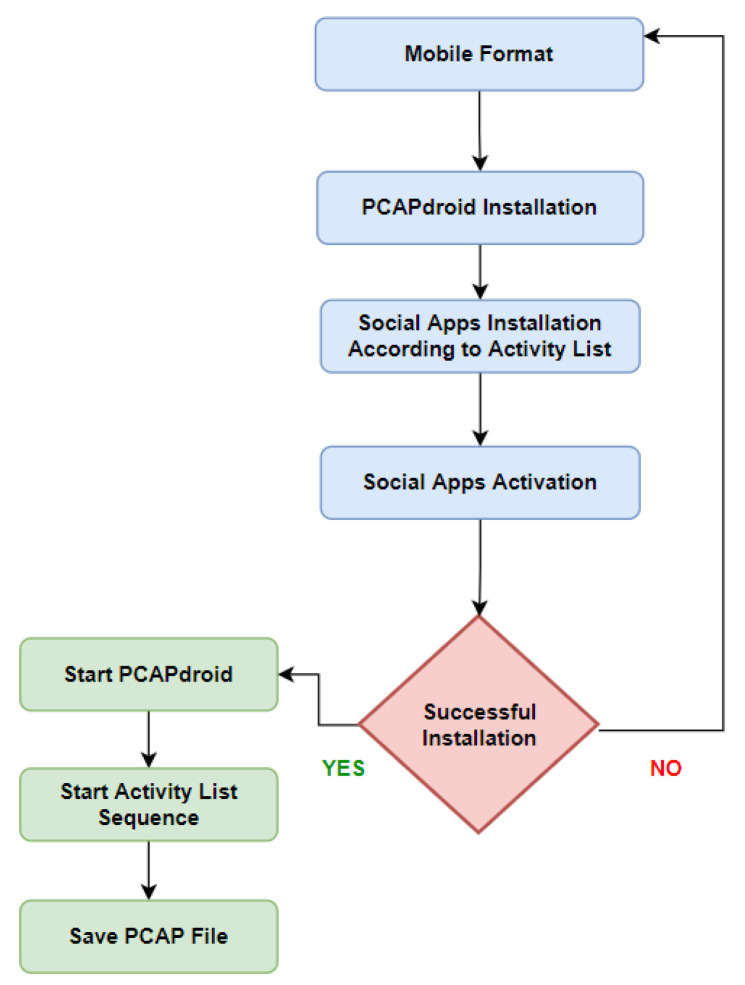
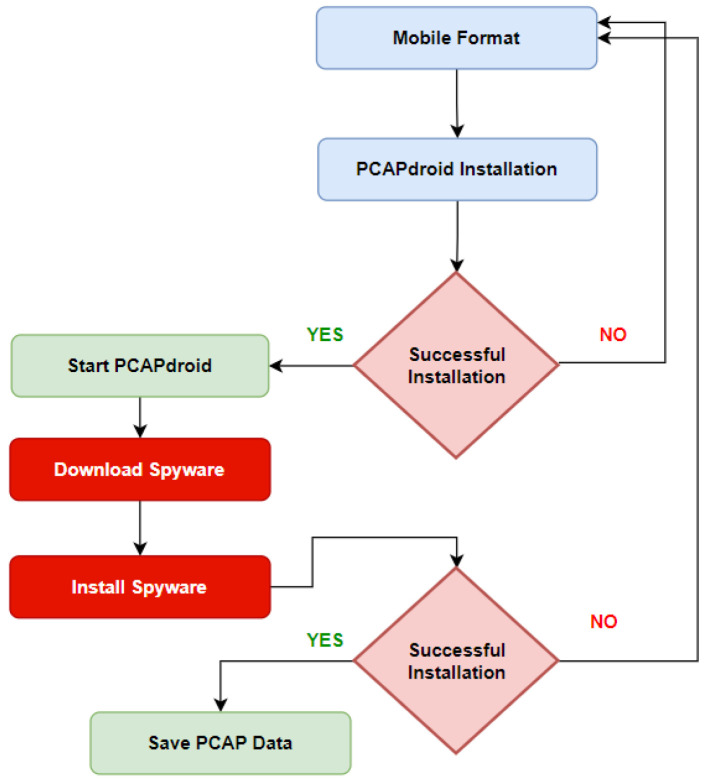
Smartphones are an essential part of all aspects of our lives. Socially, politically, and commercially, there is almost complete reliance on smartphones as a communication tool, a source of information, and for entertainment. Rapid developments in the world of information and cyber security have necessitated close attention to the privacy and protection of smartphone data. Spyware detection systems have recently been developed as a promising and encouraging solution for smartphone users' privacy protection. The Android operating system is the most widely used worldwide, making it a significant target for many parties interested in targeting smartphone users' privacy. This paper introduces a novel dataset collected in a realistic environment, obtained through a novel data collection methodology based on a unified activity list. The data are divided into three main classes: the first class represents normal smartphone traffic; the second class represents traffic data for the spyware installation process; finally, the third class represents spyware operation traffic data. The random forest classification algorithm was adopted to validate this dataset and the proposed model. Two methodologies were adopted for data classification: binary-class and multi-class classification. Good results were achieved in terms of accuracy. The overall average accuracy was 79% for the binary-class classification, and 77% for the multi-class classification. In the multi-class approach, the detection accuracy for spyware systems (UMobix, TheWiSPY, MobileSPY, FlexiSPY, and mSPY) was 90%, 83.7%, 69.3%, 69.2%, and 73.4%, respectively; in binary-class classification, the detection accuracy for spyware systems (UMobix, TheWiSPY, MobileSPY, FlexiSPY, and mSPY) was 93.9%, 85.63%, 71%, 72.3%, and 75.96%; respectively.
智能手机是我们生活方方面面不可或缺的一部分。在社交、政治和商业领域,智能手机几乎完全被用作通信工具、信息来源和娱乐工具。信息和网络安全领域的快速发展,需要密切关注智能手机数据的隐私和保护。最近,作为保护智能手机用户隐私的有希望和令人鼓舞的解决方案,已经开发出了间谍软件检测系统。安卓操作系统是全球使用最广泛的操作系统,因此成为许多对瞄准智能手机用户隐私感兴趣的各方的重要目标。本文介绍了一个在真实环境中收集的新型数据集,该数据集是通过一种基于统一活动列表的新型数据收集方法获得的。这些数据分为三类:第一类表示正常智能手机流量;第二类表示间谍软件安装过程中的流量数据;最后,第三类表示间谍软件操作流量数据。采用随机森林分类算法对该数据集和提出的模型进行验证。采用了两种数据分类方法:二进制分类和多类分类。在准确性方面取得了良好的结果。对于二进制分类,整体平均准确率为 79%,对于多类分类,整体平均准确率为 77%。在多类方法中,对 UMobix、TheWiSPY、MobileSPY、FlexiSPY 和 mSPY 等间谍软件系统的检测准确率分别为 90%、83.7%、69.3%、69.2%和 73.4%;在二进制分类中,对 UMobix、TheWiSPY、MobileSPY、FlexiSPY 和 mSPY 等间谍软件系统的检测准确率分别为 93.9%、85.63%、71%、72.3%和 75.96%。