Wu Ming, Lin Lufei, Wu Yuebiao, Zheng Yu, Chen Haidan
Department of Pediatrics, The Fourth People's Hospital of Haikou, Haikou, China.
Department of Pediatrics, Sanya Central Hospital (Hainan Third People's Hospital), Sanya, China.
Transl Pediatr. 2022 Jul;11(7):1251-1260. doi: 10.21037/tp-22-289.
Post-traumatic stress disorder (PTSD) is a trauma-related psychological disorder with serious social and familial impacts. The involvement of 5-hydroxytryptamine transporter gene-linked polymorphic region () in numerous mental disorders has been documented. This study explored the correlation between gene polymorphism and cognitive function in Chinese Han children with PTSD.
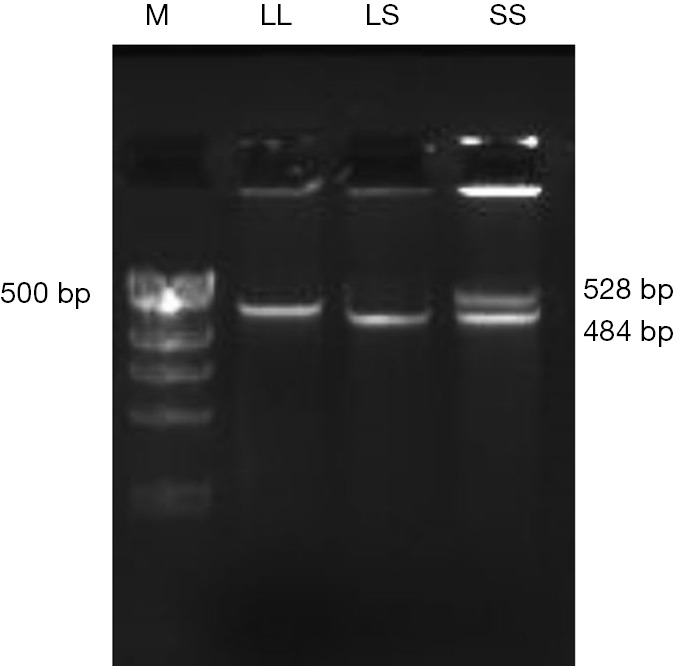
A total of 60 PTSD children treated from December 2019 to December 2021 were selected as study participants, with another 60 healthy children selected as controls. We assessed the cognitive function of participants using the Mini-Mental State Examination (MMSE). Additionally, the PTSD level was estimated by the Children's Revised Impact of Event Scale (CRIES). The gene polymorphism was detected by reverse transcription quantitative polymerase chain reaction (RT-qPCR). The genotype and allele frequency were evaluated via case-control association analysis.
Children in the PTSD group showed low MMSE scores and high CRIES scores. In terms of genotype, cases of LL, LS, and SS in PTSD children were 4 (6.67%), 20 (33.3%), and 36 (60.00%), and 18 (30.00%), 28 (46.67%), and 14 (23.33%) cases in healthy controls. In terms of allele gene frequency, incidences of L and S were 23.33% and 76.67% in PTSD children, respectively, and were 53.33% and 46.67% in healthy controls, respectively. Moreover, the CRIES and MMSE scores of LS and SS genotypes were evidently different from those of LL genotype in PTSD children.
Polymorphism of the gene is correlated with cognitive dysfunction in Chinese Han children with PTSD.
创伤后应激障碍(PTSD)是一种与创伤相关的心理障碍,具有严重的社会和家庭影响。5-羟色胺转运体基因连锁多态性区域()参与众多精神障碍已被记录。本研究探讨了中国汉族PTSD儿童基因多态性与认知功能之间的相关性。
选取2019年12月至2021年12月期间接受治疗的60例PTSD儿童作为研究对象,另选60例健康儿童作为对照。我们使用简易精神状态检查表(MMSE)评估研究对象的认知功能。此外,通过儿童事件影响量表修订版(CRIES)评估PTSD水平。通过逆转录定量聚合酶链反应(RT-qPCR)检测基因多态性。通过病例对照关联分析评估基因型和等位基因频率。
PTSD组儿童MMSE评分低,CRIES评分高。在基因型方面,PTSD儿童中LL、LS和SS病例分别为4例(6.67%)、20例(33.3%)和36例(60.00%),健康对照中分别为18例(30.00%)、28例(46.67%)和14例(23.33%)。在等位基因频率方面,PTSD儿童中L和S的发生率分别为23.33%和76.67%,健康对照中分别为53.33%和46.67%。此外,PTSD儿童中LS和SS基因型的CRIES和MMSE评分与LL基因型明显不同。
基因多态性与中国汉族PTSD儿童的认知功能障碍相关。