Feng Yi, Wang Runchen, Li Caichen, Cai Xiuyu, Huo Zhenyu, Liu Ziyu, Ge Fan, Huang Chuiguo, Lu Yi, Zhong Ran, Li Jianfu, Cheng Bo, Liang Hengrui, Xiong Shan, Mao Xingyu, Chen Yilin, Lan Ruying, Wen Yaokai, Peng Haoxin, Jiang Yu, Su Zixuan, Wu Xiangrong, He Jianxing, Liang Wenhua
Department of Thoracic Surgery and Oncology, China State Key Laboratory of Respiratory Disease & National Clinical Research Center for Respiratory Disease, the First Affiliated Hospital of Guangzhou Medical University, Guangzhou, China.
Guangzhou Institute of Respiratory Health, Guangzhou, China.
Transl Lung Cancer Res. 2022 Jul;11(7):1302-1314. doi: 10.21037/tlcr-22-34.
Previous studies have shown that metabolites play important roles in phenotypic regulation, but the causal link between metabolites and tumors has not been examined adequately. Herein, we investigate the causality between metabolites and various cancers through a Mendelian randomization (MR) study.
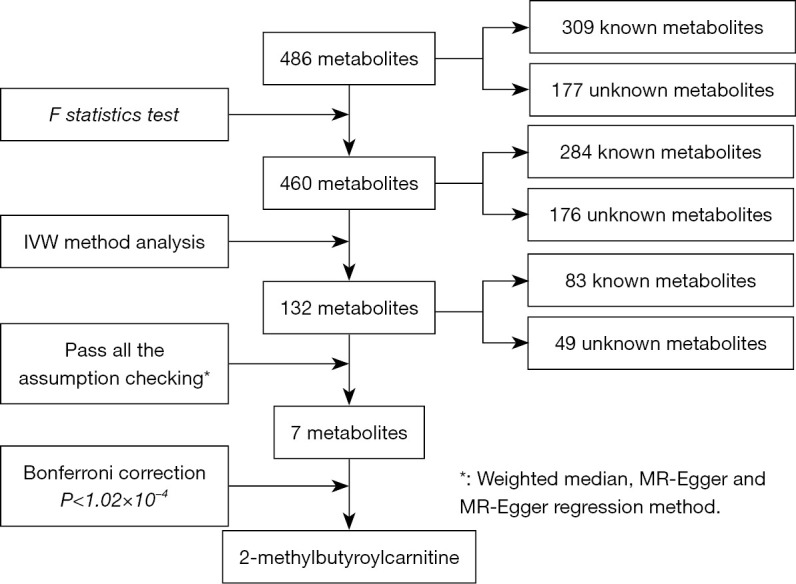
We carried out a two-sample MR analysis based on genetic instrumental variables as proxies for 486 selected human serum metabolites to evaluate the causal effects of genetically determined metabotypes (GDMs) on cancers. Summary data from various cancer types obtained from large consortia. Inverse variance weighted (IVW), MR-Egger and weighted-median methods were implemented to infer the causal effects, moreover, we particularly explored the presentence of horizontal pleiotropy through MR-Egger regression and MR-PRESSO Global test. Metabolic pathways analysis and subgroup analyses were further explored using available data. Statistical analyses were all performed in R.
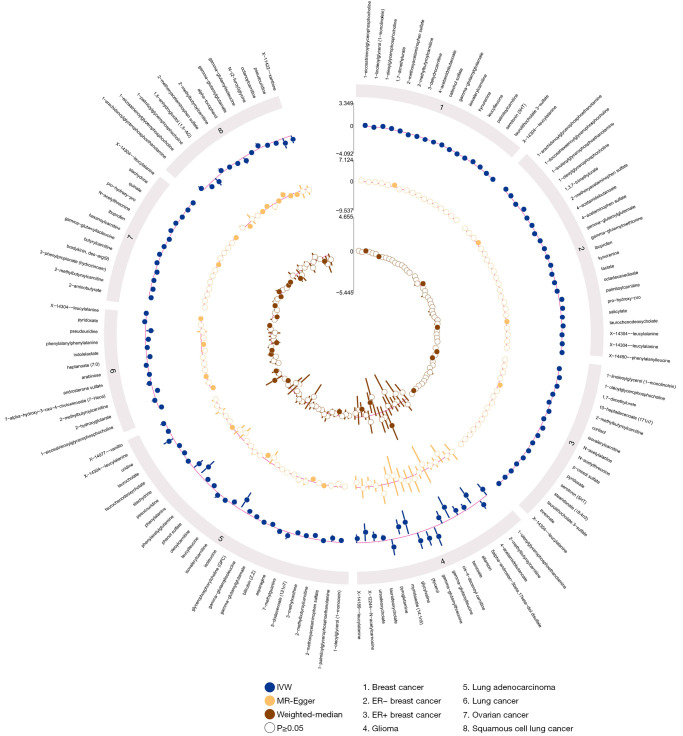
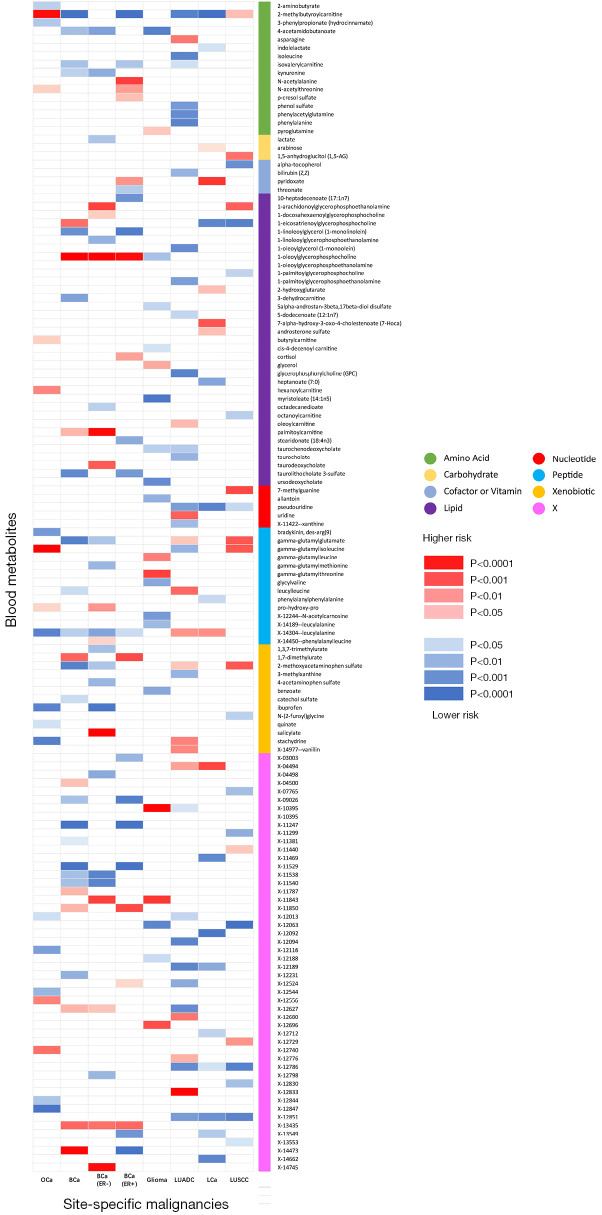
In MR analysis, 202 significant causative relationship features were identified. 7-alpha-hydroxy-3-oxo-4-cholestenoate (OR =1.45; 95% CI: 1.06-1.97; P =0.018), gamma-glutamylisoleucine (OR =1.40; 95% CI: 1.16-1.69; P =0.0004), 1-oleoylglycerophosphocholine (OR =1.22; 95% CI: 1.1-1.35; P =0.0001), gamma-glutamylleucine (OR =4.74; 95% CI: 1.18-18.93; P =0.027) were the most dangerous metabolites for lung cancer, ovarian cancer, breast cancer, and glioma, respectively; while pseudouridine (OR =0.50; 95% CI: 0.30-0.83; P =0.007), 2-methylbutyroylcarnitine (OR =0.77; 95% CI: 0.68-0.86; P =2.9×10), 2-methylbutyroylcarnitine (OR =0.77; 95% CI: 0.70-0.85; P =3.4×10), glycylvaline (OR =0.13; 95% CI: 0.02-0.75; P =0.021) were associated with lower risk of lung cancer, ovarian cancer, breast cancer, and glioma, respectively. Interestingly, 2-methylbutyroylcarnitine was also associated with decreased risk of lung cancer (OR =0.59; 0.50-0.70; =1.98×10) expect ovarian cancer and breast cancer. In subgroup analysis, 2-methylbutyroylcarnitine was associated with decreased risk of estrogen receptor (ER) positive breast cancer (OR =0.72; 0.64-0.80; P =3.55×10), lung adenocarcinoma (LAC) (OR =0.60; 0.48-0.70; P =1.14×10). Metabolic pathways analysis identified 4 significant pathways.
Our study integrated metabolomics and genomics to explore the risk factors involved in the development of cancers. It is worth exploring whether metabolites with causality can be used as biomarkers to distinguish patients at high risk of cancer in clinical practice. More detailed studies are needed to clarify the mechanistic pathways.
既往研究表明,代谢物在表型调控中发挥重要作用,但代谢物与肿瘤之间的因果关系尚未得到充分研究。在此,我们通过孟德尔随机化(MR)研究探讨代谢物与各种癌症之间的因果关系。
我们基于基因工具变量进行了两样本MR分析,以486种选定的人类血清代谢物为代理,评估基因决定的代谢型(GDM)对癌症的因果效应。从大型联盟获得各种癌症类型的汇总数据。采用逆方差加权(IVW)、MR-Egger和加权中位数方法推断因果效应,此外,我们通过MR-Egger回归和MR-PRESSO全局检验特别探讨了水平多效性的存在。利用现有数据进一步进行代谢途径分析和亚组分析。所有统计分析均在R中进行。
在MR分析中,确定了202个显著的因果关系特征。7-α-羟基-3-氧代-4-胆甾烯酸(OR =1.45;95%CI:1.06-1.97;P =0.018)、γ-谷氨酰异亮氨酸(OR =1.40;95%CI:1.16-1.69;P =0.0004)、1-油酰基甘油磷酸胆碱(OR =1.22;95%CI:1.1-1.35;P =0.0001)、γ-谷氨酰亮氨酸(OR =4.74;95%CI:1.18-18.93;P =0.027)分别是肺癌、卵巢癌、乳腺癌和神经胶质瘤最危险的代谢物;而假尿苷(OR =0.50;95%CI:0.30-0.83;P =0.007)、2-甲基丁酰肉碱(OR =0.77;95%CI:0.68-0.86;P =2.9×10)、2-甲基丁酰肉碱(OR =0.77;95%CI:0.70-0.85;P =3.4×10)、甘氨酰缬氨酸(OR =0.13;95%CI:0.02-0.75;P =0.021)分别与肺癌、卵巢癌、乳腺癌和神经胶质瘤的低风险相关。有趣的是,除卵巢癌和乳腺癌外,2-甲基丁酰肉碱也与肺癌风险降低相关(OR =0.59;0.50-0.70;P =1.98×10)。在亚组分析中,2-甲基丁酰肉碱与雌激素受体(ER)阳性乳腺癌风险降低相关(OR =0.72;0.64-0.80;P =3.55×10),与肺腺癌(LAC)风险降低相关(OR =0.60;0.48-0.70;P =1.14×10)。代谢途径分析确定了4条显著途径。
我们的研究整合了代谢组学和基因组学,以探索癌症发生发展中的危险因素。值得探讨具有因果关系的代谢物是否可作为生物标志物,在临床实践中区分癌症高危患者。需要更详细的研究来阐明其机制途径。