Campos Yuri, Lago-Rodríguez Ángel, San Juan Alejandro F, Moreno-Pérez Víctor, Lopez-Samanes Alvaro, Sánchez-Oliver Antonio J, Da Silva Sandro F, Domínguez Raúl
Postgraduate Program of the Faculty of Physical Education and Sports of the University of Juiz de Fora, Brazil.
Study Group and Research in Neuromuscular Responses, University of Lavras, Brazil.
Biol Sport. 2022 Sep;39(3):521-528. doi: 10.5114/biolsport.2022.107479. Epub 2021 Jul 8.
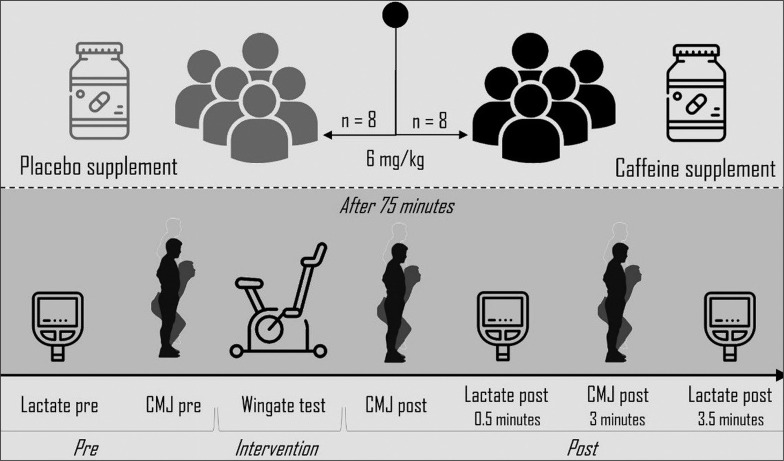
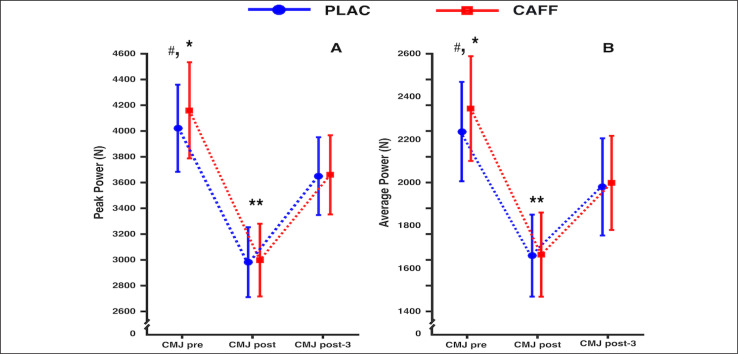
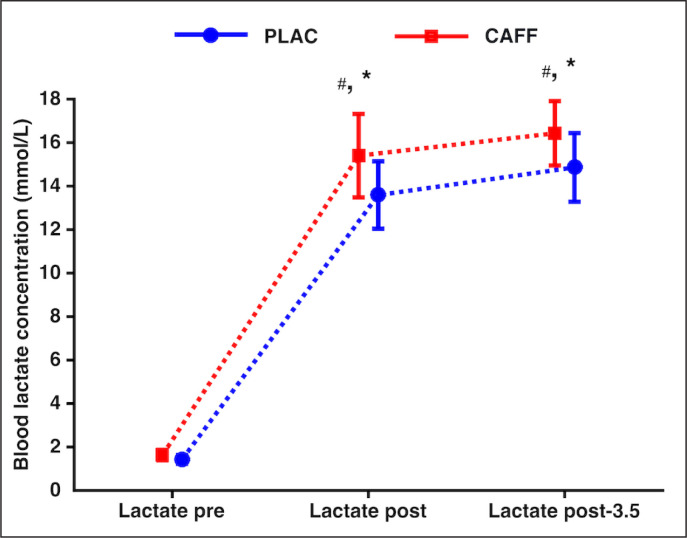
This study examined the effect of caffeine supplementation (CAFF) in a Wingate test (WT), and the behaviour of blood lactate concentrations (BLa) and neuromuscular fatigue (NMF), measured as reduced countermovement jump (CMJ) performance, in response to the WT. In a double-blind crossover study, 16 participants attended the laboratory twice, separated by a 72-hour window. In the sessions, participants first ingested 6 mg·kg of either CAFF or placebo (PLAC), and then performed a WT. BLa was measured before (L-pre), and 0.5 min (L-post-0.5) and 3.5 min (L-post-3.5) after conducting the WT. The CMJ test was conducted before (CMJ pre), after (CMJ post), and 3 min after completing (CMJ post-3) the WT. The results indicated that CAFF enhanced peak power (Wpeak: + 3.22%; = 0.040), time taken to reach Wpeak (T_Wpeak: -18.76%; = 0.001) and mean power (Wmean: + 2.7%; = 0.020). A higher BLa was recorded for CAFF at L-post-0.5 (+ 13.29%; = 0.009) and L-post-3.5 (+ 10.51%; = 0.044) compared to PLAC. CAFF improved peak power (PP; + 3.44%; = 0.003) and mean power (MP; + 4.78%; = 0.006) at CMJ pre, compared to PLAC, whereas PP and MP were significantly diminished at CMJ post and CMJ post-3 compared to pre ( < 0.001 for all comparisons) under both the CAFF and PLAC conditions. PP and MP were increased at post-3 compared to post ( < 0.001 for all comparisons) for both conditions. In conclusion, CAFF increased WT performance and BLa without affecting NMF measured by CMJ. Thus, CAFF may allow athletes to train with higher workloads and enhance the supercompensation effects after an adequate recovery period.
本研究考察了补充咖啡因(CAFF)对温盖特测试(WT)的影响,以及血液乳酸浓度(BLa)和神经肌肉疲劳(NMF,通过反向纵跳(CMJ)表现下降来衡量)对WT的反应。在一项双盲交叉研究中,16名参与者两次前往实验室,中间间隔72小时。在实验环节中,参与者首先摄入6毫克/千克的CAFF或安慰剂(PLAC),然后进行WT。在进行WT之前(L-pre)、之后0.5分钟(L-post-0.5)和3.5分钟(L-post-3.5)测量BLa。在WT之前(CMJ pre)、之后(CMJ post)以及完成WT后3分钟(CMJ post-3)进行CMJ测试。结果表明,CAFF提高了峰值功率(Wpeak:+3.22%;P = 0.040)、达到Wpeak的时间(T_Wpeak:-18.76%;P = 0.001)和平均功率(Wmean:+2.7%;P = 0.020)。与PLAC相比,CAFF在L-post-0.5时的BLa更高(+13.29%;P = 0.009),在L-post-3.5时也更高(+10.51%;P = 0.044)。与PLAC相比,CAFF在CMJ pre时提高了峰值功率(PP;+3.44%;P = 0.003)和平均功率(MP;+4.78%;P = 0.006),而在CAFF和PLAC两种条件下,与pre相比,CMJ post和CMJ post-3时的PP和MP均显著降低(所有比较P<0.001)。两种条件下,与post相比,post-3时的PP和MP均增加(所有比较P<0.001)。总之,CAFF提高了WT表现和BLa,而不影响通过CMJ测量的NMF。因此,CAFF可能使运动员能够进行更高强度的训练,并在适当的恢复期后增强超量恢复效果。