FHI 360, Durham, NC, USA.
Department of Obstetrics and Gynaecology, School of Medicine, College of Health Sciences, Makerere University, Kampala, Uganda.
Hum Reprod. 2022 Sep 30;37(10):2320-2333. doi: 10.1093/humrep/deac179.
Is a mechanical hand-held device for removing a single-rod subdermal contraceptive implant safe for implant users?
In terms of safety, the device is non-inferior to the standard technique for implant removal.
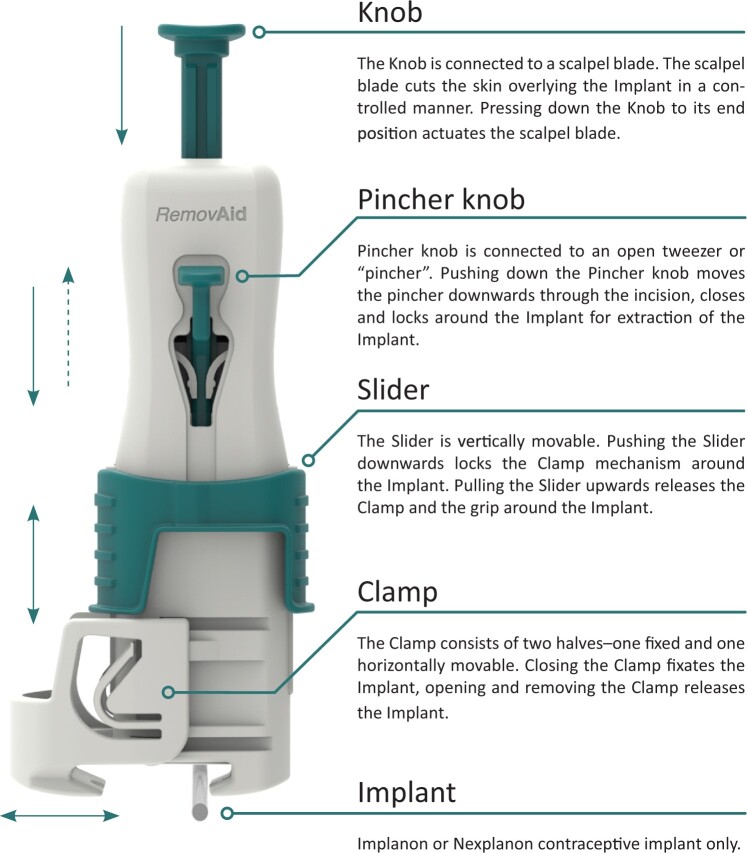
An easy-to-use device for removing a subdermal contraceptive implant may be helpful in settings where skilled providers are in short supply. Prior to this study, the only report on the world's first hand-held, mechanical device with build-in incisor was a Swedish study using earlier versions of the product.
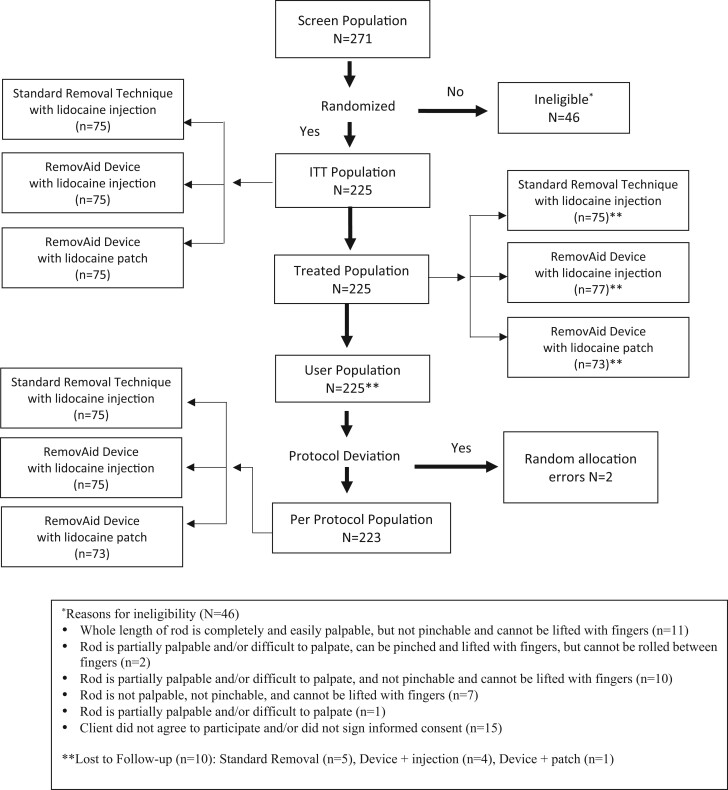
STUDY DESIGN, SIZE, DURATION: From December 2019 to November 2020, we conducted a three-arm, open-label non-inferiority randomized trial involving 225 Ugandan women to assess safety (primary outcome) and measure implant removal efficacy (secondary outcomes) of a newly developed, hand-held device, compared to the standard removal technique.
PARTICIPANTS/MATERIALS, SETTING, METHODS: We randomized participants desiring removal of their one-rod contraceptive implant in a 1:1:1 ratio: standard technique/lidocaine injection, new device/lidocaine patch or new device/lidocaine injection. For primary safety endpoints, we examined removal complications and grouped them according to severity. For secondary endpoints on efficacy, we defined three device outcomes: intact implant removed without additional tools (primary), implant removed allowing implant breakage, but without tools (secondary) and implant removed allowing implant breakage and non-scalpel tools (tertiary). We assessed provider feedback on the device and used chi-square tests for all comparisons.
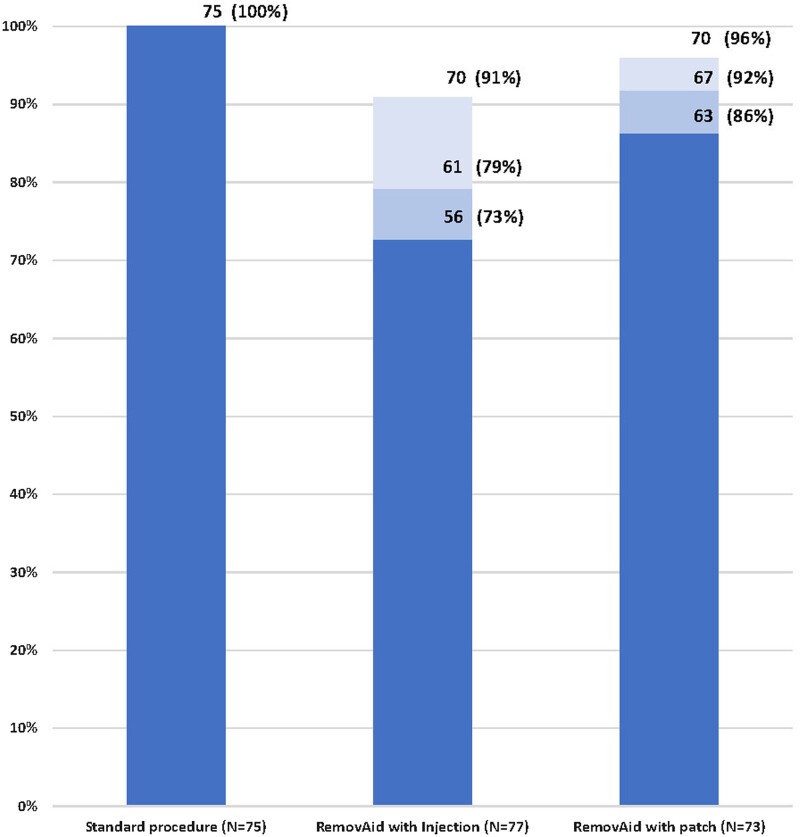
We recruited 225 participants and randomly assigned (n = 75) to each group. For safety, no primary complications occurred in any treatment group, while only one secondary complication occurred in each treatment group (1%). Primary efficacy was 100% (standard technique), 85% (new device/lidocaine patch) and 73% (new device/lidocaine injection) (P < 0.0001). Secondary efficacy was 100% (standard technique), 92% (new device/lidocaine patch) and 79% (new device/lidocaine injection) (P < 0.0001). Tertiary efficacy was 100% (standard technique), 96% (new device/lidocaine patch) and 91% (new device/lidocaine injection) (P = 0.017). Unsuccessful removals with the new device did not hinder subsequent implant extractions with standard back-up tools. In over 90% of the 150 device procedures, providers agreed or strongly agreed that the product is an acceptable alternative to standard removal technique.
LIMITATIONS, REASONS FOR CAUTION: We tested a new removal device in the hands of Ugandan nurses who were adept at standard removal techniques; our estimates of removal efficacy may not apply to lower-level providers who arguably may be the prime beneficiaries of this technology.
The study was conducted in a region of the world where the new device could be used to expand access to implant removal services. Intended beneficiaries of the new product are implant users who cannot easily find skilled providers for traditional scalpel-dependent removals and/or users who are intimidated by scalpel procedures, and lower-level providers who can be trained to help deliver services to meet a growing demand. The new device is a safe, acceptable alternative; efficacy was high, but not on par with standard technique.
STUDY FUNDING/COMPETING INTEREST(S): Funding for this study was provided by the RemovAid AS of Norway with grants from Research Council of Norway (GLOBVAC number 228319), Bill & Melinda Gates Foundation (grant INV-007571) and SkatteFUNN. M.B. is founder and former CEO of RemovAid AS, Norway. M.B. holds contraceptive rod remover patents (2012 1307156.8 and 2015), pre-removal test (filed) and shares in RemovAid AS. All of the remaining authors' institutions received payments in the form of contracts to help conduct the study; the funds for these contracts emanated from RemovAid AS.
NCT04120337.
9 October 2019.
DATE OF FIRST PATIENT’S ENROLMENT: 23 December 2019.
一种用于移除单根皮下埋植避孕装置的手动机械装置对于埋植避孕装置使用者来说是否安全?
就安全性而言,该装置不劣于植入物取出的标准技术。
在熟练提供者短缺的情况下,一种易于使用的皮下避孕植入物取出装置可能会有所帮助。在这项研究之前,世界上第一个带有内置门牙的手持式机械装置的唯一报告是瑞典的一项使用早期版本产品的研究。
研究设计、大小和持续时间:从 2019 年 12 月至 2020 年 11 月,我们进行了一项三臂、开放性、非劣效性随机试验,涉及 225 名乌干达妇女,以评估新开发的手持式设备的安全性(主要结局)和测量植入物取出效果(次要结局)与标准去除技术相比。
参与者/材料、设置、方法:我们按照 1:1:1 的比例将希望取出单根避孕植入物的参与者随机分组:标准技术/利多卡因注射、新装置/利多卡因贴剂或新装置/利多卡因注射。对于主要安全性终点,我们检查了移除并发症,并根据严重程度进行了分组。对于效果的次要终点,我们定义了三种设备结果:无需额外工具即可完整移除的植入物(主要)、植入物可移除但允许植入物断裂而无需工具(次要)和植入物可移除且允许使用非手术刀工具(次要)。我们评估了提供者对该设备的反馈,并对所有比较使用了卡方检验。
我们招募了 225 名参与者,并将(n=75)随机分配到每个组。在安全性方面,任何治疗组均未发生主要并发症,而每个治疗组仅发生 1 例次要并发症(1%)。主要疗效为 100%(标准技术)、85%(新装置/利多卡因贴剂)和 73%(新装置/利多卡因注射)(P<0.0001)。次要疗效为 100%(标准技术)、92%(新装置/利多卡因贴剂)和 79%(新装置/利多卡因注射)(P<0.0001)。三级疗效为 100%(标准技术)、96%(新装置/利多卡因贴剂)和 91%(新装置/利多卡因注射)(P=0.017)。使用新装置不成功的移除不会阻碍随后使用标准备用工具进行植入物的取出。在超过 90%的 150 个设备程序中,提供者同意或强烈同意该产品是标准移除技术的可接受替代品。
局限性、谨慎的原因:我们在熟练掌握标准移除技术的乌干达护士手中测试了一种新的移除设备;我们对移除效果的估计可能不适用于可能是该技术的主要受益者的低级别提供者。
该研究在世界上一个可能使用新设备来扩大植入物取出服务的地区进行。新产品的预期受益者是那些难以找到熟练提供者进行传统手术刀依赖的移除手术的植入物使用者和/或对手术刀手术感到害怕的使用者,以及可以接受培训以帮助提供服务以满足日益增长的需求的低级别提供者。新设备是一种安全、可接受的替代品;疗效很高,但不如标准技术。
研究资金/利益冲突:这项研究的资金由挪威的 RemovAid AS 提供,挪威研究理事会(GLOBVAC 编号 228319)、比尔和梅琳达·盖茨基金会(赠款 INV-007571)和 SkatteFUNN 提供了拨款。M.B. 是挪威 RemovAid AS 的创始人兼前首席执行官。M.B. 拥有避孕棒移除专利(2012 年 1307156.8 号和 2015 年)、预移除测试(申请中)和 RemovAid AS 的股份。所有其他作者的机构都收到了帮助进行研究的合同形式的付款;这些合同的资金来自 RemovAid AS。
NCT04120337。
2019 年 10 月 9 日。
2019 年 12 月 23 日。