Doctor of Medicine program, Hanoi Medical University, Hanoi, Vietnam.
School of Preventive Medicine and Public Health, Hanoi Medical University, Hanoi, Vietnam.
PLoS One. 2022 Aug 12;17(8):e0269740. doi: 10.1371/journal.pone.0269740. eCollection 2022.
Medical students are known to have higher levels of these issues than the general population but in Vietnam the effects of the pandemic on medical student mental health was not documented.
To estimate the prevalence and identify factors associated with self-reported anxiety disorder, depression, and perception of worsening mental health among Vietnamese medical students during the COVID-19 pandemic.
A cross-sectional study was conducted from April 7th to 29th, 2020. All students in Doctor of General Medicine, Doctor of Preventive Medicine, and Bachelor of Nursing tracks at Hanoi Medical University (3672 students) were invited to participate. Data were collected using an online questionnaire including demographic characteristics, Generalized Anxiety Disorder 7 items, Patient Health Questionnaire 9 items, Fear of COVID-19 scale, and question about worsening mental health status. Robust Poisson regression was used to assess the association between mental health status and associated factors.
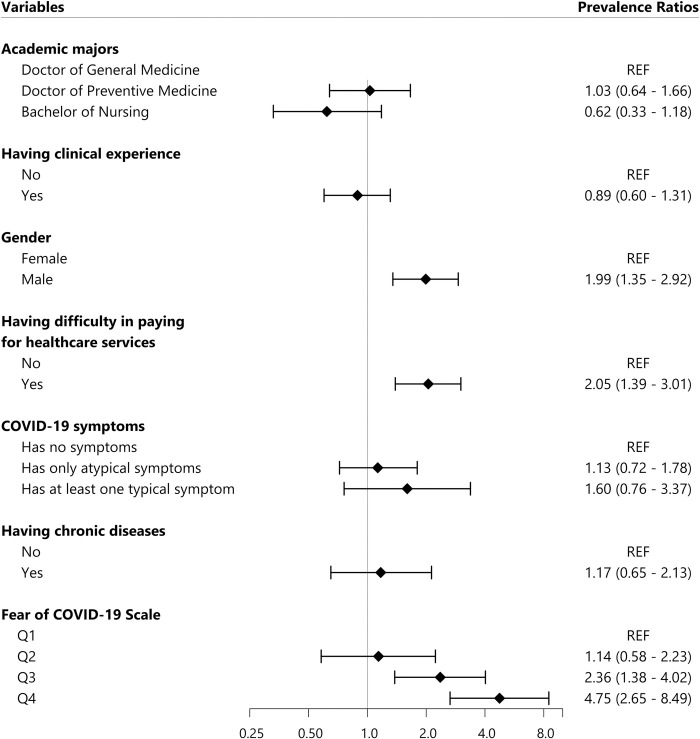
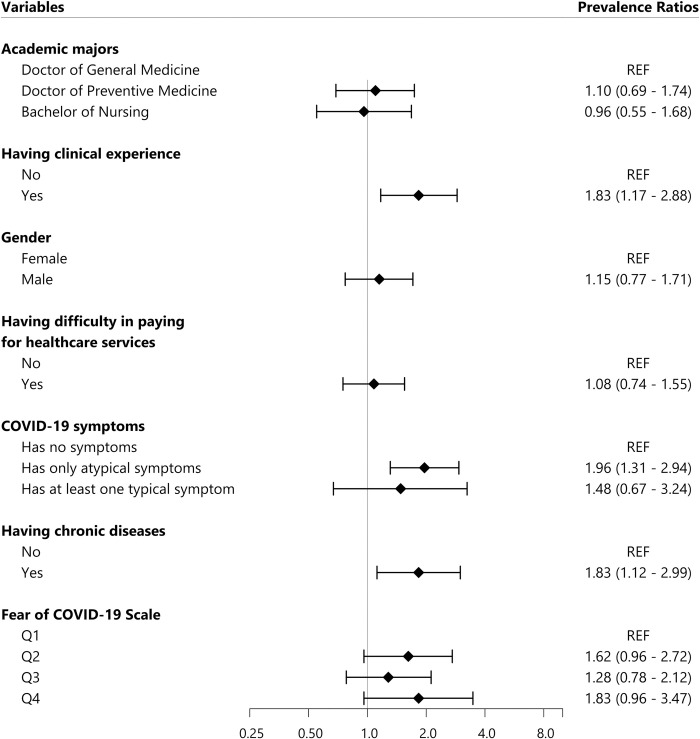
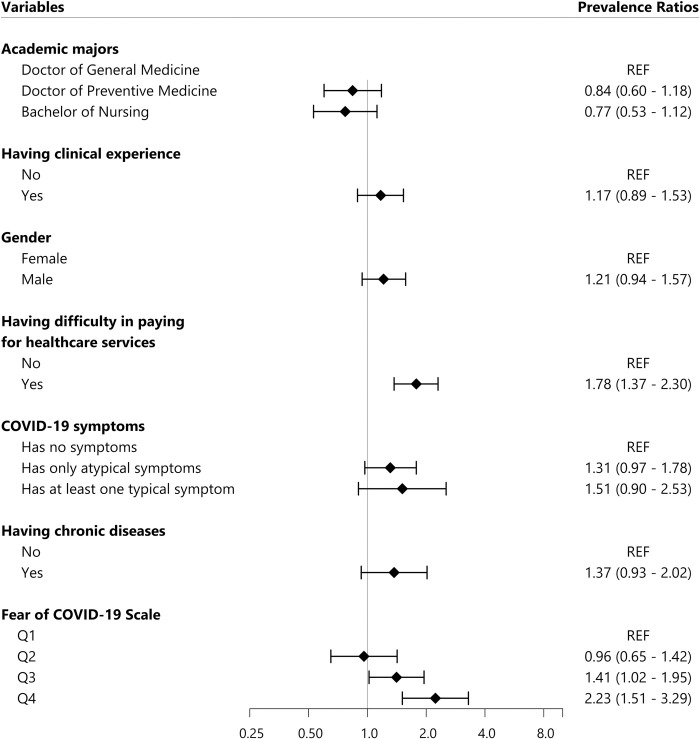
Among 1583 students (43.1% response rate), the prevalence of students screened positive for anxiety disorder was 7.3%(95%C.I.:6.0-8.7), depression was 14.5%(95%C.I.:12.8-16.3), and perceiving worsening mental health was 6.9%(95%C.I.:5.7-8.3). In multivariable regression models, significant factors associated with self-reported anxiety disorder included being male (PR = 1.99,95%C.I.:1.35-2.92), difficulty in paying for healthcare services (PR = 2.05,95%C.I.:1.39-3.01), and high level of fear of COVID-19 (Q3:PR = 2.36,95%C.I.:1.38-4.02 and Q4:PR = 4.75,95%C.I.:2.65-8.49). Significant factors associated with self-reported depression were difficulty in paying for healthcare services (PR = 1.78,95%C.I.:1.37-2.30), and high level of fear of COVID-19 (Q3:PR = 1.41,95%C.I.:1.02-1.95 and Q4:PR = 2.23,95%C.I.:1.51-3.29). Significant factors associated with perceived worsening mental health status included having clinical experience (PR = 1.83,95%C.I.:1.17-2.88) and having atypical symptoms of COVID-19 (PR = 1.96,95%C.I.:1.31-2.94).
The prevalence of self-reported depression, anxiety disorder, and worsening mental health among Vietnamese students during the first wave of COVID-19 was lower than in medical students in other countries. Further investigation is needed to confirm this finding.
众所周知,医学生比普通人群更容易出现这些问题,但在越南,大流行对医学生心理健康的影响尚未记录。
评估在 COVID-19 大流行期间越南医学生自我报告的焦虑症、抑郁症和心理健康恶化的患病率,并确定与这些问题相关的因素。
这是一项 2020 年 4 月 7 日至 29 日进行的横断面研究。邀请河内医科大学(3672 名学生)的普通医学博士、预防医学博士和护理学士专业的所有学生参加。使用在线问卷收集数据,包括人口统计学特征、广义焦虑症 7 项、患者健康问卷 9 项、对 COVID-19 的恐惧量表和关于心理健康恶化状况的问题。使用稳健泊松回归评估心理健康状况与相关因素之间的关联。
在 1583 名学生(43.1%的应答率)中,筛查出焦虑症阳性的学生比例为 7.3%(95%CI:6.0-8.7),抑郁症为 14.5%(95%CI:12.8-16.3),心理健康恶化的比例为 6.9%(95%CI:5.7-8.3)。在多变量回归模型中,与自我报告的焦虑症相关的显著因素包括男性(PR = 1.99,95%CI:1.35-2.92)、难以支付医疗保健服务费用(PR = 2.05,95%CI:1.39-3.01)和高水平的对 COVID-19 的恐惧(Q3:PR = 2.36,95%CI:1.38-4.02 和 Q4:PR = 4.75,95%CI:2.65-8.49)。与自我报告的抑郁症相关的显著因素包括难以支付医疗保健服务费用(PR = 1.78,95%CI:1.37-2.30)和高水平的对 COVID-19 的恐惧(Q3:PR = 1.41,95%CI:1.02-1.95 和 Q4:PR = 2.23,95%CI:1.51-3.29)。与感知到的心理健康恶化状况相关的显著因素包括有临床经验(PR = 1.83,95%CI:1.17-2.88)和有 COVID-19 的非典型症状(PR = 1.96,95%CI:1.31-2.94)。
在 COVID-19 大流行的第一波期间,越南学生中自我报告的抑郁症、焦虑症和心理健康恶化的患病率低于其他国家的医学生。需要进一步调查以证实这一发现。