Discipline of Physiology, School of Biomedicine, University of Adelaide, Adelaide, SA, 5005, Australia.
Clinical and Health Sciences, University of South Australia, Adelaide, SA, Australia.
Cancer Chemother Pharmacol. 2022 Sep;90(3):267-278. doi: 10.1007/s00280-022-04463-x. Epub 2022 Aug 12.
Gastrointestinal mucositis (GIM) is a side effect of high-dose irinotecan (CPT-11), causing debilitating symptoms that are often poorly managed. The role of TLR4 in the development of GIM has been clearly demonstrated. We, therefore, aimed to investigate the potential of the TLR4 antagonist, IAXO-102, to attenuate gastrointestinal inflammation as well as supress tumour activity in a colorectal-tumour-bearing mouse model of GIM induced by CPT-11.
24 C57BL/6 mice received a vehicle, daily i.p. IAXO-102 (3 mg/kg), i.p. CPT-11 (270 mg/kg) or a combination of CPT-11 and IAXO-102. GIM was assessed using validated toxicity markers. At 72 h, colon and tumour tissue were collected and examined for histopathological changes and RT-PCR for genes of interest; TLR4, MD-2, CD-14, MyD88, IL-6, IL-6R, CXCL2, CXCR1, and CXCR2.
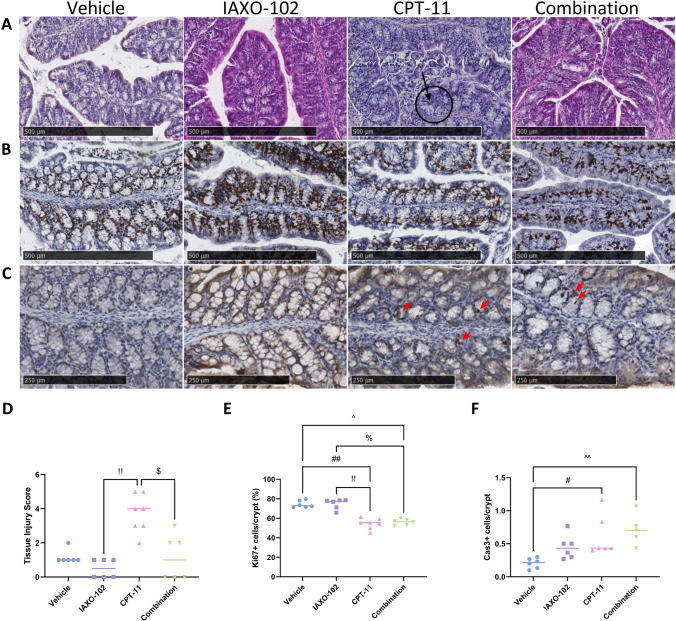
IAXO-102 prevented diarrhoea in mice treated with CPT-11. Tumour volume in IAXO-102-treated mice was lower compared to vehicle at 48 h (P < 0.05). There were no differences observed in colon and tumour weights between the treatment groups. Mice who received the combination treatment had improved tissue injury score (P < 0.05) in the colon but did not show any improvements in cell proliferation or apoptotic rate. Expression of all genes was similar across all treatment groups in the tumour (P > 0.05). In the colon, there was a difference in transcript expression in vehicle vs. IAXO-102 (P < 0.05) and CPT-11 vs. combination (P < 0.01) in MD-2 and IL-6R, respectively.
IAXO-102 was able to attenuate symptomatic parameters of GIM induced by CPT-11 as well as reduce tissue injury in the colon. However, there was no effect on cell proliferation and apoptosis. As such, TLR4 activation plays a partial role in GIM development but further research is required to understand the specific inflammatory signals underpinning tissue-level changes.
胃肠道粘膜炎(GIM)是高剂量伊立替康(CPT-11)的副作用,导致衰弱症状,通常管理不善。TLR4 在 GIM 发展中的作用已得到明确证实。因此,我们旨在研究 TLR4 拮抗剂 IAXO-102 降低 CPT-11 诱导的 GIM 中结直肠肿瘤荷瘤小鼠模型中胃肠道炎症和抑制肿瘤活性的潜力。
24 只 C57BL/6 小鼠接受了载体、每日腹腔注射 IAXO-102(3mg/kg)、腹腔注射 CPT-11(270mg/kg)或 CPT-11 和 IAXO-102 的组合。使用验证的毒性标志物评估 GIM。在 72 小时时,收集结肠和肿瘤组织,检查组织病理学变化和感兴趣基因的 RT-PCR;TLR4、MD-2、CD-14、MyD88、IL-6、IL-6R、CXCL2、CXCR1 和 CXCR2。
IAXO-102 预防了 CPT-11 治疗小鼠的腹泻。IAXO-102 治疗小鼠的肿瘤体积在 48 小时时低于载体(P < 0.05)。治疗组之间在结肠和肿瘤重量上没有差异。联合治疗组的小鼠在结肠的组织损伤评分得到改善(P < 0.05),但细胞增殖或凋亡率没有任何改善。所有基因在肿瘤中的表达在所有治疗组之间相似(P > 0.05)。在结肠中,载体与 IAXO-102 相比(P < 0.05)和 CPT-11 与联合治疗相比(P < 0.01),MD-2 和 IL-6R 的转录表达存在差异。
IAXO-102 能够减轻 CPT-11 诱导的 GIM 的症状参数,并减少结肠的组织损伤。然而,对细胞增殖和凋亡没有影响。因此,TLR4 激活在 GIM 发展中起部分作用,但需要进一步研究以了解支持组织水平变化的特定炎症信号。