Korlimarla Aruna, Ps Hari, Prabhu Jyoti, Ragulan Chanthirika, Patil Yatish, Vp Snijesh, Desai Krisha, Mathews Aju, Appachu Sandhya, Diwakar Ravi B, Bs Srinath, Melcher Alan, Cheang Maggie, Sadanandam Anguraj
St. John's Research Institute, St. John's National Academy of Health Sciences, Bangalore, India; Sri Shankara Cancer Hospital and Research Centre, Bangalore, India.
St. John's Research Institute, St. John's National Academy of Health Sciences, Bangalore, India; Sri Shankara Cancer Hospital and Research Centre, Bangalore, India; Division of Molecular Pathology, The Institute of Cancer Research, London, UK.
Transl Oncol. 2022 Nov;25:101511. doi: 10.1016/j.tranon.2022.101511. Epub 2022 Aug 11.
Triple-negative breast cancer (TNBC) is a heterogeneous disease with a significant challenge to effectively manage in the clinic worldwide. Immunotherapy may be beneficial to TNBC patients if responders can be effectively identified. Here we sought to elucidate the immune landscape of TNBCs by stratifying patients into immune-specific subtypes (immunotypes) to decipher the molecular and cellular presentations and signaling events of this heterogeneous disease and associating them with their clinical outcomes and potential treatment options.
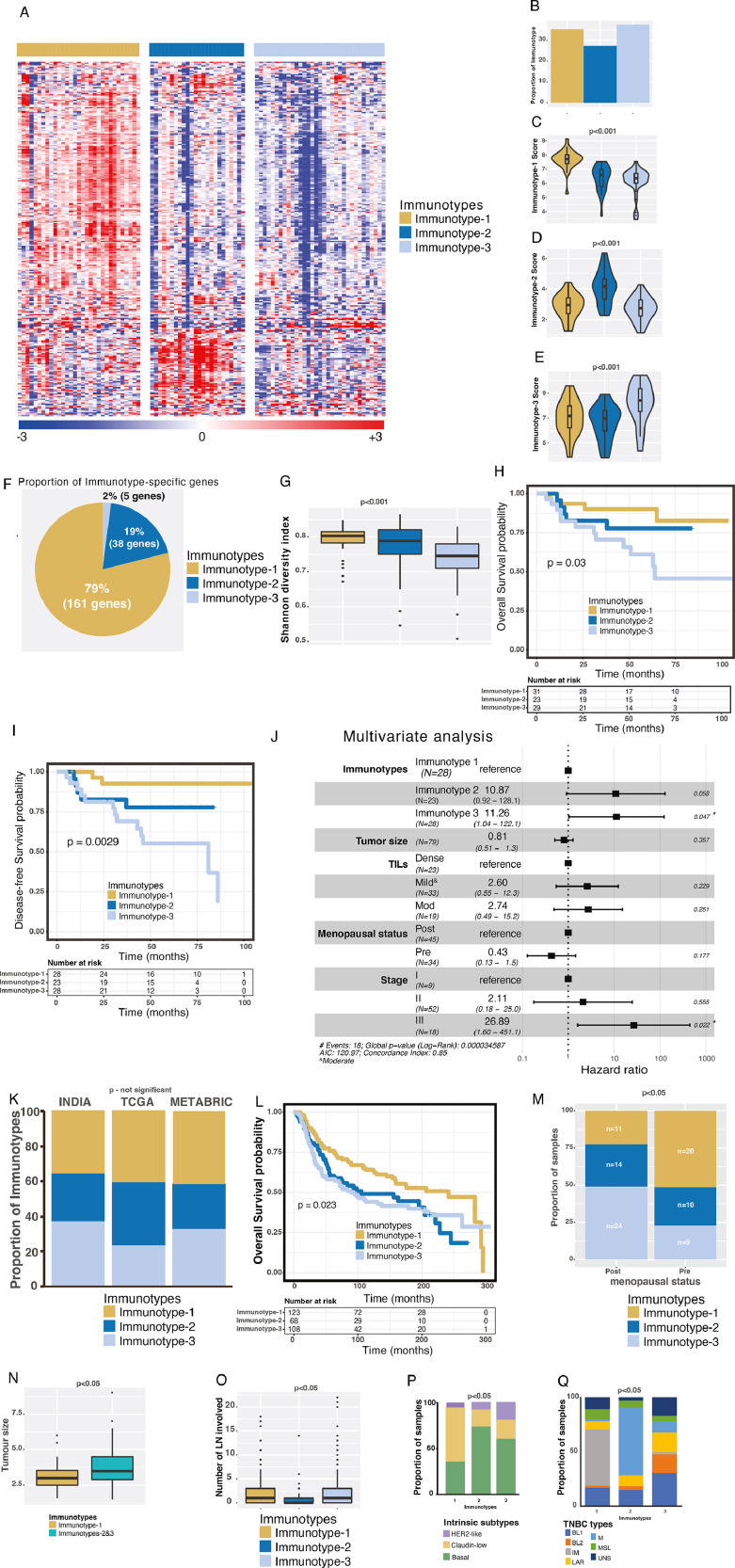
We profiled 730 immune genes in 88 retrospective Indian TNBC samples using the NanoString platform, established immunotypes using non-negative matrix factorization-based machine learning approach, and validated them using Western TNBCs (n=422; public datasets). Immunotype-specific gene signatures were associated with clinicopathological features, immune cell types, biological pathways, acute/chronic inflammatory responses, and immunogenic cell death processes. Responses to different immunotherapies associated with TNBC immunotypes were assessed using cross-cancer comparison to melanoma (n=504). Tumor-infiltrating lymphocytes (TILs) and pan-macrophage spatial marker expression were evaluated.
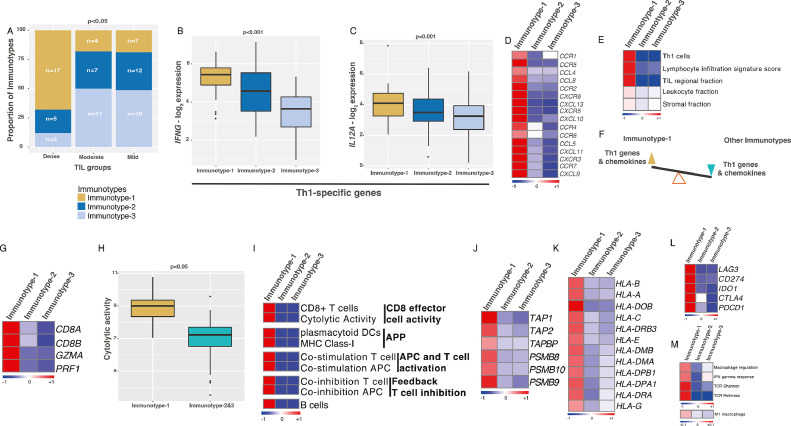
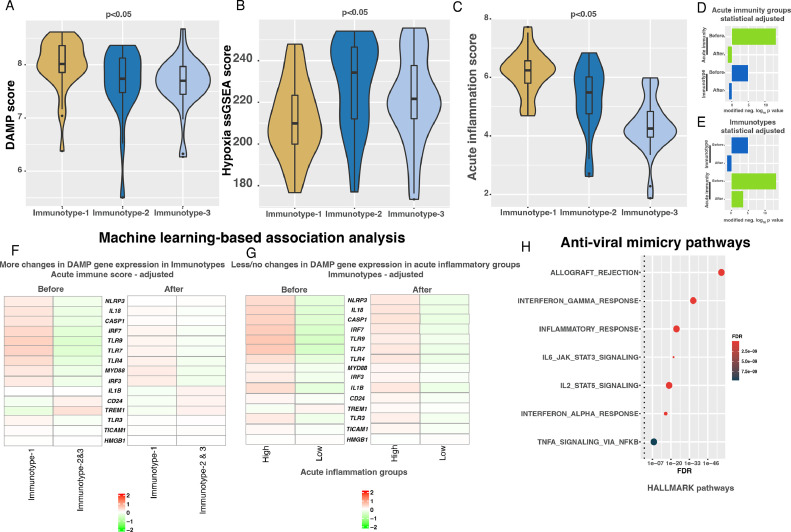
We identified three robust transcriptome-based immunotypes in both Indian and Western TNBCs in similar proportions. Immunotype-1 tumors, mainly representing well-known claudin-low and immunomodulatory subgroups, harbored dense TIL infiltrates and T-helper-1 (Th1) response profiles associated with smaller tumors, pre-menopausal status, and a better prognosis. They displayed a cascade of events, including acute inflammation, damage-associated molecular patterns, T-cell receptor-related and chemokine-specific signaling, antigen presentation, and viral-mimicry pathways. On the other hand, immunotype-2 was enriched for Th2/Th17 responses, CD4 regulatory cells, basal-like/mesenchymal immunotypes, and an intermediate prognosis. In contrast to the two T-cell enriched immunotypes, immunotype-3 patients expressed innate immune genes/proteins, including those representing myeloid infiltrations (validated by spatial immunohistochemistry), and had poor survival. Remarkably, a cross-cancer comparison analysis revealed the association of immunotype-1 with responses to anti-PD-L1 and MAGEA3 immunotherapies.
Overall, the TNBC immunotypes identified in TNBCs reveal different prognoses, immune infiltrations, signaling, acute/chronic inflammation leading to immunogenic cell death of cancer cells, and potentially distinct responses to immunotherapies. The overlap in immune characteristics in Indian and Western TNBCs suggests similar efficiency of immunotherapy in both populations if strategies to select patients according to immunotypes can be further optimized and implemented.
三阴性乳腺癌(TNBC)是一种异质性疾病,在全球临床治疗中面临有效管理的重大挑战。如果能够有效识别应答者,免疫疗法可能对TNBC患者有益。在此,我们试图通过将患者分层为免疫特异性亚型(免疫型)来阐明TNBC的免疫格局,以解读这种异质性疾病的分子和细胞表现及信号事件,并将它们与临床结局和潜在治疗方案相关联。
我们使用NanoString平台对88例印度TNBC回顾性样本中的730个免疫基因进行了分析,采用基于非负矩阵分解的机器学习方法建立免疫型,并使用西方TNBC样本(n = 422;公共数据集)进行验证。免疫型特异性基因特征与临床病理特征、免疫细胞类型、生物学途径、急性/慢性炎症反应及免疫原性细胞死亡过程相关联。通过与黑色素瘤(n = 504)的跨癌种比较,评估了与TNBC免疫型相关的不同免疫疗法的反应。评估了肿瘤浸润淋巴细胞(TILs)和全巨噬细胞空间标志物表达。
我们在印度和西方TNBC中以相似比例鉴定出三种基于转录组的稳健免疫型。免疫型1肿瘤主要代表众所周知的claudin低表达和免疫调节亚组,具有密集的TIL浸润以及与较小肿瘤、绝经前状态和较好预后相关的辅助性T细胞1(Th1)反应特征。它们呈现出一系列事件级联,包括急性炎症反应、损伤相关分子模式、T细胞受体相关和趋化因子特异性信号传导、抗原呈递以及病毒模拟途径。另一方面,免疫型2富含Th2/Th17反应、CD4调节性细胞、基底样/间充质免疫型,且预后中等。与两种富含T细胞的免疫型不同,免疫型3患者表达先天免疫基因/蛋白,包括那些代表髓系浸润的基因/蛋白(经空间免疫组化验证),且生存情况较差。值得注意的是,跨癌种比较分析揭示了免疫型l与抗PD-L1和MAGEA3免疫疗法反应之间的关联。
总体而言,在TNBC中鉴定出的TNBC免疫型揭示了不同的预后、免疫浸润、信号传导、导致癌细胞免疫原性细胞死亡的急性/慢性炎症,以及可能对抗免疫疗法的不同反应。印度和西方TNBC免疫特征的重叠表明,如果能够进一步优化并实施根据免疫型选择患者的策略,免疫疗法在这两个人群中的疗效相似。