Division of Rheumatology, Department of Internal Medicine, Toho University School of Medicine, Japan.
Department of Inflammation and Pain Control Research, Toho University School of Medicine, Japan.
Intern Med. 2022;61(16):2405-2415. doi: 10.2169/internalmedicine.8560-21. Epub 2022 Aug 15.
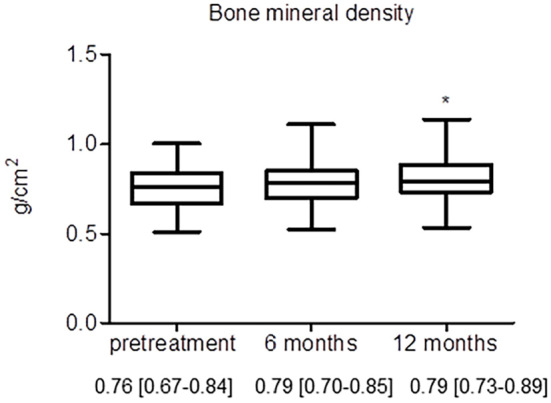
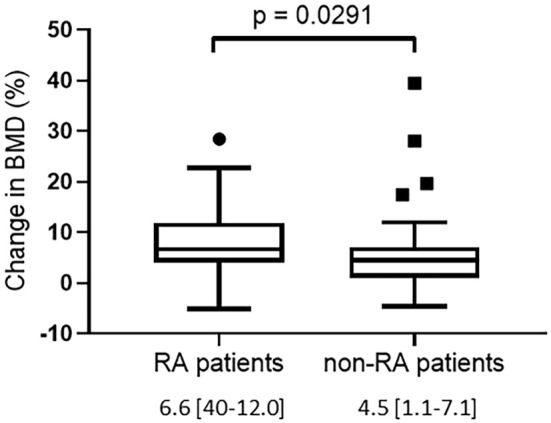
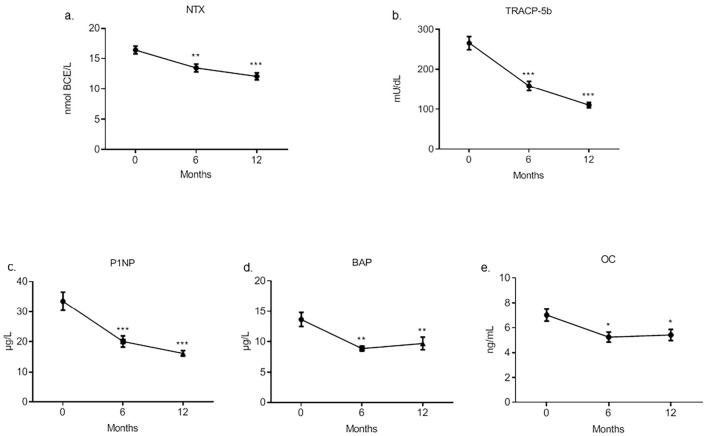
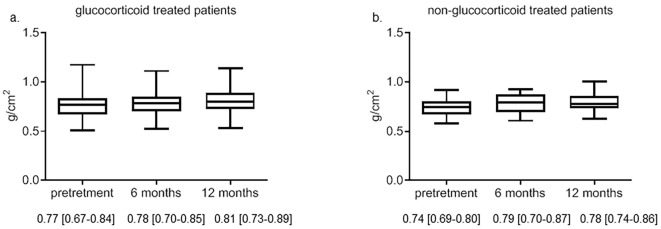
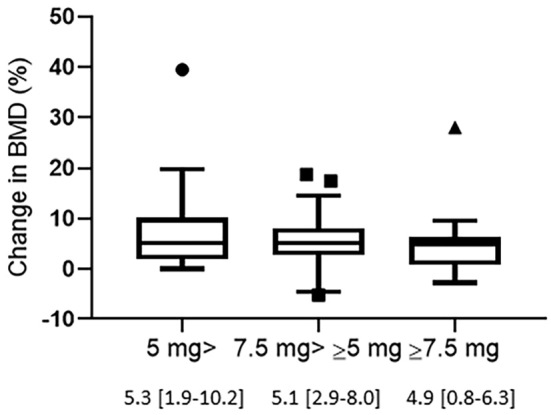
Objective Denosumab, an anti-RANKL monoclonal antibody, was reported to improve bone mineral density (BMD) and reduce fracture risk, offering favorable efficacy against postmenopausal osteoporosis. However, some patients have experienced a reduced BMD despite denosumab therapy. Methods We performed an observational study to clarify the clinical efficacy of denosumab for osteoporosis in rheumatic disease patients. Serum levels of bone turnover markers and lumber BMD in 100 rheumatic disease patients were examined at baseline and 6 and 12 months after denosumab therapy. The independent influence of changes in the BMD was examined by multiple regression analyses adjusted for patient characteristics and bone turnover markers. Results As bone resorption markers, serum levels of N-telopeptide crosslinked of type I collagen (NTx) and tartrate-resistant acid phosphatase isoform 5b were statistically decreased after 12 months. As bone formation markers, serum levels of osteocalcin, procollagen type I N-terminal peptide, and bone alkaline phosphatase were significantly decreased after 12 months. The mean BMD was significantly increased after 12 months. However, in 10 patients, the BMD decreased. A multivariate analysis of factors related to BMD changes highlighted a young age, low prednisolone dosage, and reduction in NTx. Conclusions Denosumab increases the BMD to combat osteoporosis in rheumatic disease patients, and potential predictors of a better response to denosumab include a young age, reduction in bone turnover markers, and low-dose glucocorticoid use.
抗核因子 - κB 受体激活配体(RANKL)单克隆抗体地舒单抗可提高骨密度(BMD)并降低骨折风险,对绝经后骨质疏松症具有良好的疗效。然而,一些患者在接受地舒单抗治疗后 BMD 降低。方法:我们进行了一项观察性研究,以阐明地舒单抗治疗风湿病患者骨质疏松症的临床疗效。在接受地舒单抗治疗前、治疗后 6 个月和 12 个月,检测 100 例风湿病患者的血清骨转换标志物和腰椎 BMD。通过多元回归分析,调整患者特征和骨转换标志物,检查 BMD 变化的独立影响。结果:作为骨吸收标志物,Ⅰ型胶原 N-末端肽交联(NTx)和抗酒石酸酸性磷酸酶 5b 的血清水平在治疗 12 个月后统计学上降低。作为骨形成标志物,骨钙素、Ⅰ型前胶原 N 端肽和骨碱性磷酸酶的血清水平在治疗 12 个月后显著降低。治疗 12 个月后平均 BMD 显著增加。然而,在 10 名患者中,BMD 下降。与 BMD 变化相关的多因素分析突出了年龄较小、泼尼松剂量较低和 NTx 减少。结论:地舒单抗可增加 BMD 以治疗风湿病患者的骨质疏松症,对地舒单抗更好反应的潜在预测因子包括年龄较小、骨转换标志物减少和低剂量糖皮质激素使用。