Shu Bingyan, Shen Huayan, Shao Xinyang, Luo Fengming, Li Tianjiao, Zhou Zhou
Fuwai Hospital, Chinese Academy of Medical Sciences and Peking Union Medical College, Beijing, China.
Front Cardiovasc Med. 2022 Jul 29;9:898289. doi: 10.3389/fcvm.2022.898289. eCollection 2022.
Pulmonary atresia (PA) is a heterogeneous congenital heart defect and ventricular septal defect (VSD) is the most vital factor for the conventional classification of PA patients. The simple dichotomy could not fully describe the cardiac morphologies and pathophysiology in such a complex disease. We utilized the Human Phenotype Ontology (HPO) database to explore the phenotypic patterns of PA and the phenotypic influence on prognosis.
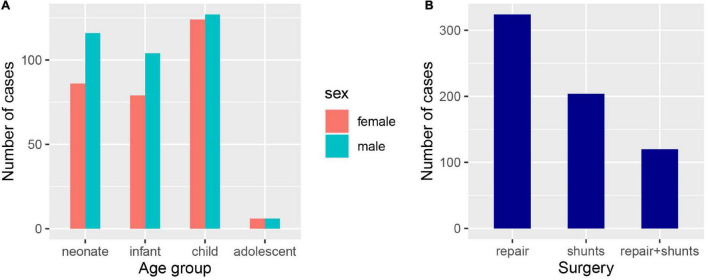
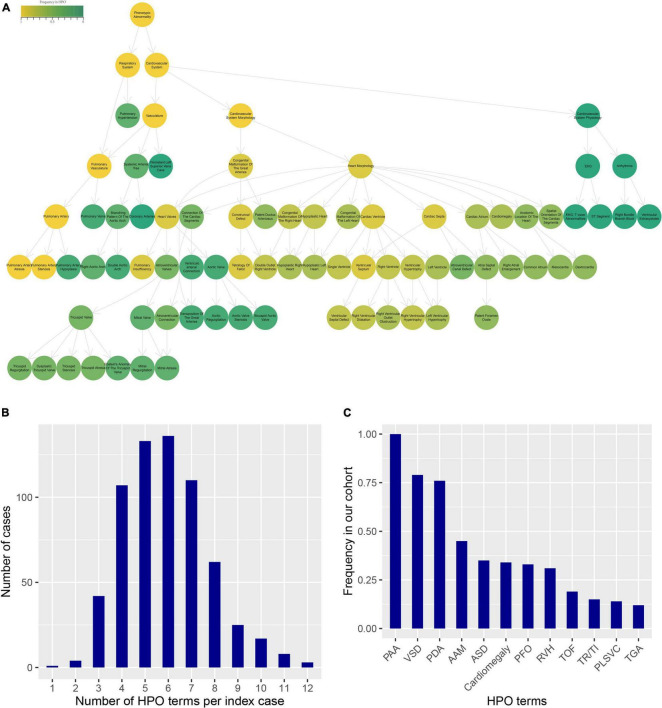
We recruited 786 patients with diagnoses of PA between 2008 and 2016 at Fuwai Hospital. According to cardiovascular phenotypes of patients, we retrieved 52 HPO terms for further analyses. The patients were classified into three clusters based on unsupervised hierarchical clustering. We used Kaplan-Meier curves to estimate survival, the log-rank test to compare survival between clusters, and univariate and multivariate Cox proportional hazards regression modeling to investigate potential risk factors.
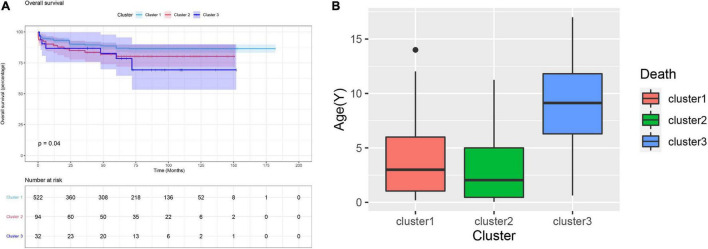
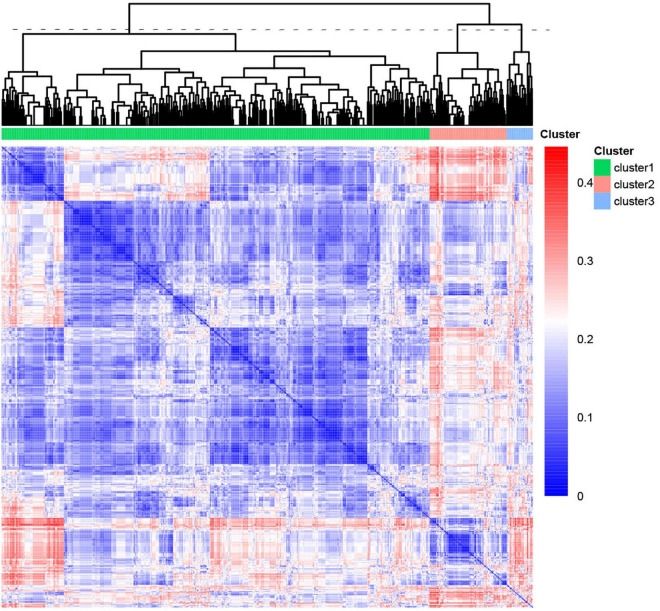
According to HPO term distribution, we observed significant differences of morphological abnormalities in 3 clusters. We defined cluster 1 as being associated with Tetralogy of Fallot (TOF), VSD, right ventricular hypertrophy (RVH), and aortopulmonary collateral arteries (ACA). ACA was not included in the cluster classification because it was not an HPO term. Cluster 2 was associated with hypoplastic right heart (HRH), atrial septal defect (ASD) and tricuspid disease as the main morphological abnormalities. Cluster 3 presented higher frequency of single ventricle (SV), dextrocardia, and common atrium (CA). The mortality rate in cluster 1 was significantly lower than the rates in cluster 2 and 3 ( = 0.04). Multivariable analysis revealed that abnormal atrioventricular connection (AAC, = 0.011) and persistent left superior vena cava (LSVC, = 0.003) were associated with an increased risk of mortality.
Our study reported a large cohort with clinical phenotypic, surgical strategy and long time follow-up. In addition, we provided a precise classification and successfully risk stratification for patients with PA.
肺动脉闭锁(PA)是一种异质性先天性心脏缺陷,室间隔缺损(VSD)是PA患者传统分类的最重要因素。这种简单的二分法无法完全描述如此复杂疾病中的心脏形态和病理生理学。我们利用人类表型本体论(HPO)数据库来探索PA的表型模式及其对预后的表型影响。
我们招募了2008年至2016年期间在阜外医院诊断为PA的786例患者。根据患者的心血管表型,我们检索了52个HPO术语进行进一步分析。基于无监督层次聚类将患者分为三个簇。我们使用Kaplan-Meier曲线估计生存率,对数秩检验比较簇间生存率,并使用单变量和多变量Cox比例风险回归模型研究潜在风险因素。
根据HPO术语分布,我们观察到3个簇中形态学异常存在显著差异。我们将簇1定义为与法洛四联症(TOF)、室间隔缺损、右心室肥厚(RVH)和主肺动脉侧支动脉(ACA)相关。ACA未包含在簇分类中,因为它不是一个HPO术语。簇2与右心发育不全(HRH)、房间隔缺损(ASD)和三尖瓣疾病相关,为主要形态学异常。簇3中单心室(SV)、右位心和共同心房(CA)的出现频率更高。簇1中的死亡率显著低于簇2和簇3中的死亡率(P = 0.04)。多变量分析显示,房室连接异常(AAC,P = 0.011)和永存左上腔静脉(LSVC,P = 0.003)与死亡风险增加相关。
我们的研究报告了一个具有临床表型、手术策略和长期随访的大型队列。此外,我们为PA患者提供了精确的分类并成功进行了风险分层。