Briones-Claudett Killen H, Briones-Claudett Mónica H, Baños Mariuxi Del Pilar Cabrera, Briones Zamora Killen H, Briones Marquez Diana C, Zimmermann Luc J I, Gavilanes Antonio W D, Grunauer Michelle
Universidad de Las Americas, Facultad de Medicina, Quito, Ecuador.
Intensive Care Unit, Ecuadorian Institute of Social Security (IESS), Babahoyo, Ecuador.
Crit Care Res Pract. 2022 Aug 3;2022:4333345. doi: 10.1155/2022/4333345. eCollection 2022.
Bilevel positive airway pressure in spontaneous/time and average volume-assured pressure support (BiPAP·S/T-AVAPS) could maintain an adequate tidal volume by reducing the patient's inspiratory effort; however, this ventilatory strategy has not been compared with other ventilatory modes, especially the conventional BiPAP S/T mode, when noninvasive mechanical ventilation (NIMV) is used. The primary objective of this study was to determine the rate of success and failure of the use of BiPAP·S/T-AVAPS versus BiPAP·S/T alone in patients with mild-to-moderate "de novo" hypoxemic respiratory failure.
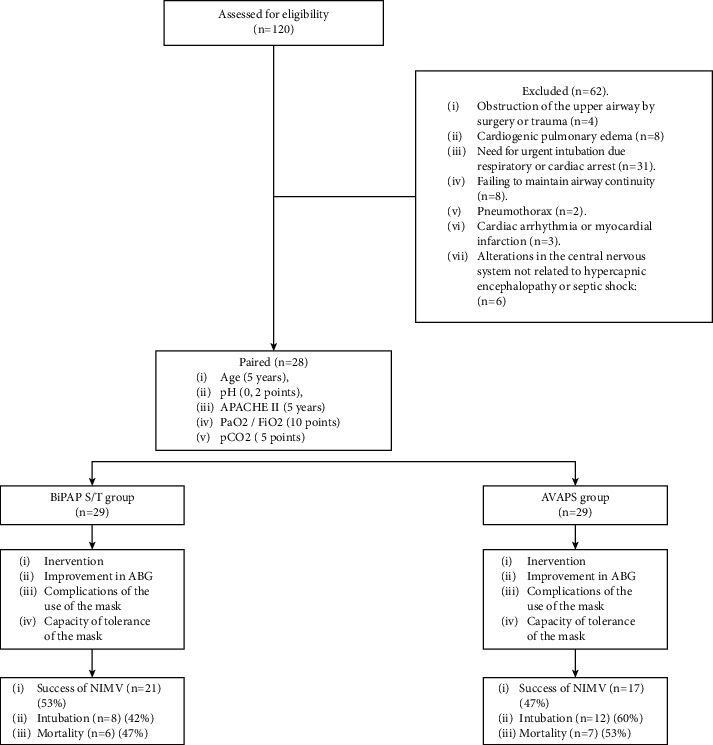
This was a matched-cohort study. Subjects with mild-to-moderate de novo hypoxemic respiratory failure were divided into two groups according to the ventilatory strategy used. The subjects in the BiPAP·S/T group were paired with those in the BiPAP·S/T-AVAPS group.
A total of 58 subjects were studied. Twenty-nine subjects in the BiPAP·S/T group were paired with 29 subjects in the BiPAP·S/T-AVAPS group. Twenty patients (34.5%) presented with "failure of NIMV," while 38 (65.5%) patients did not. In addition, 13 (22.4%) patients died, while 45 (77.6%) recovered. No differences were found in the percentage of intubation (=0.44) and mortality (=0.1).
The BiPAP S/T-AVAPS ventilator mode was not superior to the BiPAP·S/T mode. A high mortality rate was observed in patients with NIMV failure in both modes. This trial is registered with https://doi.org/10.1186/ISRCTN17904857.
双水平气道正压通气的自主/定时和平均容量保证压力支持模式(BiPAP·S/T-AVAPS)可通过减轻患者吸气努力来维持足够的潮气量;然而,在使用无创机械通气(NIMV)时,这种通气策略尚未与其他通气模式进行比较,尤其是传统的BiPAP S/T模式。本研究的主要目的是确定在轻度至中度“初发”低氧性呼吸衰竭患者中,使用BiPAP·S/T-AVAPS与单独使用BiPAP·S/T的成功率和失败率。
这是一项匹配队列研究。根据所使用的通气策略,将轻度至中度初发低氧性呼吸衰竭患者分为两组。BiPAP·S/T组的受试者与BiPAP·S/T-AVAPS组的受试者进行配对。
共研究了58名受试者。BiPAP·S/T组的29名受试者与BiPAP·S/T-AVAPS组的29名受试者配对。20名患者(34.5%)出现“NIMV失败”,而38名(65.5%)患者未出现。此外,13名(22.4%)患者死亡,45名(77.6%)患者康复。插管率(=0.44)和死亡率(=0.1)方面未发现差异。
BiPAP S/T-AVAPS通气模式并不优于BiPAP·S/T模式。两种模式下NIMV失败的患者死亡率均较高。本试验已在https://doi.org/10.1186/ISRCTN17904857注册。