Eluri Swathi, Runge Thomas M, Cirri Holly, Martin Christopher F, Dellon Evan S, Crockett Seth D
Division of Gastroenterology and Hepatology, University of North Carolina School of Medicine, Chapel Hill, NC, the United States.
J Gastroenterol Hepatol Res. 2018;7(5):2702-2708. doi: 10.17554/j.issn.2224-3992.2018.07.787.
ColoWrap is an external abdominal compression device applied during colonoscopy to reduce looping and procedure time. It is unclear if a shorter procedure duration or increased abdominal pressure impacts polyp detection. We determined if use of ColoWrap affected adenoma detection rate (ADR) or detection of sessile serrated polyps (SSP) compared to sham.
At a single center, participants aged 40-80 were randomized to have ColoWrap or a sham device applied to the lower abdomen. Baseline characteristics, procedural factors, location of polyps, ADR and SSP detection rate (SSPDR) were compared between the groups. Multivariable logistic regression was performed to assess whether ColoWrap was associated with detection of adenomas and SSP.
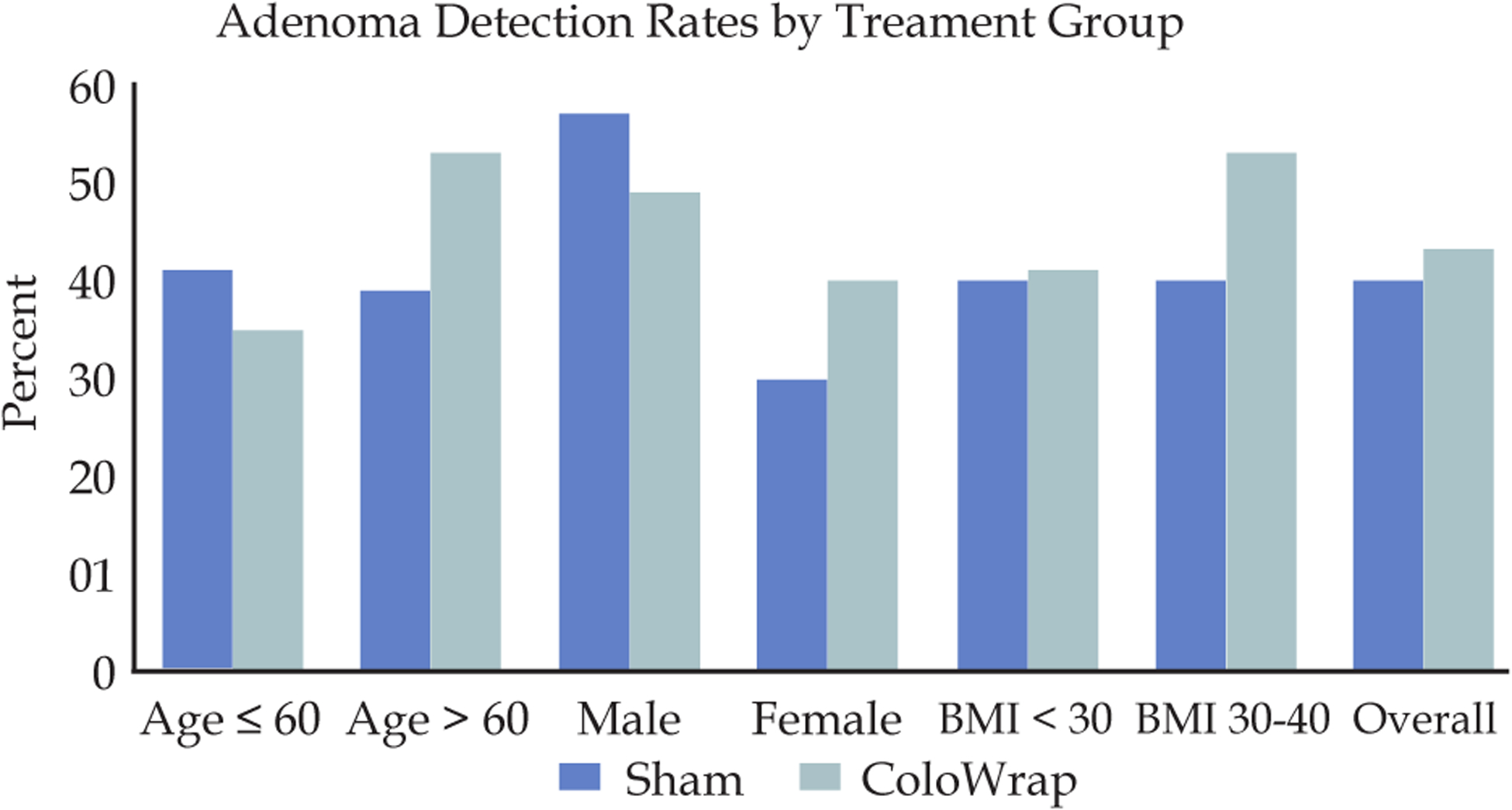
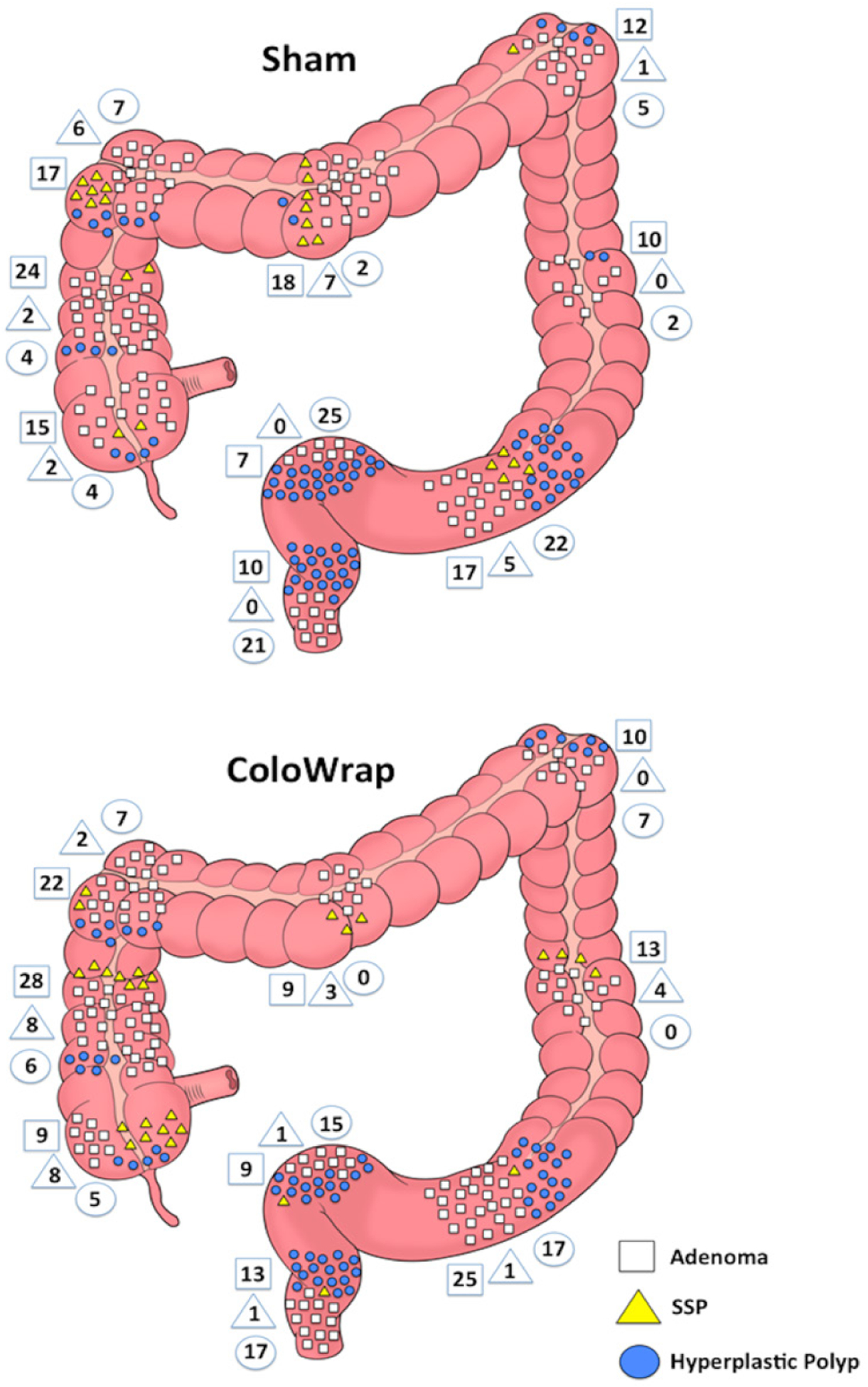
Of 350 participants, 175 were assigned to each arm. Overall, there were no significant differences in ADR (43% 40%, = 0.52) or SSPDR (8% 6%, = 0.53) between ColoWrap and sham. In sub-group analysis, there were increased odds of adenoma detection with ColoWrap in women (OR: 2.32, 95%CI: 1.21, 4.46), participants > 60 years (OR: 2.95, 95%CI: 1.43, 6.07) and those with a BMI 30-40 (OR: 3.50, 95%CI: 1.00, 12.23). Use of ColoWrap also increased ADR in the left colon (splenic flexure to rectum) (29% 22%; = 0.03) and increased SSPDR in the cecum/ascending colon (6% 2%; = 0.02) compared to sham.
Use of ColoWrap during colonoscopy did not negatively impact ADR or SSPDR, and there was an apparent improvement in polyp detection in certain colon locations and patient sub-groups. These results should be interpreted with caution due to the small sample size.
ColoWrap是一种在结肠镜检查期间应用的腹部外部压迫装置,用于减少肠袢形成和检查时间。目前尚不清楚较短的检查持续时间或增加的腹部压力是否会影响息肉检测。我们比较了使用ColoWrap与使用假装置相比,对腺瘤检出率(ADR)或无蒂锯齿状息肉(SSP)检测的影响。
在一个中心,将年龄在40 - 80岁的参与者随机分为两组,一组在下腹部使用ColoWrap,另一组使用假装置。比较两组之间的基线特征、操作因素、息肉位置、ADR和SSP检出率(SSPDR)。进行多变量逻辑回归分析,以评估ColoWrap是否与腺瘤和SSP的检测相关。
350名参与者中,每组各分配175人。总体而言,ColoWrap组与假装置组在ADR(43%对40%,P = 0.52)或SSPDR(8%对6%,P = 0.53)方面无显著差异。在亚组分析中,ColoWrap在女性(比值比:2.32,95%置信区间:1.21,4.46)、年龄大于60岁的参与者(比值比:2.95,95%置信区间:1.43,6.07)以及体重指数为30 - 40的参与者(比值比:3.50,95%置信区间:1.00,12.23)中腺瘤检测的几率增加。与假装置相比,使用ColoWrap还使左半结肠(脾曲至直肠)的ADR增加(29%对22%;P = 0.03),盲肠/升结肠的SSPDR增加(6%对2%;P = 0.02)。
结肠镜检查期间使用ColoWrap对ADR或SSPDR没有负面影响,并且在某些结肠部位和患者亚组中息肉检测有明显改善。由于样本量小,这些结果应谨慎解释。