Fenstemaker Sean, Cho Jin, McCoy Jack E, Mercer Kristin L, Francis David M
Department of Horticulture and Crop Science, The Ohio State University, Wooster, OH, United States.
Department of Horticulture and Crop Science, The Ohio State University, Columbus, OH, United States.
Front Plant Sci. 2022 Jul 28;13:947538. doi: 10.3389/fpls.2022.947538. eCollection 2022.
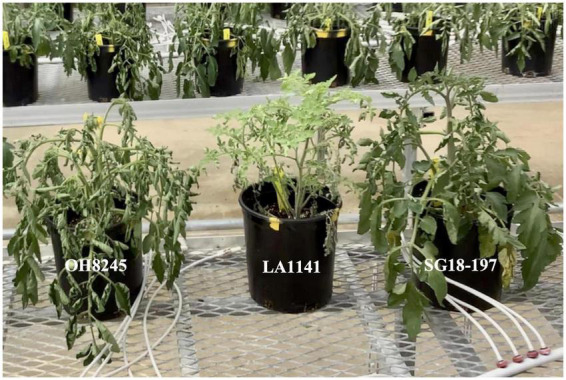
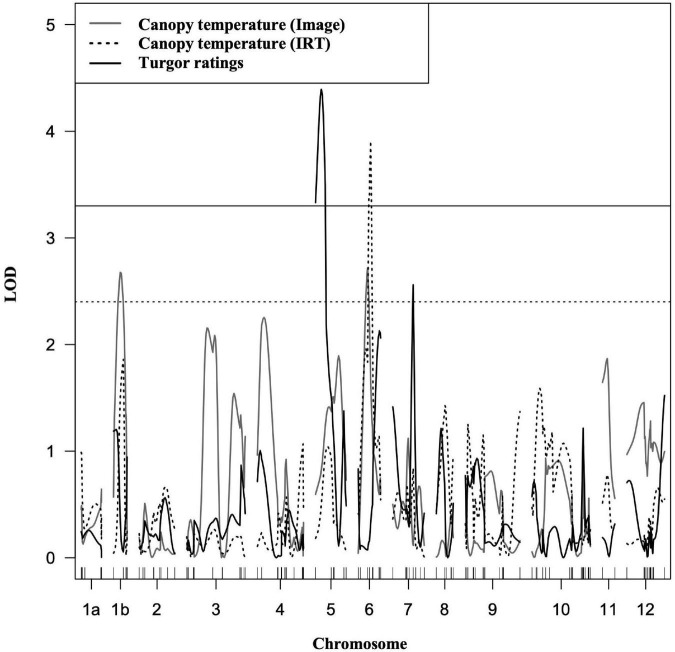
Crop wild relatives have been used as a source of genetic diversity for over one hundred years. The wild tomato relative accession LA1141 demonstrates the ability to tolerate deficit irrigation, making it a potential resource for crop improvement. Accessing traits from LA1141 through introgression may improve the response of cultivated tomatoes grown in water-limited environments. Canopy temperature is a proxy for physiological traits which are challenging to measure efficiently and may be related to water deficit tolerance. We optimized phenotypic evaluation based on variance partitioning and further show that objective phenotyping methods coupled with genomic prediction lead to gain under selection for water deficit tolerance. The objectives of this work were to improve phenotyping workflows for measuring canopy temperature, mapping quantitative trait loci (QTLs) from LA1141 that contribute to water deficit tolerance and comparing selection strategies. The phenotypic variance attributed to genetic causes for canopy temperature was higher when estimated from thermal images relative to estimates based on an infrared thermometer. Composite interval mapping using BCS families, genotyped with single nucleotide polymorphisms, suggested that accession LA1141 contributed alleles that lower canopy temperature and increase plant turgor under water deficit. QTLs for lower canopy temperature were mapped to chromosomes 1 and 6 and explained between 6.6 and 9.5% of the total phenotypic variance. QTLs for higher leaf turgor were detected on chromosomes 5 and 7 and explained between 6.8 and 9.1% of the variance. We advanced tolerant BCS families to the BCS generation using selection indices based on phenotypic values and genomic estimated breeding values (GEBVs). Phenotypic, genomic, and combined selection strategies demonstrated gain under selection and improved performance compared to randomly advanced BCS progenies. Leaf turgor, canopy temperature, stomatal conductance, and vapor pressure deficit (VPD) were evaluated and compared in BCS progenies grown under deficit irrigation. Progenies co-selected for phenotypic values and GEBVs wilted less, had significantly lower canopy temperature, higher stomatal conductance, and lower VPD than randomly advanced lines. The fruit size of water deficit tolerant selections was small compared to the recurrent parent. However, lines with acceptable yield, canopy width, and quality parameters were recovered. These results suggest that we can create selection indices to improve water deficit tolerance in a recurrent parent background, and additional crossing and evaluation are warranted.
一百多年来,作物野生近缘种一直被用作遗传多样性的来源。野生番茄近缘种LA1141表现出耐受亏缺灌溉的能力,使其成为作物改良的潜在资源。通过渐渗从LA1141获取性状可能会改善在水分有限环境中种植的栽培番茄的响应。冠层温度是生理性状的一个替代指标,这些生理性状难以有效测量,并且可能与水分亏缺耐受性有关。我们基于方差分解优化了表型评估,并进一步表明,客观的表型分析方法与基因组预测相结合会在水分亏缺耐受性选择下带来增益。这项工作的目标是改进测量冠层温度的表型分析工作流程,定位LA1141中有助于水分亏缺耐受性的数量性状位点(QTL),并比较选择策略。与基于红外温度计的估计相比,从热图像估计时,冠层温度归因于遗传原因的表型方差更高。使用单核苷酸多态性进行基因分型的BCS家系的复合区间作图表明,LA1141近缘种贡献了在水分亏缺下降低冠层温度和增加植物膨压的等位基因。较低冠层温度的QTL被定位到第1和第6号染色体上,解释了总表型方差的6.6%至9.5%。在第5和第7号染色体上检测到较高叶片膨压的QTL,解释了方差的6.8%至9.1%。我们使用基于表型值和基因组估计育种值(GEBV)的选择指数,将耐受性BCS家系推进到BCS世代。与随机推进的BCS后代相比,表型、基因组和联合选择策略在选择下表现出增益并提高了性能。在亏缺灌溉条件下生长的BCS后代中,对叶片膨压、冠层温度、气孔导度和蒸汽压亏缺(VPD)进行了评估和比较。与随机推进的品系相比,同时根据表型值和GEBV共同选择的后代枯萎较少,冠层温度显著较低,气孔导度较高,VPD较低。与轮回亲本相比,水分亏缺耐受性选择的果实大小较小。然而,获得了具有可接受产量、冠层宽度和品质参数的品系。这些结果表明,我们可以创建选择指数来提高轮回亲本背景下的水分亏缺耐受性,并且有必要进行额外的杂交和评估。