Xu Wenshen, Huang Liming, Xie Bingsen, Yang Bin
Department of Laboratory Medicine, Gene Diagnosis Research Center, The First Affiliated Hospital, Fujian Medical University, Fuzhou, China.
Fujian Key Laboratory of Laboratory Medicine, The First Affiliated Hospital, Fujian Medical University, Fuzhou, China.
Front Neurol. 2022 Jul 27;13:888221. doi: 10.3389/fneur.2022.888221. eCollection 2022.
Gliomas account for nearly 80% of brain cancers, tending to occur more frequently in men with adverse outcomes. Emerging microRNAs have been positioned as promising predictors for glioma's histological grade and prognosis. However, there have been few studies concerning the sex-biased impacts on the clinical approach for the potential microRNA-4297 (miR-4297).
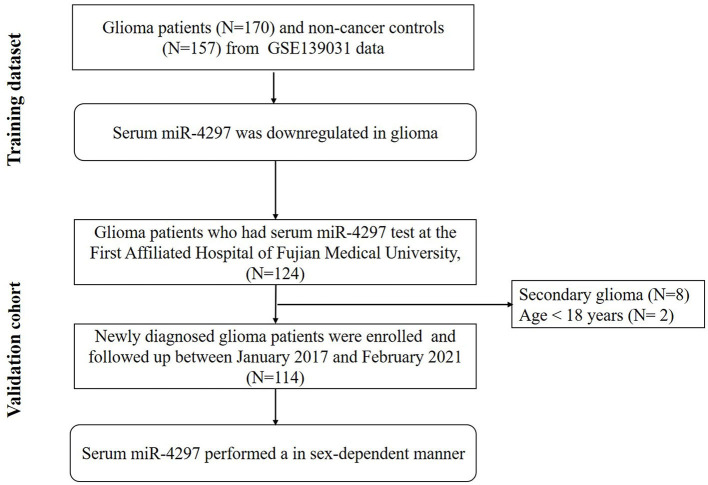
We utilized GSE139031micro-RNAs profiling to analyze serum miR-4297 expression in glioma. A total of 114 newly diagnosed glioma patients at the First Affiliated Hospital of Fujian Medical University from January 2017 to February 2021 were recruited and prospectively followed up. The association of miR-4297 levels with glioma grade and prognosis was investigated. Luciferase reporter gene assays and genotype analyses were carried out to explore the potential mechanism of sexually dimorphic miR-4297 in glioma.
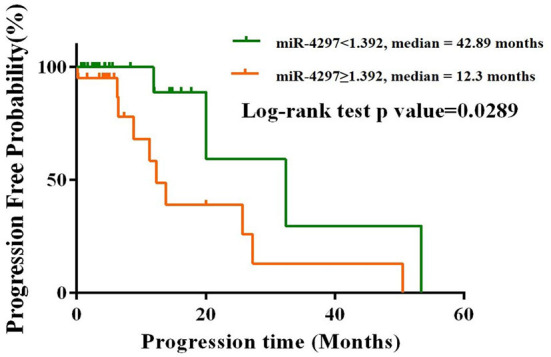
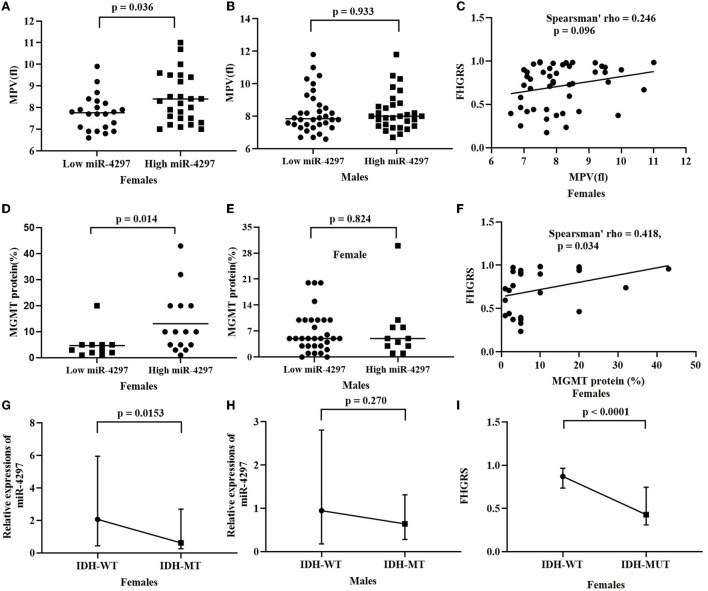
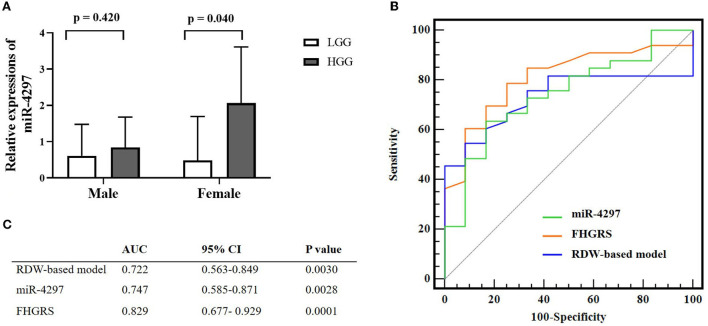
Serum miR-4297 levels were notably down-regulated in glioma. Besides, serum miR-4297 levels were positively associated with the high grades, which were exclusively present for females. The positive correlations of miR-4297 with O6-methylguanine-DNA methyltransferase (MGMT) protein and mean platelet volume were also observed in females. IDH-mutant females had decreased miR-4297. Median PFS time for females with miR-4297 ≥ 1.392 was distinctly shorter than those with miR-4297 <1.392 (12.3 months vs. 42.89 months, = 0.0289). Based on multivariate logistic regression, miR-4297-based equation model was established as FHGRS. AU-ROC analysis revealed FHGRS exhibited a robust performance in predicting high-grade glioma in females ( < 0.001), whereas there was no such relationship in males. Furthermore, the MGMT-3'UTR variant rs7896488 in the specific binding region of miR-4297 was correlated with prognosis.
Our study uncovers sex-dependent characterization of serum miR-4297 in predicting glioma grade and the relapse risk for female patients, which underscores the clinical benefits of sex-specific analysis in non-coding RNA research.
胶质瘤占脑癌的近80%,在男性中更易发生且预后不良。新兴的微小RNA已被定位为胶质瘤组织学分级和预后的有前景的预测指标。然而,关于潜在的微小RNA-4297(miR-4297)对临床方法的性别差异影响的研究很少。
我们利用GSE139031微小RNA谱分析胶质瘤患者血清中miR-4297的表达。招募了2017年1月至2021年2月在福建医科大学附属第一医院新诊断的114例胶质瘤患者,并进行前瞻性随访。研究了miR-4297水平与胶质瘤分级和预后的关系。进行荧光素酶报告基因检测和基因分型分析,以探讨miR-4297在胶质瘤中性别差异的潜在机制。
胶质瘤患者血清miR-4297水平显著下调。此外,血清miR-4297水平与高级别呈正相关,且仅在女性中存在。在女性中还观察到miR-4297与O6-甲基鸟嘌呤-DNA甲基转移酶(MGMT)蛋白和平均血小板体积呈正相关。IDH突变的女性miR-4297降低。miR-4297≥1.392的女性患者的中位无进展生存期明显短于miR-4297<1.392的女性患者(12.3个月对42.89个月,P=0.0289)。基于多因素逻辑回归,建立了以miR-4297为基础的方程模型FHGRS。受试者工作特征曲线下面积分析显示,FHGRS在预测女性高级别胶质瘤方面表现出强大的性能(P<0.001),而在男性中不存在这种关系。此外,miR-4297特异性结合区域的MGMT-3'UTR变体rs7896488与预后相关。
我们的研究揭示了血清miR-4297在预测胶质瘤分级和女性患者复发风险方面的性别依赖性特征,这强调了非编码RNA研究中性别特异性分析的临床益处。