Department of Community Health and Social Sciences, CUNY Graduate School of Public Health and Health Policy, Institute for Implementation Science in Population Health (ISPH), New York, NY, United States.
Department of Health Policy and Management, Center for Systems and Community Design (CSCD), CUNY Graduate School of Public Health and Health Policy, New York, NY, United States.
Front Public Health. 2022 Jul 29;10:835836. doi: 10.3389/fpubh.2022.835836. eCollection 2022.
Injection drug use (IDU) is the leading risk factor for hepatitis C virus (HCV) transmission in the U.S. While the general risk factors for HCV transmission are known, there is limited work on how these factors interact and impact young people who inject drugs (YPWID).
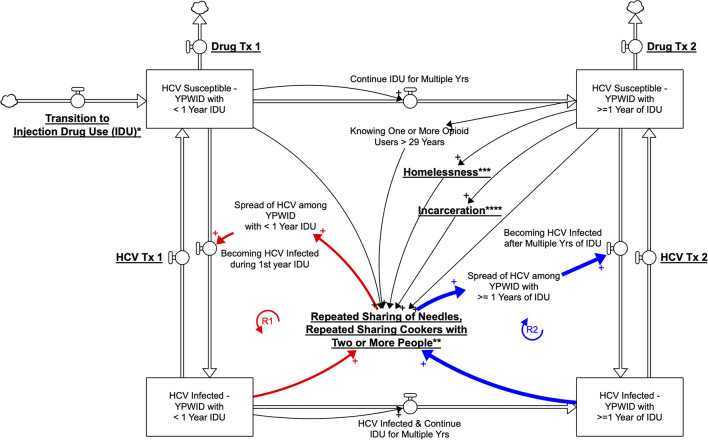
Project data were drawn from a study of 539 New York City (NYC) residents ages 18-29 who were recruited Respondent-Driven Sampling and, reported past-month non-medical use of prescription opioids and/or heroin. Analyses are based on a subsample of 337 (62%) who reported injecting any drug in the past 12 months. All variables were assessed self-report, except HCV status, which was established rapid antibody testing. Integrating the observed statistical associations with extant literature on HCV risk, we also developed a qualitative system dynamics (SD) model to use as a supplemental data visualization tool to explore plausible pathways and interactions among key risk and protective factors for HCV.
Results showed a 31% HCV antibody prevalence with an overall incidence of 10 per 100 person-years. HCV status was independently correlated with having shared cookers with two or more people (AOR = 2.17); injected drugs 4-6 years (AOR = 2.49) and 7 or more years (AOR = 4.95); lifetime homelessness (AOR = 2.52); and having been incarcerated two or more times (AOR = 1.99). These outcomes along with the extant literature on HCV risk were used to develop the qualitative SD model, which describes a causal hypothesis around non-linearities and feedback loop structures underlying the spread of HCV among YPWID.
Despite ongoing harm reduction efforts, close to a third of YPWID in the community sample have been exposed to HCV, have risks for injection drug use, and face challenges with structural factors that may be preventing adequate intervention. The qualitative SD model explores these issues and contributes to a better understanding of how these various risk factors interact and what policies could potentially be effective in reducing HCV infections.
在美国,注射吸毒(IDU)是丙型肝炎病毒(HCV)传播的主要风险因素。虽然人们已经了解了 HCV 传播的一般危险因素,但对于这些因素如何相互作用以及影响注射吸毒的年轻人(YPWID),相关研究还很有限。
本研究的数据来自一项对纽约市(NYC)539 名年龄在 18-29 岁的居民进行的研究,这些居民是通过回应驱动抽样法招募的,并报告了过去一个月内非医疗使用处方类阿片类药物和/或海洛因的情况。分析基于过去 12 个月内报告使用任何药物进行注射的 337 名(62%)亚组。除 HCV 状态外,所有变量均通过自我报告进行评估,而 HCV 状态则通过快速抗体检测确定。我们将观察到的统计关联与 HCV 风险的现有文献相结合,还开发了一个定性系统动力学(SD)模型,作为补充数据可视化工具,以探索 HCV 关键风险和保护因素之间的可能途径和相互作用。
结果显示 HCV 抗体的阳性率为 31%,总体发病率为每 100 人年 10 例。HCV 状态与与两人或更多人共用炊具(AOR = 2.17);注射毒品 4-6 年(AOR = 2.49)和 7 年或以上(AOR = 4.95);终生无家可归(AOR = 2.52);以及两次或以上入狱(AOR = 1.99)独立相关。这些结果以及 HCV 风险的现有文献被用于开发定性 SD 模型,该模型描述了一个因果假设,即 YPWID 中 HCV 传播的非线性和反馈环结构。
尽管正在进行减少伤害的努力,但社区样本中的近三分之一的 YPWID 已经接触到 HCV,有注射吸毒的风险,并且面临着可能阻碍充分干预的结构性因素的挑战。定性 SD 模型探讨了这些问题,有助于更好地理解这些不同的风险因素如何相互作用,以及哪些政策可能有效地减少 HCV 感染。