Yale School of Medicine, Yale University, New Haven, CT, United States.
Faculty of Health Sciences, American University in Beirut, Beirut, Lebanon.
Injury. 2022 Oct;53(10):3255-3262. doi: 10.1016/j.injury.2022.08.014. Epub 2022 Aug 8.
Injuries account for a large portion of the global burden of disease, representing over 10% of all disability adjusted life years (DALYs). This study analyzes the economic impact of injury for those experiencing moderate-to-severe injury in Beirut, Lebanon. It further examines the impact of different demographic and socioeconomic factors on trauma-specific quality of life 1-2 years following injury.
This was a prospective cohort study following patients 1-2 years after being treated for injury at one of three hospitals in Beirut, Lebanon. Patients interviewed by phone. In addition to questions on financial impact, access to healthcare, and socioeconomic status, the Trauma-specific Quality of Life (TQoL) Questionnaire was used to assess quality of life following injury. Multivariable linear models were constructed to examine TQoL and demographics among institutes.
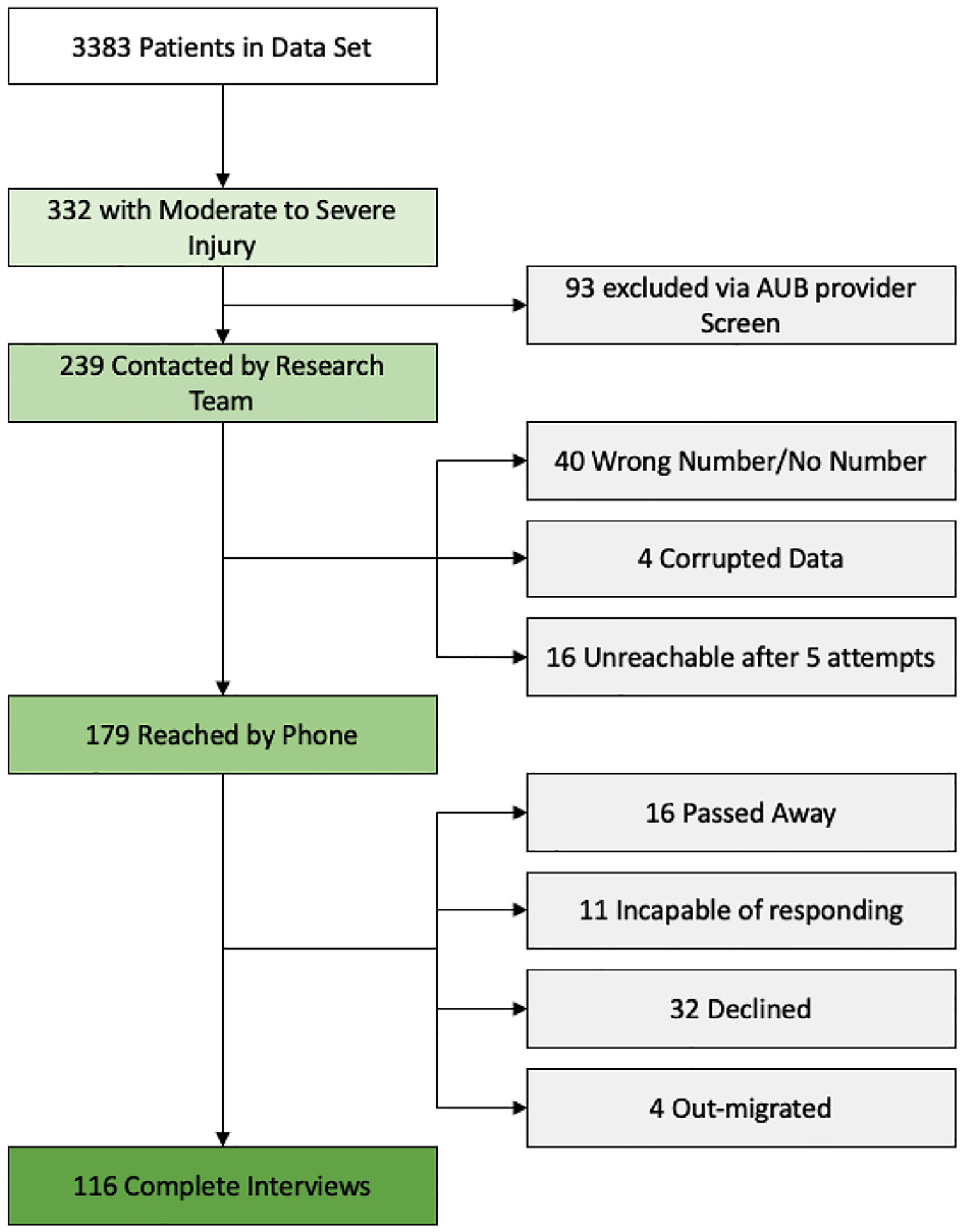
116 patients completed interviews. The average out-of-pocket cost of injury was 2975.42 USD, 65% of which was borrowed. 21% of people lost employment due to injury. Patients at Geitawi Hospital and the Rafic Hariri Governmental Hospital borrowed more on average and had higher reductions in employment than patients at the American University of Beirut Medical Center (AUBMC). There was a loss of income for those employed at the time of injury, with a mean monthly loss of 261.6 USD. The economic impact of injury was 10,329.00 USD. 25% of patients reported difficulty with accessing follow-up care, predominantly due to cost. Mean-adjusted Trauma-specific Quality of life (TQoL) was highest at AUBMC. Education was associated with functional recovery in the TQoL questionnaire; for every additional year of education there was an increase in the functional recovery domain of 0.03.
Individuals that experienced moderate-to-severe injury in Beirut, Lebanon, suffered financial repercussions, including reductions in income, less employment, or unemployment. Across all patients surveyed, higher level of education was associated with better functional quality of life. More study into the intricacies of accessing healthcare care in Lebanon, especially given the current economic and political climate, are crucial to maintain the health of those experiencing injury and can help inform targeted interventions.
伤害在全球疾病负担中占很大比例,占所有伤残调整生命年(DALYs)的 10%以上。本研究分析了在黎巴嫩贝鲁特经历中度至重度伤害的人的经济影响。它进一步研究了不同人口统计学和社会经济因素对受伤后 1-2 年创伤特异性生活质量的影响。
这是一项在黎巴嫩贝鲁特的三家医院之一接受治疗后 1-2 年对患者进行随访的前瞻性队列研究。通过电话对患者进行访谈。除了关于经济影响、获得医疗保健和社会经济地位的问题外,还使用创伤特异性生活质量(TQoL)问卷评估受伤后的生活质量。构建多变量线性模型以检查研究所之间的 TQoL 和人口统计学。
116 名患者完成了访谈。受伤的平均自付费用为 2975.42 美元,其中 65%是借来的。21%的人因受伤而失业。Geitawi 医院和拉菲克·哈里里政府医院的患者平均借款更多,就业减少率高于贝鲁特美国大学医学中心(AUBMC)的患者。受伤时有工作的人收入损失,平均每月损失 261.6 美元。受伤的经济影响为 10329.00 美元。25%的患者报告难以获得后续护理,主要是因为费用。经调整后的平均创伤特异性生活质量(TQoL)在 AUBMC 最高。教育与 TQoL 问卷中的功能恢复有关;每增加一年教育,功能恢复领域的得分就会增加 0.03。
在黎巴嫩贝鲁特经历中度至重度伤害的个人遭受了经济影响,包括收入减少、就业减少或失业。在所有接受调查的患者中,教育程度越高,功能生活质量越好。对黎巴嫩获得医疗保健服务的复杂性进行更多研究,特别是考虑到当前的经济和政治环境,对于维护受伤者的健康至关重要,并有助于为有针对性的干预措施提供信息。