Psychiatry & Clinical Psychology, Division of Neuroscience, IRCCS San Raffaele Scientific Institute, Milan, Italy.
University Vita-Salute San Raffaele, Milan, Italy.
Eur Psychiatry. 2022 Aug 16;65(1):e47. doi: 10.1192/j.eurpsy.2022.2307.
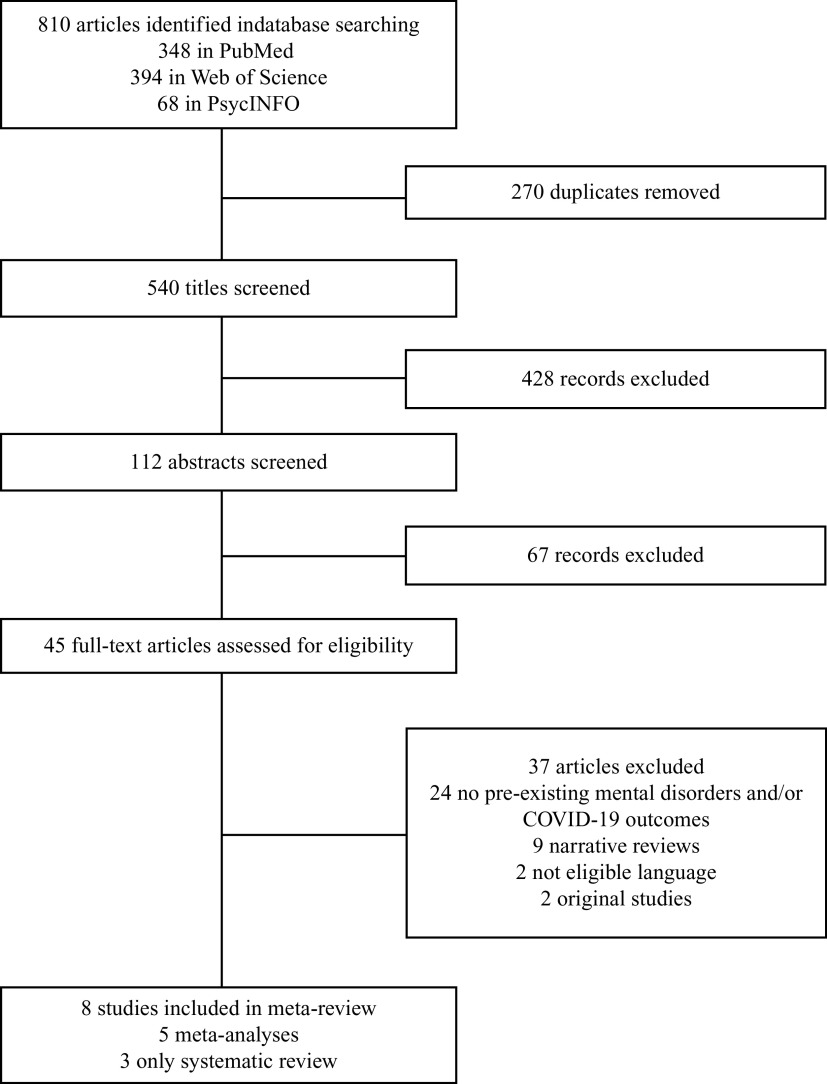
As COVID-19 becomes endemic, identifying vulnerable population groups for severe infection outcomes and defining rapid and effective preventive and therapeutic strategies remains a public health priority. We performed an umbrella review, including comprehensive studies (meta-analyses and systematic reviews) investigating COVID-19 risk for infection, hospitalization, intensive care unit (ICU) admission, and mortality in people with psychiatric disorders, and outlined evidence- and consensus-based recommendations for overcoming potential barriers that psychiatric patients may experience in preventing and managing COVID-19, and defining optimal therapeutic options and current research priorities in psychiatry. We searched Web of Science, PubMed, and Ovid/PsycINFO databases up to 17 January 2022 for the umbrella review. We synthesized evidence, extracting when available pooled odd ratio estimates for the categories "any mental disorder" and "severe mental disorders." The quality of each study was assessed using the AMSTAR-2 approach and ranking evidence quality. We identified four systematic review/meta-analysis combinations, one meta-analysis, and three systematic reviews, each including up to 28 original studies. Although we rated the quality of studies from moderate to low and the evidence ranged from highly suggestive to non-significant, we found consistent evidence that people with mental illness are at increased risk of COVID-19 infection, hospitalization, and most importantly mortality, but not of ICU admission. The risk and the burden of COVID-19 in people with mental disorders, in particular those with severe mental illness, can no longer be ignored but demands urgent targeted and persistent action. Twenty-two recommendations are proposed to facilitate this process.
随着 COVID-19 成为地方病,确定易感染严重感染结局的脆弱人群群体,并定义快速有效的预防和治疗策略仍然是公共卫生的重点。我们进行了一项伞式综述,包括全面研究(荟萃分析和系统综述),调查了精神障碍患者 COVID-19 感染、住院、重症监护病房(ICU)入院和死亡的风险,并概述了克服精神障碍患者在预防和管理 COVID-19 方面可能遇到的潜在障碍的循证和共识建议,并确定了精神病学的最佳治疗选择和当前研究重点。我们搜索了 Web of Science、PubMed 和 Ovid/PsycINFO 数据库,截至 2022 年 1 月 17 日,进行了伞式综述。我们综合了证据,在可用时提取了“任何精神障碍”和“严重精神障碍”类别的汇总比值比估计值。使用 AMSTAR-2 方法和证据质量等级评估每个研究的质量。我们确定了四个系统评价/荟萃分析组合、一个荟萃分析和三个系统评价,每个系统评价都包括多达 28 项原始研究。尽管我们将研究质量评为从中等到低,并且证据范围从高度提示到无显著性,但我们发现了一致的证据表明,精神疾病患者感染 COVID-19、住院的风险增加,最重要的是死亡率增加,但 ICU 入院率没有增加。精神障碍患者,特别是严重精神疾病患者,COVID-19 的风险和负担不容忽视,但需要紧急采取有针对性和持续的行动。提出了 22 条建议来促进这一进程。