Department of Human Movement Sciences, Institute of Brain and Behavior Amsterdam, Amsterdam Movement Sciences, Vrije Universiteit Amsterdam, 1081 BT, Amsterdam, The Netherlands.
Exp Brain Res. 2022 Oct;240(10):2667-2676. doi: 10.1007/s00221-022-06436-1. Epub 2022 Aug 16.
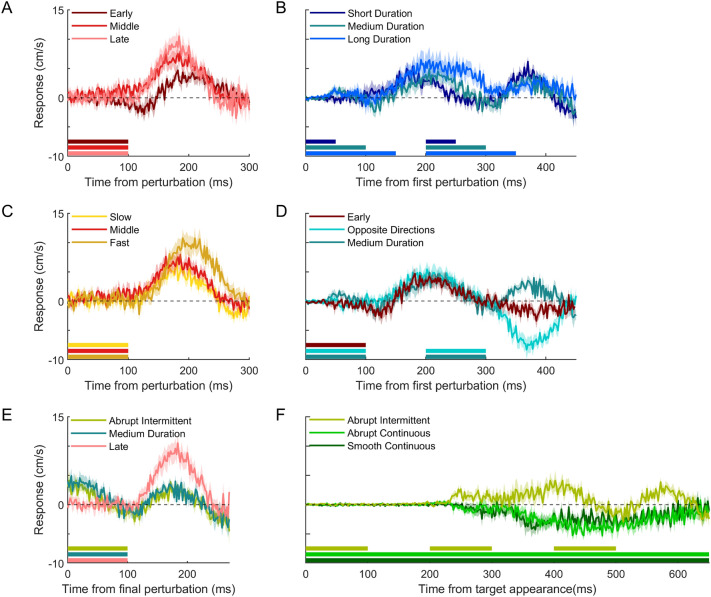
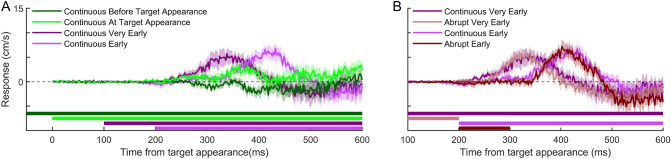
When making a goal-directed movement towards a target, our hand follows abrupt background motion. This response resembles that of a shift in the target's position. Does background motion simply change the position towards which the movement is guided? If so, the response to background motion should resemble the response to a target displacement. To find out whether this is the case, we ran two exploratory studies where we asked participants to hit a moving target at a specified moment. At various times during the hand's movement, the background could move briefly at one of several speeds, and for various durations. The response to abrupt background motion was larger when the background moved later in the movement and when the background moved faster, in line with known responses to target displacements. The response to a second epoch of background motion was smaller than it would have been if there had been no first epoch, in contrast to responses to multiple target displacements. If the background was already moving before the target appeared, the hand even moved in the opposite direction. Thus, the response to background motion and that to a target displacement are clearly not identical, but they do share several features.
当我们朝着目标进行有目标的运动时,我们的手会跟随背景的突然运动。这种反应类似于目标位置的变化。背景运动是否只是改变了运动的导向位置?如果是这样,那么对背景运动的反应应该类似于对目标位移的反应。为了查明情况,我们进行了两项探索性研究,要求参与者在特定时刻击中移动的目标。在手部运动的各个时间点,背景可以以几种速度短暂移动,并持续各种时间。当背景在运动后期移动且速度更快时,对背景的突然运动的反应更大,这与对目标位移的已知反应一致。与对多个目标位移的反应相比,对第二个背景运动时段的反应要小。如果目标出现之前背景已经在移动,那么手甚至会朝相反的方向移动。因此,对背景运动的反应和对目标位移的反应显然并不完全相同,但它们确实有几个共同特征。