Department of Infectious Diseases, St-Louis and Lariboisière Hospitals, APHP, University of Paris, INSERM U944.
Department of Infectious Diseases, Bichat Claude Barnard Hospital, APHP, University of Paris, Inserm U1137.
J Acquir Immune Defic Syndr. 2022 Sep 1;91(1):68-72. doi: 10.1097/QAI.0000000000002879. Epub 2021 Dec 8.
Islatravir (MK-8591) is a nucleoside reverse transcriptase translocation inhibitor in development for treatment and prevention of HIV-1. We present efficacy and safety data for islatravir and doravirine (DOR) through 96 weeks of the phase 2b trial (NCT03272347).
In this randomized, double-blind, dose-ranging trial, participants initially received islatravir (0.25, 0.75, or 2.25 mg) with doravirine (100 mg) and lamivudine (3TC, 300 mg) or a fixed-dose combination of doravirine, 3TC, and tenofovir disoproxil fumarate (DOR/3TC/TDF) daily. Beginning at week 24, participants receiving islatravir stopped 3TC if HIV-1 RNA from the prior visit was <50 copies per milliliter and continued taking the assigned islatravir dose (still blinded) with doravirine. All islatravir groups transitioned to open-label use of 0.75 mg between weeks 60 and 84. Efficacy end points at week 96 included the proportion of participants maintaining HIV-1 RNA of <50 copies per milliliter (FDA Snapshot). Safety was assessed by adverse event (AE) reporting.
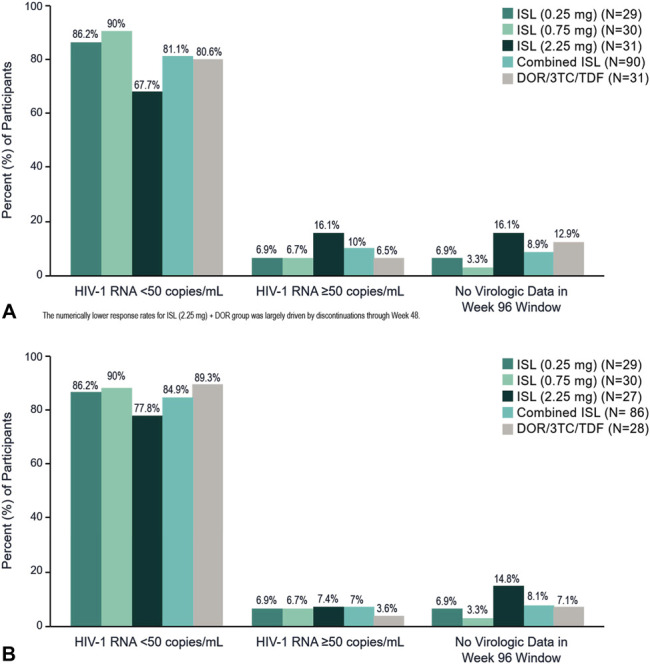
One hundred twenty-one treatment-naive participants received the study drugs and were included in the analyses. Through week 96, HIV-1 RNA<50 copies per milliliter was maintained in 86.2% (25/29), 90.0% (27/30), and 67.7% (21/31) of participants in the 0.25-, 0.75-, and 2.25-mg islatravir groups, respectively, 81.1% (73/90) of the combined islatravir group, and 80.6% (25/31) of the DOR/3TC/TDF group. One participant in the 2.25-mg islatravir group had Protocol-Defined Virologic Failure after week 48. Drug-related AE rates were higher for DOR/3TC/TDF participants (22.6%) compared with islatravir (combined 7.8%). Two participants (2.2%) receiving islatravir with doravirine and one (3.2%) receiving DOR/3TC/TDF discontinued because of an AE.
Treatment regimens containing islatravir and doravirine maintained viral suppression through week 96 and were well tolerated regardless of dose.
伊斯拉特拉韦(MK-8591)是一种正在开发用于治疗和预防 HIV-1 的核苷逆转录酶易位抑制剂。我们通过 2b 期试验(NCT03272347)展示了伊斯拉特拉韦和多伟拉韦(DOR)的疗效和安全性数据,时间长达 96 周。
在这项随机、双盲、剂量范围试验中,参与者最初接受伊斯拉特拉韦(0.25、0.75 或 2.25 mg)联合多伟拉韦(100 mg)和拉米夫定(3TC,300 mg)或多伟拉韦、3TC 和富马酸替诺福韦二吡呋酯(DOR/3TC/TDF)的固定剂量组合,每日一次。从第 24 周开始,如果上一次就诊时 HIV-1 RNA 低于 50 拷贝/毫升,接受伊斯拉特拉韦治疗的参与者停止服用 3TC,并继续服用指定剂量的伊斯拉特拉韦(仍保持盲态)联合多伟拉韦。所有伊斯拉特拉韦组在第 60 至 84 周之间转换为开放标签使用 0.75 mg。第 96 周的疗效终点包括维持 HIV-1 RNA<50 拷贝/毫升的参与者比例(FDA Snapshot)。通过不良事件(AE)报告评估安全性。
121 名初治参与者接受了研究药物治疗,并纳入了分析。截至第 96 周,0.25、0.75 和 2.25 mg 伊斯拉特拉韦组分别有 86.2%(25/29)、90.0%(27/30)和 67.7%(21/31)的参与者、联合伊斯拉特拉韦组的 81.1%(73/90)和 DOR/3TC/TDF 组的 80.6%(25/31)的 HIV-1 RNA<50 拷贝/毫升。1 名 2.25 mg 伊斯拉特拉韦组的参与者在第 48 周后出现了方案定义的病毒学失败。DOR/3TC/TDF 组的药物相关 AE 发生率(22.6%)高于伊斯拉特拉韦组(联合组 7.8%)。两名(2.2%)接受伊斯拉特拉韦联合多伟拉韦和一名(3.2%)接受 DOR/3TC/TDF 的参与者因 AE 而停药。
含伊斯拉特拉韦和多伟拉韦的治疗方案在第 96 周时维持了病毒抑制,并且无论剂量如何,均具有良好的耐受性。