Department of Evolutionary Biology and Environmental Studies, University of Zurich-Irchel, Zurich, Switzerland.
Centre for Coastal Research, Department of Natural Sciences, University of Agder, Kristiansand, Norway.
J Evol Biol. 2022 Oct;35(10):1309-1318. doi: 10.1111/jeb.14073. Epub 2022 Aug 16.
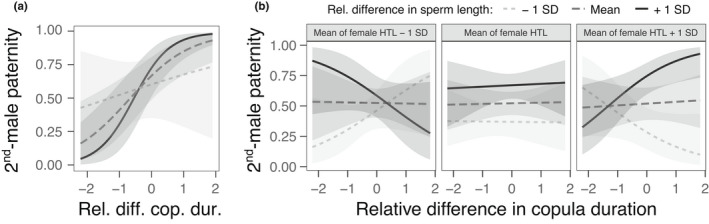
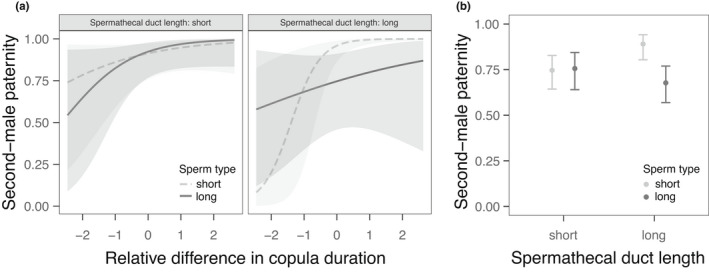
The male competition for fertilization that results from female multiple mating promotes the evolution of increased sperm numbers and can impact sperm morphology, with theory predicting that longer sperm can at times be advantageous during sperm competition. If so, males with longer sperm should sire more offspring than competitors with shorter sperm. Few studies have directly tested this prediction, and findings are inconsistent. Here we assessed whether longer sperm provide a competitive advantage in the yellow dung fly (Scathophaga stercoraria; Diptera: Scathophagidae). Initially, we let brothers with different temperature-mediated mean sperm lengths compete - thus minimizing confounding effects of genetic background - and found no clear advantage of longer sperm. We then used flies from lines subjected to bidirectional selection on phenoloxidase activity that had shown correlated evolutionary responses in sperm and female spermathecal duct lengths. This experiment also yielded no main effect of sperm size on siring success. Instead, there was a trend for a shorter-sperm advantage, but only when competing in females with longer spermathecal ducts. Our data corroborated many previously reported findings (last-male precedence, effects of copula duration and body size), suggesting our failure to find sperm size effects is not inherently due to our experimental protocols. We conclude that longer sperm are not competitively superior in yellow dung flies under most circumstances, and that, consistent with previous work, in this species competitive fertilization success is primarily determined by the relative numbers of sperm competing.
雄性为了争夺受精机会而进行的竞争,源于雌性的多次交配,这促进了精子数量的增加,并可能影响精子形态。理论预测,在精子竞争中,较长的精子有时会具有优势。很少有研究直接检验这一预测,而且研究结果也不一致。在这里,我们评估了较长的精子是否在黄粪蝇(Scathophaga stercoraria;双翅目:粪蝇科)中具有竞争优势。最初,我们让具有不同温度介导的平均精子长度的兄弟竞争——从而最大限度地减少遗传背景的混杂影响——发现长精子没有明显的优势。然后,我们使用来自酚氧化酶活性双向选择的品系的苍蝇进行实验,这些苍蝇在精子和雌性受精囊管长度上表现出相关的进化反应。该实验也没有发现精子大小对生育成功率有主要影响。相反,精子较短具有优势,但仅在具有较长受精囊管的雌性中。我们的数据证实了许多先前的报告结果(最后雄性优势、交配持续时间和体型的影响),这表明我们未能发现精子大小的影响并不是由于我们的实验方案本身造成的。我们得出的结论是,在大多数情况下,长精子在黄粪蝇中没有竞争优势,并且与之前的工作一致,在这个物种中,竞争受精成功主要取决于竞争精子的相对数量。