Department of Endocrinology, Shanghai Children's Hospital, School of Medicine, Shanghai Jiao Tong University, Shanghai, 200062, People's Republic of China.
J Endocrinol Invest. 2023 Jan;46(1):151-158. doi: 10.1007/s40618-022-01894-4. Epub 2022 Aug 16.
Androgen insensitivity syndrome (AIS) is caused by abnormal androgen receptor (AR) genes that show variable genotypes and phenotypes. However, the correlation between genotype and phenotype is unclear.
We retrospectively evaluated 64 patients with AIS at Shanghai Children's Hospital from 2015 to 2022. We analysed the clinical data of the patients, including hormone levels, AR gene variants, and functional domains.
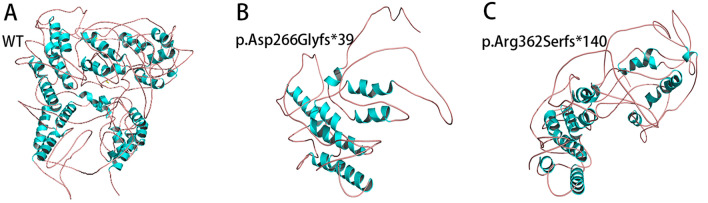
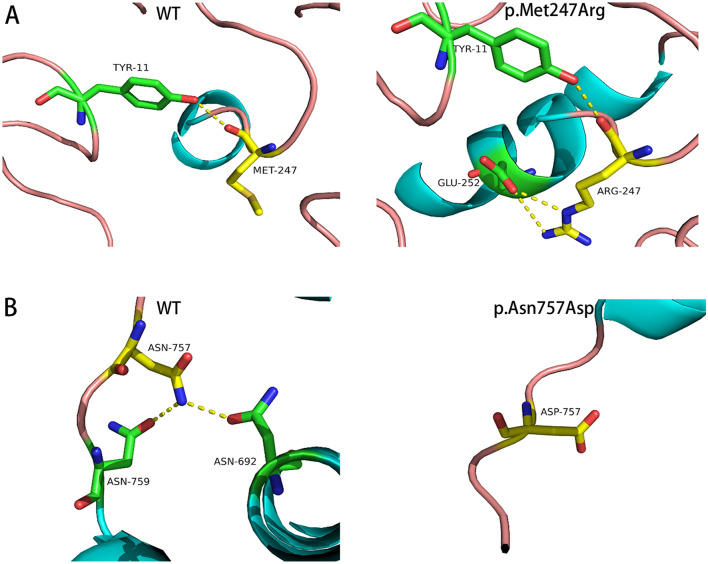
Variants occurred in the 3 major functional domains in 56 patients, including 23 patients with complete androgen insensitivity syndrome (CAIS) and 33 with partial androgen insensitivity syndrome (PAIS). The incidence of nonscrotal fusion (P = 0.019) and proximal urethral opening (P = 0.0002) in the ligand-binding domain (LBD) group was higher than that in the non-LBD group. The phallus length in the LBD group was significantly shorter than that in the non-LBD group (P = 0.009). The external masculinization score (EMS) in the LBD group was significantly lower than that in the non-LBD group (P = 0.013). The levels of inhibin-B (INHB; P = 0.0007), basal luteinizing hormone (LH; P = 0.033), LH peak (P = 0.002), and testosterone (T) after human chorionic gonadotropin (HCG) stimulation (P = 0.001) in the LBD group were higher than those in the non-LBD group. There were 53 variants in 64 patients, including 42 reported and 11 novel AR variants, including p.Met247Arg, p.Asp266Glyfs39, p.Arg362Serfs140, p.Ala385Val, p.Glu541Asp, p.Pro613Leu, p.Pro695Leu, p.Asn757Asp, c.1616 + 1dup, c.1886-1G > A and exon 5-7 deletion.
The EMS of patients with AIS in the LBD group was significantly lower than that in the non-LBD group. The phallus length was shorter, and the incidences of proximal urethral opening and nonscrotal fusion were higher, suggesting that the phenotypes in the LBD group were more severe. The levels of INHB, basal LH, peak LH, and T after HCG stimulation in the LBD group were higher than those in the non-LBD group, suggesting that androgen resistance in the LBD group was more severe. We identified 53 variants in 64 patients: 42 reported and 11 novel AR variants. These findings provide new and deeper insight into AIS diagnosis and genetic assessment of AIS.
雄激素不敏感综合征(AIS)是由异常的雄激素受体(AR)基因引起的,这些基因表现出不同的基因型和表型。然而,基因型与表型之间的相关性尚不清楚。
我们回顾性评估了 2015 年至 2022 年期间在上海儿童医学中心就诊的 64 例 AIS 患者。我们分析了患者的临床数据,包括激素水平、AR 基因变异和功能域。
56 例患者的 3 个主要功能域发生了变异,包括 23 例完全雄激素不敏感综合征(CAIS)和 33 例部分雄激素不敏感综合征(PAIS)。配体结合域(LBD)组的非阴囊融合(P=0.019)和近端尿道开口(P=0.0002)的发生率高于非-LBD 组。LBD 组的阴茎长度明显短于非-LBD 组(P=0.009)。LBD 组的外部男性化评分(EMS)明显低于非-LBD 组(P=0.013)。LBD 组的抑制素-B(INHB;P=0.0007)、基础黄体生成素(LH;P=0.033)、LH 峰值(P=0.002)和人绒毛膜促性腺激素(HCG)刺激后的睾酮(T)水平(P=0.001)均高于非-LBD 组。64 例患者中有 53 种变异,包括 42 种已报道的和 11 种新的 AR 变异,包括 p.Met247Arg、p.Asp266Glyfs39、p.Arg362Serfs140、p.Ala385Val、p.Glu541Asp、p.Pro613Leu、p.Pro695Leu、p.Asn757Asp、c.1616+1dup、c.1886-1G>A 和外显子 5-7 缺失。
LBD 组 AIS 患者的 EMS 明显低于非-LBD 组。阴茎长度较短,近端尿道开口和非阴囊融合的发生率较高,提示 LBD 组的表型更为严重。LBD 组的 INHB、基础 LH、峰值 LH 和 HCG 刺激后的 T 水平均高于非-LBD 组,提示 LBD 组的雄激素抵抗更为严重。我们在 64 例患者中发现了 53 种变异:42 种已报道的和 11 种新的 AR 变异。这些发现为 AIS 的诊断和 AIS 的遗传评估提供了新的、更深入的见解。