Department of Respiratory and Critical Care Medicine, The First Affiliated Hospital of Xi'an Jiaotong University, Xi'an, People's Republic of China.
Int J Chron Obstruct Pulmon Dis. 2022 Aug 10;17:1797-1809. doi: 10.2147/COPD.S371765. eCollection 2022.
High levels of red blood cell distribution width (RDW) and hypoalbuminemia are markers of poor prognosis in chronic obstructive pulmonary disease (COPD) patients. However, few studies have shown that the red blood cell distribution width-albumin ratio (RAR) is related to the mortality of COPD. This study aimed to explore the relationship between RAR and hospital mortality in COPD patients admitted to the intensive care unit (ICU).
Patients were retrospectively incorporated from the Medical Information Mart for Intensive Care IV (MIMIC-IV) database and divided into two groups by a cutoff value of RAR. Propensity score matching (PSM) was performed to adjust for the imbalance of covariates. Logistic regression models and subgroup analyses were carried out to investigate the relationship between RAR and hospital mortality. The receiver operating characteristic (ROC) curve was used to evaluate the predictive performance of RAR and decision curve analysis (DCA) to assess the clinical utility.
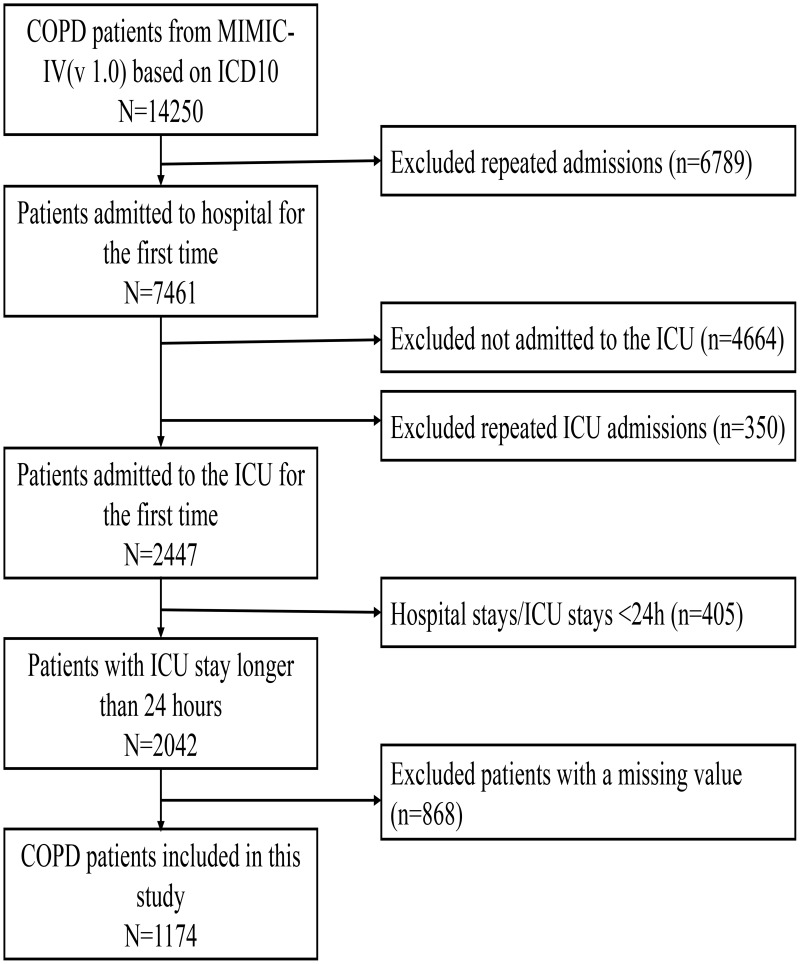
In total, 1174 patients were finally identified from the MIMIC-IV database. The cutoff value for RAR was 5.315%/g/dL. After PSM at a 1:1 ratio, 638 patients were included in the matched cohort. In the original and matched cohorts, the high RAR group had higher hospital mortality and longer hospital stays. Logistic regression analysis suggested that RAR was an independent risk factor for hospital mortality. The areas under the ROC curve in the original and matched cohorts were 0.706 and 0.611, respectively, which were larger than applying RDW alone (the original cohort: 0.600, the matched cohort: 0.514). The DCA indicated that RAR had a clinical utility.
A higher RAR (>5.315%/g/dL) was associated with hospital mortality in COPD patients admitted to ICU. As an easily available peripheral blood marker, RAR can predict hospital mortality in critically ill patients with COPD independently.
红细胞分布宽度(RDW)和低白蛋白血症水平较高是慢性阻塞性肺疾病(COPD)患者预后不良的标志物。然而,很少有研究表明红细胞分布宽度-白蛋白比值(RAR)与 COPD 患者的死亡率有关。本研究旨在探讨 RAR 与入住重症监护病房(ICU)的 COPD 患者院内死亡率之间的关系。
本研究回顾性纳入了来自医学信息监护 IV (MIMIC-IV)数据库的患者,并通过 RAR 截断值将患者分为两组。采用倾向评分匹配(PSM)对协变量的不平衡进行调整。采用 logistic 回归模型和亚组分析来研究 RAR 与院内死亡率之间的关系。采用受试者工作特征(ROC)曲线评估 RAR 的预测性能,采用决策曲线分析(DCA)评估其临床实用性。
从 MIMIC-IV 数据库中最终确定了 1174 例患者。RAR 的截断值为 5.315%/g/dL。经过 1:1 比例的 PSM 后,共有 638 例患者纳入匹配队列。在原始队列和匹配队列中,高 RAR 组的院内死亡率和住院时间均较高。logistic 回归分析表明,RAR 是院内死亡率的独立危险因素。原始队列和匹配队列的 ROC 曲线下面积分别为 0.706 和 0.611,均大于单独应用 RDW(原始队列:0.600,匹配队列:0.514)。DCA 表明 RAR 具有临床实用性。
较高的 RAR(>5.315%/g/dL)与入住 ICU 的 COPD 患者的院内死亡率相关。作为一种易于获得的外周血标志物,RAR 可独立预测 COPD 危重症患者的院内死亡率。